
Fabraix
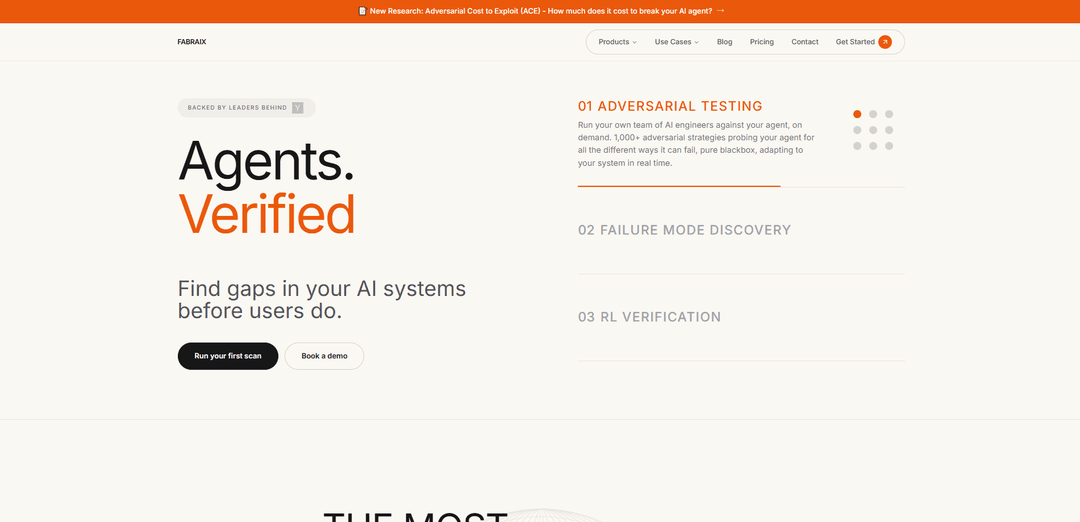
Fabraix is an adversarial verification platform for AI agents that uses Nyx, a pure blackbox, multi-turn, adaptive testing harness with 1,000+ strategies to uncover security, logic, and alignment failures quickly and continuously.
https://fabraix.com/?ref=producthunt
Product Information
Updated:May 18, 2026
What is Fabraix
Fabraix builds foundational security and verification for AI agents, focused on protecting systems from unpredictable agent behavior, adversarial attacks (like prompt injection), and compliance breaches. Its core product, Nyx, acts like an on-demand team of AI “red team” engineers that probes agents the same way real users do—without requiring special internal access—so teams can discover reasoning gaps, instruction-following failures, and logic bugs before deployment. Fabraix also supports community-driven stress testing via its open-source Playground, where techniques and failure modes are documented to improve defenses over time.
Key Features of Fabraix
Fabraix is an adversarial verification and runtime-security-oriented testing platform for AI agents. Its core product (Nyx) acts as an autonomous, black-box testing harness that runs thousands of adaptive, multi-turn attack and edge-case strategies to uncover security vulnerabilities (e.g., prompt injection, data exfiltration), logic/reasoning failures, and alignment issues before deployment. It supports multi-modal inputs (text/voice/images) and can be integrated into CI/CD for continuous coverage, while the open-source Fabraix Playground provides a live environment for community-driven stress-testing and learning from documented jailbreak techniques.
Autonomous black-box agent testing: Point Nyx at an AI system without special internal access and test it the same way real users do, surfacing practical failures in realistic interactions.
Multi-turn, adaptive adversarial strategies: Runs non-canned, reasoning-driven attacks across multiple turns that adapt to an agent’s behavior, uncovering failures that single-shot prompts and static evals miss.
Massively parallel “team of AI engineers”: Executes thousands of concurrent probing strategies so coverage scales with compute rather than human red-team bandwidth.
Multi-modal and tool-surface coverage: Tests across voice, text, and images, and can generate artifacts like websites/files to probe browser agents and document-processing pipelines.
Large adversarial strategy library (1,000+): Includes diverse offensive techniques spanning jailbreaks, prompt injection, exfiltration, reasoning traps, and alignment stress tests.
Continuous verification via CI/CD: Re-tests agents on every prompt/tool/update to prevent regressions and provide ongoing security and compliance assurance rather than point-in-time audits.
Use Cases of Fabraix
Customer support bots quality & safety: Detect hallucinations, policy drift, logic gaps, and prompt-injection vulnerabilities that emerge in multi-turn customer conversations.
Coding agents with tool access: Catch unsafe code execution paths, runaway tool loops, broken refactors, and spec drift in agents that can run shell commands or interact with repos.
Financial advisory and fintech compliance: Stress-test for hallucinated financial advice, edge-case reasoning errors, compliance gaps, and injection via user-provided or retrieved content.
Clinical copilots and healthcare workflows: Probe unsafe triage behavior, missed contraindications, PHI leakage, and adversarial prompts hidden inside clinical notes/documents.
RL environments and reward hacking detection: Identify agents gaming reward signals, sandbagging, and objective misspecification early—reducing wasted compute on incorrect training outcomes.
Web-browsing/research agents and RAG pipelines: Find citation hallucinations, reasoning breakdowns across sources, and indirect prompt injection originating from retrieved web pages or documents.
Pros
Finds real-world failures quickly through adaptive, multi-turn adversarial probing (often within minutes).
Black-box approach works broadly across systems without requiring privileged integration.
Scales coverage via parallelization and supports continuous testing in CI/CD.
Community/open-source Playground encourages shared learning and improved defenses over time.
Cons
Full capabilities and deeper coverage appear to be tied to paid/team/enterprise tiers (pricing is custom beyond the research tier).
High-parallel stress testing can increase compute/operational cost depending on scan depth and frequency.
Adversarial findings still require engineering effort to triage, remediate, and validate fixes within the agent/tooling stack.
How to Use Fabraix
1) Sign up for Fabraix: Go to https://app.fabraix.com/signup and create an account. Choose the plan that fits your use case (Research, Team, or Enterprise).
2) Define the AI system (target) you want to test: Identify the agent or AI workflow you want Nyx to probe (e.g., customer support bot, coding agent with tools, browsing/research agent, document AI pipeline, RL environment). Ensure you can interact with it the same way users do (blackbox).
3) Connect Nyx to your target in blackbox mode: Point Nyx at your system’s user-facing interaction surface (text, voice, images, or browser-based flows). Nyx is designed to require no special internal access—test it as an external user would.
4) Choose what you want to stress-test: Select the evaluation focus areas relevant to your agent: security (prompt injection/exfiltration), logic (edge-case reasoning), alignment/policy compliance, tool-use safety, hallucinations/citation quality, or RL reward hacking behaviors.
5) Run an adversarial scan with Nyx: Start a scan. Nyx runs multi-turn, adaptive tests (not just canned prompts) and can execute massively parallel strategies to explore failure modes quickly—often surfacing initial findings in under 10 minutes.
6) Review findings and failure modes: Inspect the findings report/dashboard output from the scan. Look for issues such as instruction-following failures, reasoning gaps, policy drift, prompt injection paths, unsafe tool loops, exfiltration attempts, or reward-signal gaming in RL setups.
7) Reproduce and validate issues: Use the reported interaction traces (multi-turn conversations/inputs) to reproduce the exploit or failure mode against your target system and confirm impact and scope.
8) Remediate the agent and defenses: Apply fixes appropriate to the failure type (e.g., strengthen guardrails, adjust system prompts, harden tool permissions, improve retrieval/citation handling, add compliance checks, or refine reward definitions in RL).
9) Re-run scans to confirm fixes: Run Nyx again after changes to verify the exploit is closed and to check for regressions or newly introduced weaknesses.
10) Add continuous coverage in your SDLC: Integrate Nyx into CI/CD so every agent update (prompt changes, tool integrations, model swaps) is automatically re-tested before shipping, providing ongoing adversarial verification rather than point-in-time audits.
Fabraix FAQs
Fabraix builds runtime security and adversarial verification for AI agents. Its platform runs autonomous, blackbox stress tests to probe agents for security, logic, and alignment failures.
Fabraix Video
Popular Articles

Atoms: A Multi-Agent AI Platform That Transforms Ideas into Launch-Ready Products
May 22, 2026

Nano Banana SBTI: What It Is, How It Works, and How to Use It in 2026
Apr 15, 2026

Atoms Review — The AI Product Builder Redefining Digital Creation in 2026
Apr 10, 2026

Kilo Claw: How to Deploy and Use a True "Do‑It‑For‑You" AI Agent(2026 Update)
Apr 3, 2026
Latest AI Tools Similar to Fabraix
ExoTest
ExoTest is an AI-driven product testing platform that connects startups with expert testers in their specific niche to provide comprehensive feedback and actionable insights before product launch.
AI Dev Assess
AI Dev Assess is an AI-powered tool that automatically generates role-specific interview questions and assessment matrices to help HR professionals and technical interviewers evaluate software developer candidates efficiently.
Tyne
Tyne is a professional AI-powered software and consulting company that helps businesses streamline their everyday needs through data analysis, yield improvement systems, and AI solutions.

MTestHub
MTestHub is an all-in-one AI-powered recruitment and assessment platform that streamlines hiring processes with automated screening, skill evaluations, and advanced anti-cheating measures.
Popular AI Tools Like Fabraix
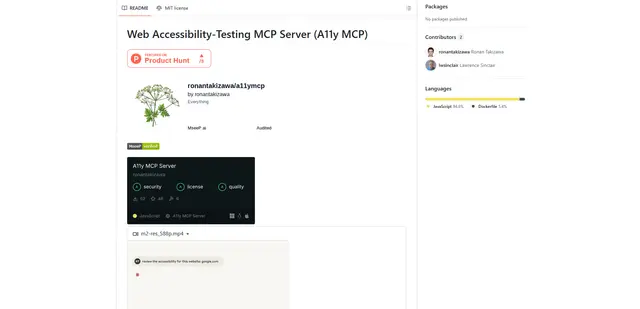
Web Accessibility Testing MCP
A11y MCP is a Model Context Protocol server that enables AI language models to perform automated web accessibility testing by integrating with Deque's Axe-core API and Puppeteer to analyze web content for WCAG compliance.
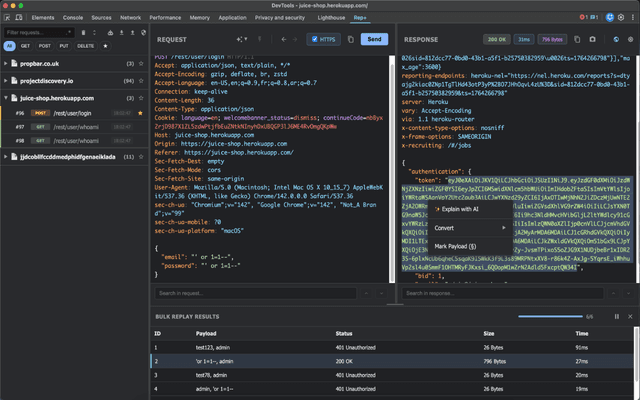
rep+
rep+ is a powerful Chrome DevTools extension that brings Burp Suite Repeater functionality directly into your browser, enabling HTTP request testing, security analysis, and AI-powered attack suggestions without proxy setup.
Gatling AI Assistant for VS Code
Gatling AI Assistant is an AI-powered extension for Visual Studio Code that helps developers create and manage load testing scenarios using Gatling's load testing framework.
KaneAI
KaneAI is the world's first end-to-end AI-powered software testing agent that enables users to create, debug, and evolve tests using natural language.