
LaReview
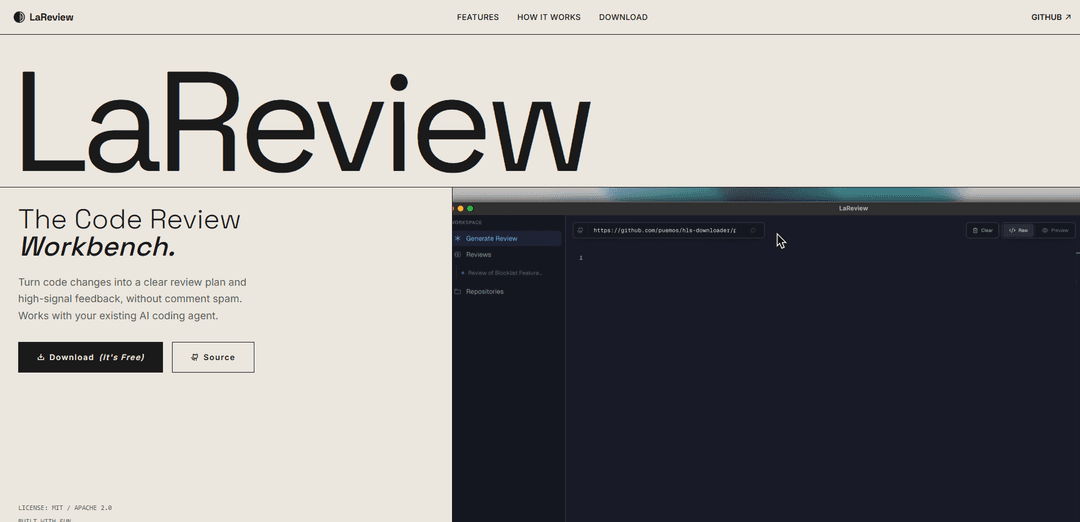
LaReview is a local-first, AI-powered code review workbench that transforms diffs and pull requests into structured review plans, visual diagrams, and high-signal feedback without comment spam.
https://lareview.dev/?ref=producthunt
Product Information
Updated:Apr 15, 2026
What is LaReview
LaReview is an open-source code review workbench designed for senior engineers who need to conduct deep, thorough reviews of complex code changes. Unlike traditional AI code review bots that flood PRs with comment spam, LaReview operates as a reviewer-first tool that helps developers understand system impact and architectural changes before diving into line-by-line analysis. Built with a local-first philosophy, it integrates with existing AI coding agents like Claude, Gemini, OpenCode, and Codex, while ensuring zero data leaks by processing everything locally. Available under MIT/Apache 2.0 licenses, LaReview supports GitHub and GitLab integration and can be launched directly from the terminal via CLI commands, making it a natural part of any developer's workflow.
Key Features of LaReview
LaReview is a local-first, privacy-focused code review workbench designed for senior engineers who value depth over speed. It transforms code diffs and pull requests into structured review plans by analyzing changes through AI coding agents (Claude, Gemini, Codex, etc.) to identify logical flows, risks, and system impacts. Unlike traditional AI bots that generate comment spam, LaReview provides a reviewer-first experience with task-focused workflows, custom rule enforcement, visual diagrams, and learning patterns that improve over time. It integrates seamlessly with GitHub/GitLab and operates entirely locally without cloud data leaks, making it ideal for complex code reviews that require deep understanding.
AI-Powered Review Planning: Automatically analyzes PRs or diffs to generate structured review plans grouped by logical flows (auth, API, billing) and ordered by risk, acting like a staff engineer to identify hazards and system impacts.
Local-First Architecture: Processes all code reviews locally with zero cloud uploads, linking to local Git repositories to give AI agents full codebase context while maintaining complete privacy and security.
Custom Rule Enforcement: Define and enforce custom standards like 'DB queries must have timeouts' or 'API changes need migration notes' to automatically validate code against team-specific requirements.
Visual Flow Diagrams: Automatically generates architectural diagrams to visualize code changes and system flows before reviewing individual lines, providing high-level understanding of modifications.
Learning Patterns & Feedback Calibration: Learns from rejected feedback during reviews to discover patterns and calibrate future suggestions, reducing nitpicks and increasing signal-to-noise ratio over time.
CLI Integration & Git Host Sync: Provides command-line tools for terminal-based workflows and directly submits review feedback to GitHub/GitLab PRs with auto-generated summaries.
Use Cases of LaReview
Enterprise Security-Critical Reviews: Financial services and healthcare companies can review sensitive code changes locally without cloud exposure, enforcing strict compliance rules while maintaining complete data privacy.
Large-Scale Architecture Changes: Engineering teams reviewing major refactors or microservice migrations can use flow-based planning and visual diagrams to understand system-wide impacts before diving into file-level details.
Open Source Project Maintenance: OSS maintainers can efficiently review complex pull requests from contributors by generating structured review plans that prioritize high-risk changes and enforce project-specific coding standards.
Staff Engineer Code Audits: Senior engineers conducting deep technical reviews can leverage AI-assisted analysis to identify architectural issues, performance bottlenecks, and security vulnerabilities across multiple logical flows.
Cross-Team API Integration Reviews: Teams integrating with external APIs or building new service endpoints can use custom rules to ensure consistent error handling, timeout configurations, and migration documentation.
Developer Onboarding & Mentorship: Senior developers mentoring junior team members can use LaReview's structured feedback and learning patterns to teach code review best practices and maintain consistent quality standards.
Pros
Complete privacy with local-first architecture that prevents cloud data leaks and works entirely on your machine
Works with existing AI coding agents (Claude, Gemini, Codex) without requiring additional subscriptions
Generates high-signal, flow-based review plans instead of overwhelming comment spam
Open source (MIT/Apache 2.0) and free to use with active development community
Cons
Requires local installation and setup of AI coding agents, which may have learning curve for some users
Limited to GitHub and GitLab integration, may not support other version control platforms
Effectiveness depends on quality of custom rules configuration and AI agent capabilities
May require significant computational resources for analyzing large codebases locally
How to Use LaReview
1. Install LaReview: Install LaReview using Homebrew with the command 'brew install --cask puemos/tap/lareview', or download the binary directly. For macOS, drag LaReview.app into /Applications. If blocked on first run, open System Settings → Privacy & Security and allow it. Optionally add to PATH for terminal use via the CLI Installation button in Settings.
2. Set up your AI coding agent: Configure LaReview to work with your existing AI coding agent (Claude Code, OpenCode, Codex, Gemini, Kimi, Mistral, Qwen, etc.). LaReview leverages your agent instead of requiring a separate AI subscription.
3. Link local Git repositories (optional): Link your local Git repositories to give the AI agent full access to search your codebase without uploading data. This provides deeper context for more accurate reviews while maintaining privacy.
4. Set up GitHub/GitLab CLI (optional): Install and configure the GitHub CLI ('gh') or GitLab CLI ('glab') to enable LaReview to fetch PR data locally and submit reviews directly to your Git host.
5. Define custom rules (optional): Create custom review rules in LaReview to enforce your team's standards automatically, such as 'DB queries must have timeouts' or 'API changes need a migration note'.
6. Input code changes for review: Launch LaReview and input code changes using one of these methods: paste a unified diff, provide a GitHub/GitLab PR URL (e.g., owner/repo#123), use CLI commands like 'lareview' to open GUI with current repo, 'lareview main feature' to review between branches, 'git diff HEAD | lareview' to pipe a diff, or 'lareview pr owner/repo#123' to review a specific PR.
7. Generate AI-powered review plan: LaReview fetches the data locally (via GitHub/GitLab CLI if using PR URLs) and your AI coding agent analyzes the changes to build a structured review plan. The plan groups changes by logical flows (auth, API, billing, etc.) and orders tasks by risk level.
8. Review visual diagrams: Examine automatically generated diagrams that visualize the architectural changes and code flow before diving into the code details.
9. Execute the review plan: Work through the task-focused review interface, which displays all review tasks grouped by flow and ordered by risk. Use the files heatmap to navigate changes and track your progress through each task.
10. Review AI-generated feedback: Examine high-signal feedback threads that the AI has identified and authenticated against your rules. These are anchored to specific lines of code and focus on bugs and important issues rather than comment spam.
11. Add your own notes and feedback: Add your own review comments, notes, and feedback items as you work through the review tasks. Mark suggestions as 'ignored' if they're not relevant.
12. Calibrate AI learning: Analyze rejected feedback patterns to help the AI learn from your preferences. This calibrates future reviews to provide fewer nitpicks and more signal based on what you've marked as ignored.
13. Export or submit your review: Export your review to Markdown format, or submit it directly to GitHub/GitLab PRs with automatic summary generation using the Git host sync feature. LaReview will compile your feedback and create a comprehensive review summary.
LaReview FAQs
LaReview is a local-first code review workbench that transforms diffs into structured review plans, diagrams, and insights. Unlike most AI tools that act as bots posting comment spam, LaReview is a reviewer-first workbench designed to help you understand changes, plan reviews, and provide high-signal feedback. It focuses on depth and system impact rather than just catching bugs.
Popular Articles

Atoms: A Multi-Agent AI Platform That Transforms Ideas into Launch-Ready Products
Oct 13, 2026

Nano Banana SBTI: What It Is, How It Works, and How to Use It in 2026
Apr 15, 2026

Atoms Review — The AI Product Builder Redefining Digital Creation in 2026
Apr 10, 2026

Kilo Claw: How to Deploy and Use a True "Do‑It‑For‑You" AI Agent(2026 Update)
Apr 3, 2026
Latest AI Tools Similar to LaReview
Gait
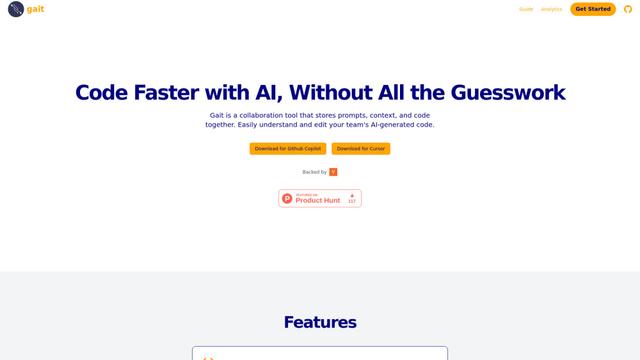
Gait is a collaboration tool that integrates AI-assisted code generation with version control, enabling teams to track, understand, and share AI-generated code context efficiently.
invoices.dev
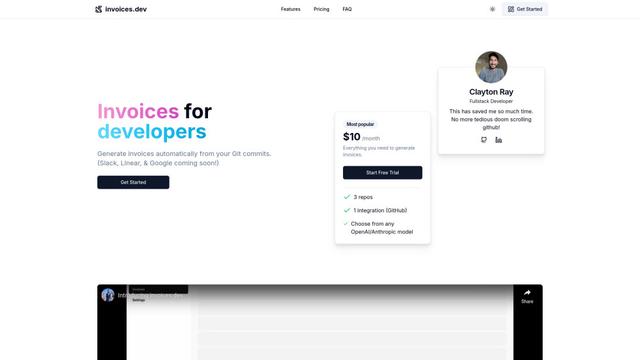
invoices.dev is an automated invoicing platform that generates invoices directly from developers' Git commits, with integration capabilities for GitHub, Slack, Linear, and Google services.
EasyRFP
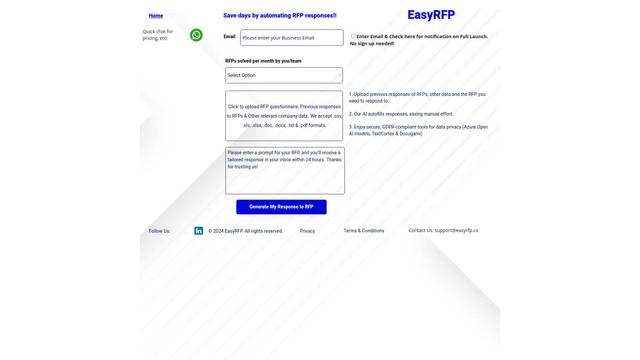
EasyRFP is an AI-powered edge computing toolkit that streamlines RFP (Request for Proposal) responses and enables real-time field phenotyping through deep learning technology.

Cart.ai
Cart.ai is an AI-powered service platform that provides comprehensive business automation solutions including coding, customer relations management, video editing, e-commerce setup, and custom AI development with 24/7 support.
Popular AI Tools Like LaReview

GitHub Copilot Chat
GitHub Copilot Chat is an AI-powered coding assistant that provides natural language interactions, real-time code suggestions, and contextual support directly within supported IDEs and GitHub.com.
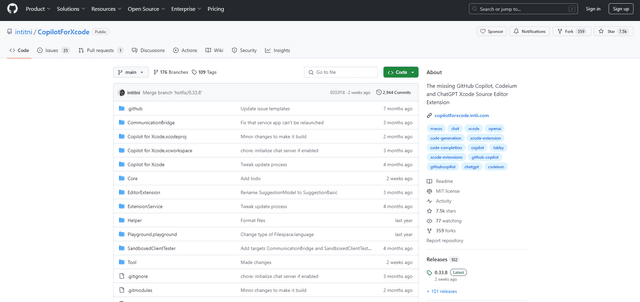
CopilotForXcode
CopilotForXcode is an Xcode Source Editor Extension that integrates GitHub Copilot, Codeium, and ChatGPT to provide AI-powered code suggestions, chat assistance, and prompt-to-code functionality within Xcode.
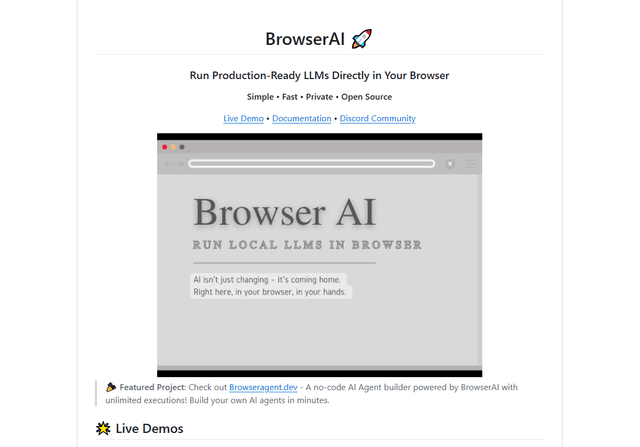
BrowserAI
BrowserAI is an open-source library that enables running local Large Language Models (LLMs) directly in web browsers with WebGPU acceleration, offering privacy-focused AI capabilities without requiring server infrastructure.
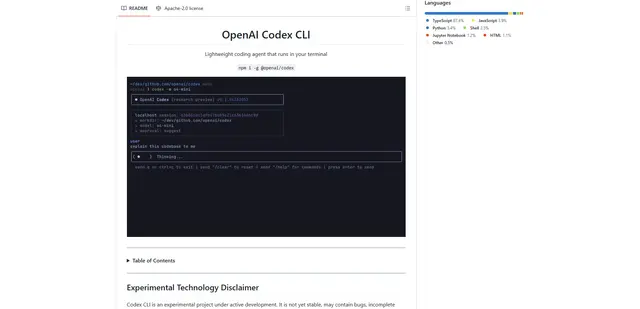
OpenAI Codex CLI
OpenAI Codex CLI is a lightweight, open-source coding agent that runs in your terminal, enabling developers to translate natural language into code execution while providing ChatGPT-level reasoning with the ability to run code, manipulate files, and iterate under version control.