
HasData
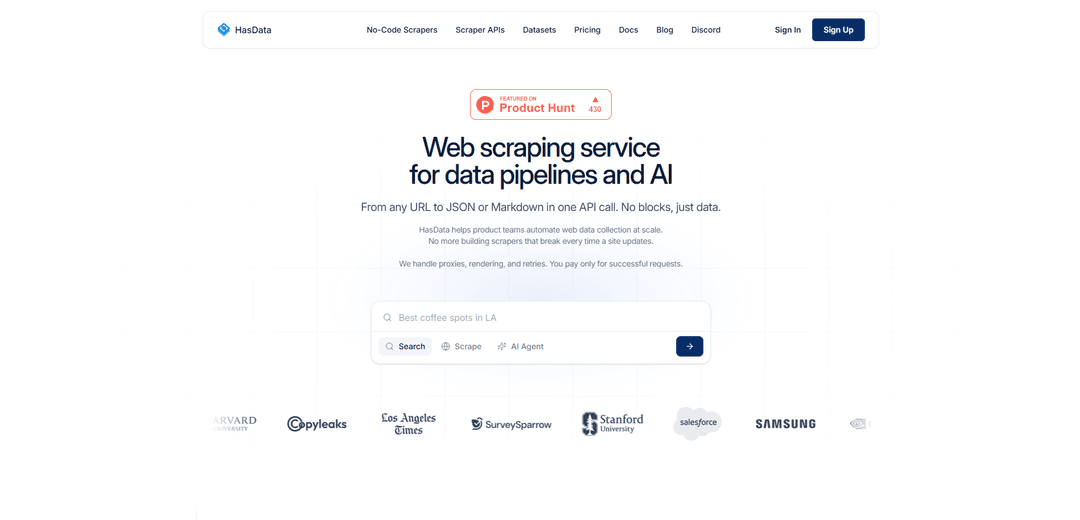
HasData is a cloud-based web scraping platform that delivers clean structured outputs (JSON/Markdown) via simple APIs while handling proxies, rendering, retries, and anti-bot/CAPTCHA challenges for reliable large-scale data extraction.
https://hasdata.com/?ref=producthunt
Product Information
Updated:May 18, 2026
What is HasData
HasData is a managed web scraping service built to simplify and operationalize web data collection for startups, product teams, and B2B SaaS businesses. Instead of building and maintaining fragile in-house scrapers, users can send URLs or queries to HasData and receive extracted, structured data back in formats that are easy to use in analytics, automation, and AI workflows. The platform emphasizes reliability at scale—removing the need to manage scraping infrastructure, proxy rotation, headless browsers, and frequent scraper breakages when websites change.
Key Features of HasData
HasData is a cloud-based web scraping and SERP data service that turns common scraping targets (e.g., Google Search/SERP, Google Maps, Amazon, Zillow, Indeed, Redfin) into documented API endpoints returning structured JSON. It offloads the hard parts of scraping—proxy rotation, CAPTCHA/anti-bot handling, JavaScript rendering, and scaling—while also offering no-code configuration, scheduling, and exports (CSV/XLSX/JSON). It’s positioned for data pipelines and AI workflows (LLMs/RAG/automation) with integrations/SDKs and an emphasis on speed, reliability, global coverage, and pay-for-successful-results cost control.
Pre-built Scraper APIs for popular sites: Access ready-made endpoints for major data sources (e.g., Google SERP/AI Overviews, Google Maps, Amazon, Zillow, Indeed, Redfin) with structured responses instead of maintaining custom scrapers.
Anti-bot + proxy infrastructure managed for you: Built-in proxy rotation and anti-bot evasion (including CAPTCHA handling and support for modern protections like Cloudflare/DataDome) to reduce blocks and downtime.
Structured JSON with documented schemas: Returns clean, machine-readable outputs designed for downstream analytics and AI pipelines (e.g., organic results, local packs, product panels, and AI overview retrieval via page tokens).
No-code scraping jobs and scheduling: Configure runs in a visual interface, schedule recurring jobs, and export results to CSV/XLSX/JSON without building a full scraping stack.
Scale, reliability, and global coverage: Designed for high-volume collection with strong uptime claims and geo-targeting across many countries, supporting large data operations without self-managed infrastructure.
Developer tooling + AI/automation integrations: SDKs (Python/NodeJS) and compatibility with tools like Zapier, LangChain, LlamaIndex, Make, n8n, webhooks, and agent tooling (e.g., MCP/OpenClaw) for fast integration.
Use Cases of HasData
SEO rank tracking and SERP feature monitoring: Collect real-time Google SERP data (including rich features like local packs and AI overviews) to power rank trackers, competitor monitoring, and client reporting.
Lead generation and enrichment: Automate discovery of businesses/contacts from public sources (e.g., Google results/Maps) and enrich CRM datasets with verified details at scale.
E-commerce price and product intelligence: Track product listings, prices, reviews, and availability from marketplaces (e.g., Amazon and Google product surfaces) for pricing, assortment, and competitive analysis.
Real estate research and listings intelligence: Extract property and listing details from platforms like Zillow/Redfin to support market analysis, investment research, and internal dashboards.
Social listening and brand monitoring: Combine SERP collection with LLM inference to identify brand mentions across the web and generate structured insights, reports, and notifications on a schedule.
AI data pipelines (RAG/training/agents): Feed structured web data into LLM workflows (RAG indices, evaluation sets, or autonomous agents) with consistent schemas and automation-friendly outputs.
Pros
Removes operational burden (proxies, CAPTCHAs, headless browsers, parser upkeep) and speeds up time-to-data.
Structured, documented outputs are well-suited for analytics and LLM/RAG pipelines.
No-code scheduling/exports plus SDKs/integrations supports both non-technical and developer teams.
Designed for scale with strong reliability/global coverage positioning and pay-for-successful-results cost control.
Cons
Not intended for private/restricted data; use is focused on legal, public information scraping.
Coverage is strongest for supported targets; unsupported or niche sites may require custom scraping work.
As with any third-party scraping API, feature availability and parsing depend on the provider’s updates when target sites change.
How to Use HasData
1) Decide whether HasData is the right seeding approach: Use HasData for fixed, deterministic reference/lookup data (e.g., countries, statuses). Avoid it for data that depends on external APIs, environment-specific values, or non-deterministic values like DateTime.Now or Guid.NewGuid().
2) Define your entity and primary key: Ensure the entity has a primary key. With HasData you must provide explicit primary key values for seeded rows (even if the database normally generates them) so EF Core can track changes between migrations.
3) Add HasData in OnModelCreating (Fluent API): In your DbContext, override OnModelCreating and call modelBuilder.Entity<TEntity>().HasData(...). Example: modelBuilder.Entity<Author>().HasData(new Author { AuthorId = 1, FirstName = "William", LastName = "Shakespeare" });
4) Seed related entities separately (FKs must match): For relationships, call HasData on each entity type. Seed principal/parent rows first (e.g., Author) and then dependent/child rows (e.g., Book) with matching foreign keys: modelBuilder.Entity<Book>().HasData(new Book { BookId = 1, AuthorId = 1, Title = "Hamlet" });
5) Use stable IDs (do not generate keys at runtime): Do not use Guid.NewGuid() inside HasData. Each new migration would generate different values and EF Core will treat it as a data change (delete/insert). Use hard-coded GUIDs/integers instead.
6) If you need to seed shadow properties, use anonymous objects: When you must set values for properties not on the CLR type (shadow state), use the HasData overload that accepts object/anonymous objects and include the shadow property name/value in the anonymous object.
7) Create a migration so HasData becomes InsertData/UpdateData/DeleteData operations: Run your migration creation command (e.g., dotnet ef migrations add SeedReferenceData). EF Core converts HasData definitions into migration operations like InsertData(), UpdateData(), and DeleteData().
8) Apply the migration to populate the database: Run the migration update command (e.g., dotnet ef database update). This executes the generated InsertData/UpdateData/DeleteData statements and inserts the seeded rows.
9) Seeding outside migrations: call EnsureCreated (only when not using migrations): If you want HasData to seed without migrations, you must call Database.EnsureCreated() (commonly in tests or initialization code). Note: EnsureCreated does not update schema/data if the database already exists, and you generally should not use EnsureCreated if you plan to use migrations.
10) Remember there is no Data Annotation equivalent: HasData is a Fluent API feature; there is no data-annotation alternative. Keep seeding logic in OnModelCreating (or entity configuration classes) using Fluent API.
HasData FAQs
HasData is a managed web scraping service for product teams that helps automate web data collection at scale. You can send a URL and get structured output such as clean JSON or Markdown.
HasData Video
Popular Articles

Atoms: A Multi-Agent AI Platform That Transforms Ideas into Launch-Ready Products
May 22, 2026

Nano Banana SBTI: What It Is, How It Works, and How to Use It in 2026
Apr 15, 2026

Atoms Review — The AI Product Builder Redefining Digital Creation in 2026
Apr 10, 2026

Kilo Claw: How to Deploy and Use a True "Do‑It‑For‑You" AI Agent(2026 Update)
Apr 3, 2026
Latest AI Tools Similar to HasData

Jorpex
Jorpex is a comprehensive tender notification platform that aggregates and delivers instant tender alerts from across European countries directly to Slack, helping businesses never miss opportunities.

Leadsmrt
Leadsmrt is a lead generation tool that helps businesses scrape, verify and personalize targeted business leads from Google Maps with AI-powered personalization capabilities.
Omnial AI
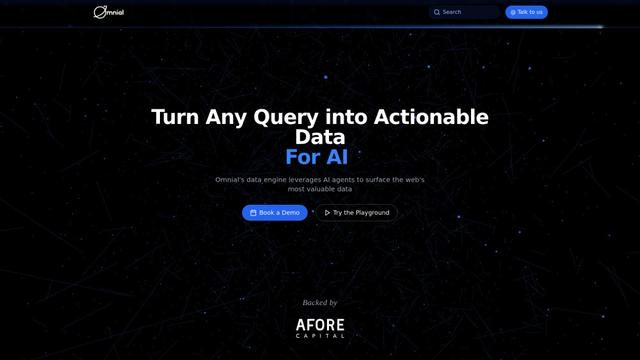
Omnial AI is a data intelligence platform that leverages AI agents to transform web prompts into structured, actionable data insights backed by Afore Capital.
SERPrecon
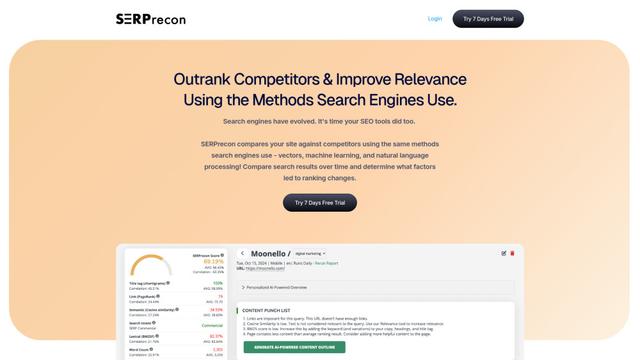
SERPrecon is an advanced SEO tool that leverages vectors, machine learning, and natural language processing to help users analyze and outrank competitors by using the same methods as modern search engines.
Popular AI Tools Like HasData
Magentic-UI
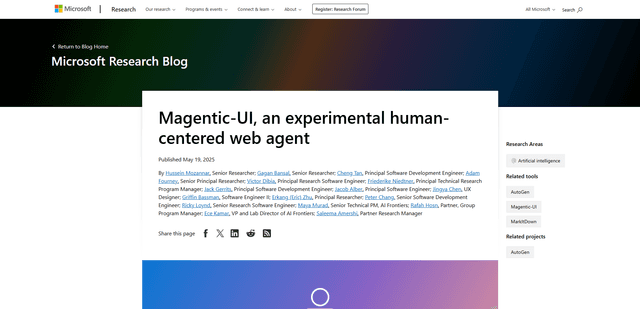
Magentic-UI is an open-source, human-centered web agent prototype by Microsoft Research that enables collaborative planning and execution of complex web-based tasks through transparent interaction between humans and AI agents.
Web Accessibility Testing MCP
A11y MCP is a Model Context Protocol server that enables AI language models to perform automated web accessibility testing by integrating with Deque's Axe-core API and Puppeteer to analyze web content for WCAG compliance.
Open Browser Use
Open Browser Use is an open-source, agent-runtime-neutral browser automation layer that pairs a Chrome extension with a CLI/SDK/MCP to enable DOM-aware, CDP-powered tab control, navigation, and actions across different AI agent tools.

Web Researcher MCP
Web Researcher MCP is a local, production-grade MCP server that lets AI assistants search the web (optionally restricted to trusted “search lenses”), read full sources (including JS-rendered pages, PDFs, and YouTube transcripts), and return verifiable citations with multi-provider failover. [Source: https://github.com/zoharbabin/web-researcher-mcp?ref=producthunt]