
Polarity
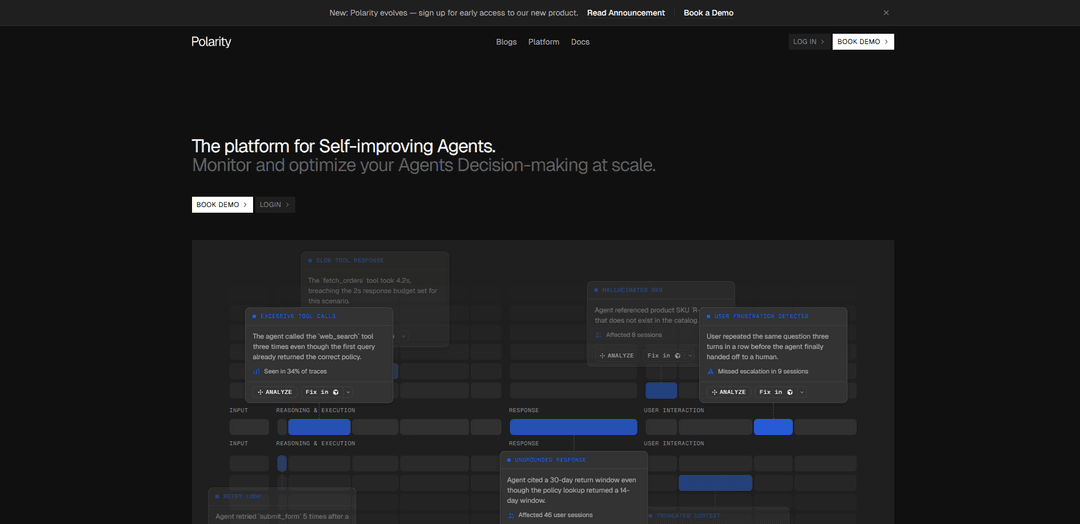
Polarity is a sandboxed evaluation and monitoring platform for AI agents that runs tasks in isolated Docker environments with real backing services, scores behavior against invariants/forbidden rules, measures non-determinism via replicas, and provides seed-based replay to reproduce and fix failures.
https://polarity.so/?ref=producthunt
Product Information
Updated:Jun 8, 2026
What is Polarity
Polarity is an eval infrastructure product designed to improve the reliability of AI agents running in production, especially long-running, multi-step workflows where stateful behavior across real services is a common source of failures. Positioned alongside tools like Braintrust, LangSmith, and Langfuse, Polarity differentiates itself by evaluating agents inside realistic sandboxes (not mocked dependencies) and by focusing on trajectory-level behavior rather than only prompt-level checks. It helps teams monitor agent decisions in real time, triage failures quickly, and turn recurring issues into durable guardrails that prevent regressions.
Key Features of Polarity
Polarity is an eval, monitoring, and regression-testing platform for production AI agents, built around running agent tasks inside isolated Docker sandboxes that include real backing services (e.g., Postgres, Redis, S3, internal APIs). It captures full agent trajectories, detects and clusters recurring failure behaviors, scores runs against behavioral invariants and forbidden rules, measures non-determinism via replica runs, and provides seed-based replay to reproduce failures locally and promote them into guardrails that can be gated in CI to prevent regressions—especially for long-running, multi-step, stateful agents.
Real-service sandboxed eval runtime (Keystone): Runs each agent task in an isolated Docker sandbox preloaded with real dependencies (databases, caches, object storage, internal APIs) to surface the failure modes that mocked environments often miss.
Behavioral invariants & forbidden rules scoring: Evaluates agent runs against explicit reliability and safety constraints (invariants) and disallowed patterns (forbidden rules), turning qualitative “agent quality” into enforceable checks.
Production decision monitoring & live streams: Instruments agents to stream decisions/trajectories into Polarity, enabling always-on monitoring, behavior-level visibility, and rapid triage when failures occur.
Behavior discovery, clustering, and recurrence alerts: Clusters decisions into recurring behaviors (e.g., tool loops, stale context drift, hallucinated citations, prompt injection following) and alerts teams when known failure modes reappear.
Seeded replay & one-command reproduction: Ships each failure with a seed reproducer that recreates the identical sandbox locally, enabling deterministic debugging and faster iteration on prompts, tools, or models.
CI regression gating from real trajectories: Promotes captured failures into behaviors/guardrails that can be run in CI as regression tests, blocking merges when an agent reintroduces known failure patterns.
Use Cases of Polarity
Customer support agents (e-commerce/SaaS): Detect and prevent tool-call loops, stale-context errors, and unsafe actions in refund/order-lookup workflows; replay real incidents and gate fixes in CI before deployment.
Software engineering agents (devtools/IT): Evaluate code-editing agents in sandboxes and catch “workspace escape” or unsafe file/system access behaviors; reproduce failures deterministically and lock in guardrails.
Fintech and regulated workflows: Use invariant/forbidden-rule scoring to enforce compliance-oriented behaviors, monitor production for drift, and maintain audit-friendly reproducibility of agent decisions.
Healthcare operations assistants: Run stateful, multi-step agents against real-service sandboxes and monitor for reliability regressions (handoff failures, incomplete tool sequences), improving safety via behavior gating.
RAG/research and knowledge agents: Detect hallucinated citations and prompt-injection following in tool outputs; cluster recurring retrieval/grounding failures and convert them into automated regression tests.
Enterprise agent platforms (multi-agent systems): Measure non-determinism with replica runs, monitor behavior-level reliability across many agents, and prioritize fixes by identifying high-impact recurring failure patterns.
Pros
High-fidelity evaluation via real backing services in isolated sandboxes, well-suited to long-running, stateful agents.
Strong reproducibility (seed replay) and fast debugging/iteration from production failures.
Behavior-based monitoring and clustering helps teams find root causes and prevent recurring regressions.
Direct path from incident → replay → promoted guardrail → CI gate, enabling compounding reliability over time.
Cons
May be heavier-weight than prompt-level eval tools for simple single-call workflows.
Sandboxing with real services can increase setup/operational complexity compared to mocked test harnesses.
Best value depends on having production agent traffic/trajectories to monitor and convert into behaviors.
How to Use Polarity
1) Decide if Polarity is the right fit: Use Polarity when you have long-running, complex, multi-step AI agents and you need eval infrastructure that catches stateful failures across real backing services (e.g., Postgres/Redis/S3/internal APIs), not just prompt-level issues.
2) Create a workspace for your environment: Set up workspaces (e.g., prod, staging, experiments) to organize agents, projects, teammates, dashboards, alerts, and access controls.
3) Instrument your agent with the Polarity SDK: Add Polarity instrumentation to your agent so it streams decisions to Polarity for monitoring and replay. Example shown in the source: import polarity as pl; agent = pl.instrument(agent=my_agent, workspace="prod", capture="decisions", sample_rate=1.0).
4) Run your agent in production with decision capture enabled: Deploy as usual, but with Polarity capturing decision-level data. Polarity is designed to monitor every agent decision in production and surface failure patterns before users hit them.
5) Monitor live decision streams and behavior-level health: Use Polarity’s production monitoring to watch decisions live and track reliability by agent and by behavior (not just latency). Configure behavior-level monitors and trajectory-aware alerts to detect regressions and recurring failure modes.
6) Investigate failures by pulling traces and finding similar incidents: When an agent fails, open the trace (trajectory) and use Polarity’s clustering to find similar failures (recurring patterns/behaviors) so you can identify root causes faster.
7) Identify and label recurring failure behaviors: Use Polarity’s behavior discovery and clustering to group decisions into behaviors (e.g., tool-loop-detector, stale-context-drift, hallucinated-citation) and understand impact across users and agents.
8) Replay a production failure locally with seed reproduction: Use Polarity’s replay tooling to reproduce the identical sandbox locally (seed reproducer) and re-run the exact production trajectory. Example shown in the source: uv run plr replay --trace <trace_id> --agent @ examples/agent/agent.toml --diff inline.
9) Promote the reproduced failure into a behavior/guardrail: Turn the captured failure into a reusable behavior definition with invariants and forbidden rules so the same regression is detected and blocked in the future. The source shows a replay flow that can include --promote-to-behavior.
10) Gate regressions in CI using promoted behaviors: Run CI regression testing by replaying production traces against candidate fixes (prompt/tool/model changes). Promote evals into CI so merges are blocked when known failure behaviors reappear.
11) Measure non-determinism with replicas: Configure replica runs to quantify non-determinism (run the same task multiple times) and score outcomes against behavioral invariants and forbidden rules.
12) Iterate: ship fixes, expand coverage, and compound reliability: As new failures emerge in production, repeat the loop: detect → trace → cluster → replay → promote to behavior → gate in CI. Over time, Polarity ‘locks in’ detected failures as guardrails so reliability compounds.
Polarity FAQs
Polarity is sandboxed eval infrastructure for AI agents. Its Keystone runtime runs each agent task inside an isolated Docker sandbox preloaded with real backing services (e.g., Postgres, Redis, S3, internal APIs), scores runs against behavioral invariants and forbidden rules, measures non-determinism via replicas, and ships failures with a seed reproducer to recreate the identical sandbox locally.
Polarity Video
Popular Articles

Vosko AI: Localize and Dub Videos for Global Audiences
Oct 15, 2026
Atoms: A Multi-Agent AI Platform That Transforms Ideas into Launch-Ready Products
Oct 13, 2026

Nano Banana SBTI: What It Is, How It Works, and How to Use It in 2026
Apr 15, 2026

Atoms Review — The AI Product Builder Redefining Digital Creation in 2026
Apr 10, 2026
Latest AI Tools Similar to Polarity

Hapticlabs
Hapticlabs is a no-code toolkit that enables designers, developers and researchers to easily design, prototype and deploy immersive haptic interactions across devices without coding.
Deployo.ai
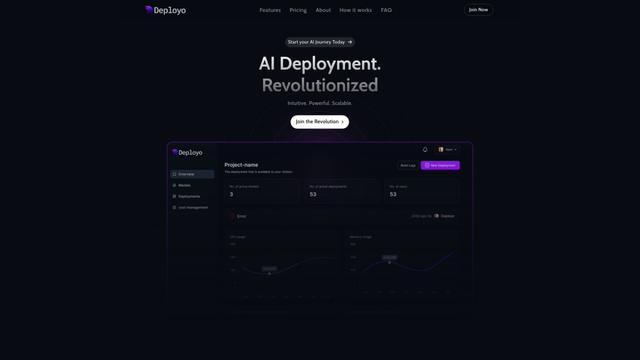
Deployo.ai is a comprehensive AI deployment platform that enables seamless model deployment, monitoring, and scaling with built-in ethical AI frameworks and cross-cloud compatibility.
CloudSoul
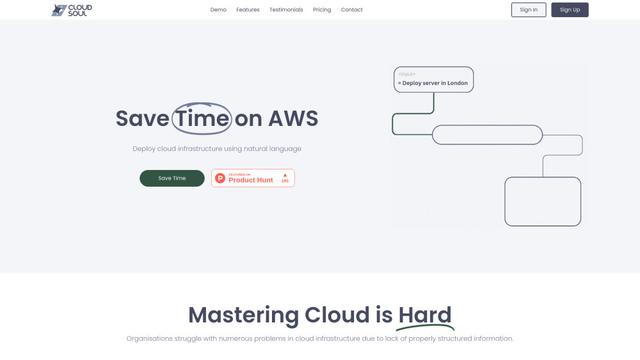
CloudSoul is an AI-powered SaaS platform that enables users to instantly deploy and manage cloud infrastructure through natural language conversations, making AWS resource management more accessible and efficient.
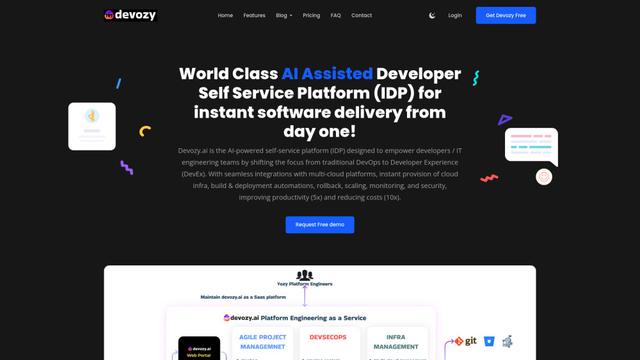
Devozy.ai
Devozy.ai is an AI-powered developer self-service platform that combines Agile project management, DevSecOps, multi-cloud infrastructure management, and IT service management into a unified solution for accelerating software delivery.
Popular AI Tools Like Polarity

A2A Protocol
A2A (Agent2Agent) Protocol is an open interoperability protocol developed by Google that enables seamless communication and collaboration between AI agents across different frameworks and vendors, regardless of their underlying architecture.
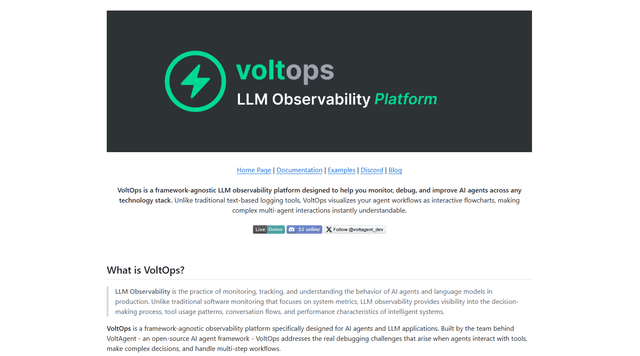
VoltOps
VoltOps is a framework-agnostic LLM observability platform that provides real-time visual monitoring, debugging, and optimization tools for AI agents across any technology stack.
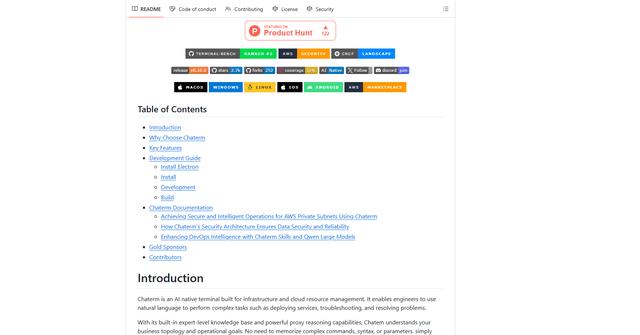
Chaterm
Chaterm is an open-source AI-native terminal and SRE copilot that enables engineers to manage complex infrastructure through natural language, automating deployment, troubleshooting, and operations without memorizing commands.
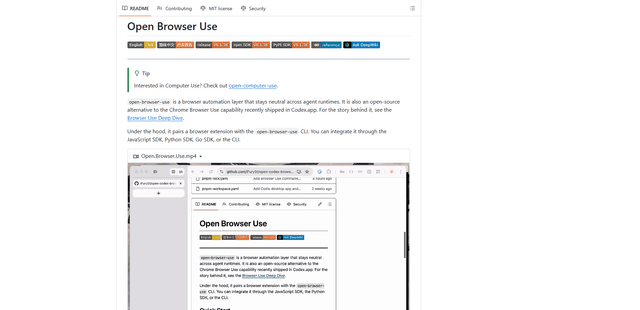
Open Browser Use
Open Browser Use is an open-source, agent-runtime-neutral browser automation layer that pairs a Chrome extension with a CLI/SDK/MCP to enable DOM-aware, CDP-powered tab control, navigation, and actions across different AI agent tools.