
git-lrc
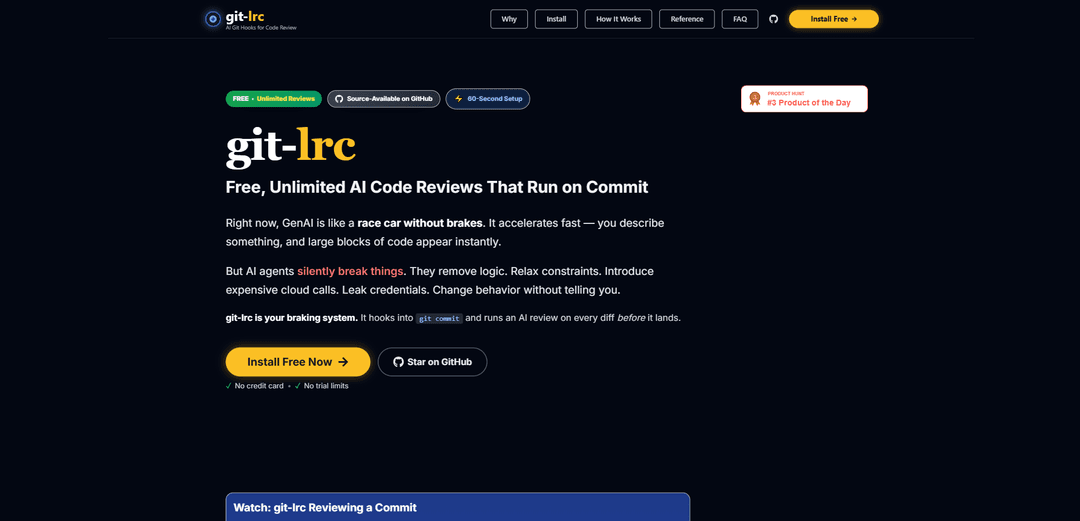
git-lrc is a free, AI-powered code review tool that automatically reviews code changes before each commit by hooking into git commit, acting as a safety check for AI-generated code.
https://hexmos.com/livereview/git-lrc?ref=producthunt
Product Information
Updated:Mar 8, 2026
What is git-lrc
git-lrc is designed to address the challenges that come with AI-generated code. While AI tools can quickly generate large blocks of code, they often introduce silent issues such as removed logic, relaxed constraints, or leaked credentials. git-lrc serves as a 'braking system' for AI-generated code by providing automated code reviews. It's completely free, requires no credit card, and operates using Google's Gemini API with its generous free tier, where users bring their own API key without any middleman billing.
Key Features of git-lrc
git-lrc is a free AI-powered code review tool that integrates with git commit process to automatically review code changes before they are committed. It uses Google's Gemini API to detect potential issues like leaked credentials, expensive cloud operations, logic removals, and behavior changes in AI-generated code. The tool provides tracking capabilities through git log messages and offers flexible review options including full review, vouch, and skip functionality.
Automated Pre-commit Reviews: Hooks into git commit process to automatically review code changes before they are committed, acting as a safety check for AI-generated code
Review Tracking System: Records review status, iteration count, and coverage percentage in git log messages for team visibility and accountability
Flexible Review Options: Provides three review modes: full AI review, vouch (taking personal responsibility), and skip option for different commit scenarios
Free Unlimited Reviews: Operates on Google Gemini's free tier with user's own API key, requiring no additional payment or subscription
Use Cases of git-lrc
AI Development Teams: Teams using AI coding tools can implement automatic safety checks to prevent common AI-generated code issues
Security-Critical Projects: Projects requiring high security can use it to catch potential credential leaks and sensitive data exposure before commit
Cost-Sensitive Applications: Development teams can identify expensive cloud operations or resource-intensive changes before they impact production
Collaborative Development: Teams can maintain code quality and accountability through tracked review history and coverage metrics
Pros
Free and unlimited usage with no hidden costs
Quick 60-second setup process
Integration with existing git workflow
Detailed tracking and logging capabilities
Cons
Requires Google Gemini API key
Adds additional step to commit process
May require internet connectivity for reviews
How to Use git-lrc
Install git-lrc: Run the command: iwr -useb https://hexmos.com/lrc-install.ps1 | iex
Set up git-lrc: Run 'git lrc setup' and complete two browser steps: sign in with Hexmos and get a LiveReview API key
Generate code: Create/modify code using your preferred AI coding assistant (like Cursor, Copilot, etc.)
Stage changes: Use 'git add' to stage the changes you want to commit
Review changes: Run 'git lrc review' or just 'lrc review' to have AI review your staged changes
Fix issues: Address any issues flagged by the AI review and repeat the review process if needed
Commit code: Once satisfied with the review, proceed with commit. You can also use 'lrc review --vouch' to skip AI review but take responsibility, or 'lrc review --skip' to skip review entirely
View review history: Check git log to see review status of commits, including iteration count and coverage percentage
Optional: Manage hooks: Use 'lrc hooks disable/enable/status' to manage review hooks for the current repository
Stay updated: Use 'lrc self-update' to update to the latest version when needed
git-lrc FAQs
git-lrc is a tool that hooks into git commit and runs AI code reviews on every diff before it lands. It acts as a 'braking system' for AI-generated code by catching issues like leaked credentials, expensive cloud operations, sensitive data in logs, silent logic removal, and changed behavior.
git-lrc Video
Popular Articles

Atoms: A Multi-Agent AI Platform That Transforms Ideas into Launch-Ready Products
May 22, 2026

Nano Banana SBTI: What It Is, How It Works, and How to Use It in 2026
Apr 15, 2026

Atoms Review — The AI Product Builder Redefining Digital Creation in 2026
Apr 10, 2026
Kilo Claw: How to Deploy and Use a True "Do‑It‑For‑You" AI Agent(2026 Update)
Apr 3, 2026
Latest AI Tools Similar to git-lrc
Gait
Gait is a collaboration tool that integrates AI-assisted code generation with version control, enabling teams to track, understand, and share AI-generated code context efficiently.
invoices.dev
invoices.dev is an automated invoicing platform that generates invoices directly from developers' Git commits, with integration capabilities for GitHub, Slack, Linear, and Google services.
EasyRFP
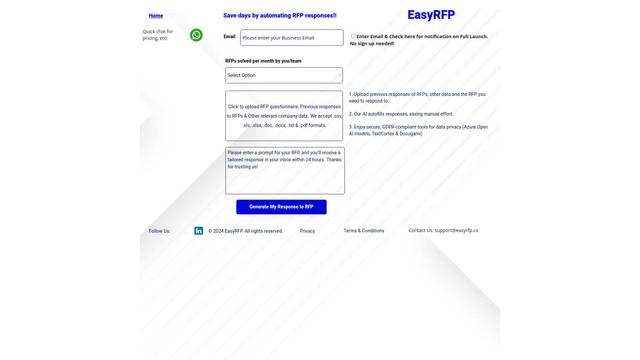
EasyRFP is an AI-powered edge computing toolkit that streamlines RFP (Request for Proposal) responses and enables real-time field phenotyping through deep learning technology.

Cart.ai
Cart.ai is an AI-powered service platform that provides comprehensive business automation solutions including coding, customer relations management, video editing, e-commerce setup, and custom AI development with 24/7 support.
Popular AI Tools Like git-lrc

GitHub Copilot Chat
GitHub Copilot Chat is an AI-powered coding assistant that provides natural language interactions, real-time code suggestions, and contextual support directly within supported IDEs and GitHub.com.
CopilotForXcode
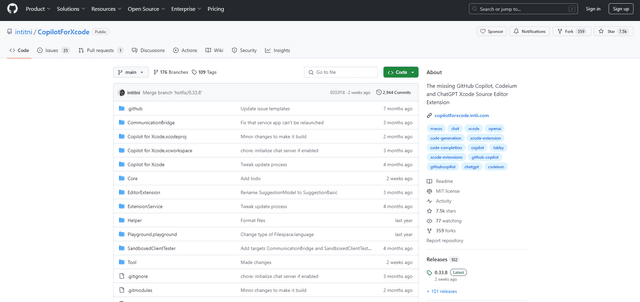
CopilotForXcode is an Xcode Source Editor Extension that integrates GitHub Copilot, Codeium, and ChatGPT to provide AI-powered code suggestions, chat assistance, and prompt-to-code functionality within Xcode.

BrowserAI
BrowserAI is an open-source library that enables running local Large Language Models (LLMs) directly in web browsers with WebGPU acceleration, offering privacy-focused AI capabilities without requiring server infrastructure.
OpenAI Codex CLI
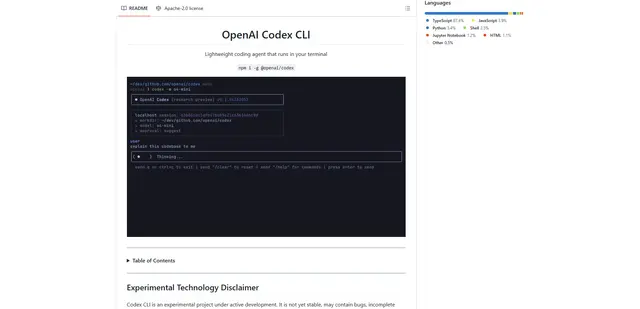
OpenAI Codex CLI is a lightweight, open-source coding agent that runs in your terminal, enabling developers to translate natural language into code execution while providing ChatGPT-level reasoning with the ability to run code, manipulate files, and iterate under version control.