
Cursor 3
Cursor 3 is a unified, agent-first workspace for building software that enables developers to run multiple AI coding agents in parallel across local and cloud environments, seamlessly switching between autonomous agent work and manual code editing.
https://cursor.com/blog/cursor-3?ref=producthunt

Product Information
Updated:Apr 16, 2026
Cursor 3 Monthly Traffic Trends
Cursor 3 achieved 14.8% growth, reaching 16.8M visits in the month. The release of Composer in Cursor 2.0, a proprietary model that processes code four times faster than peers, likely contributed to this increase. Additionally, enhancements in team workflows and the acquisition of Graphite for AI code review may have further boosted user engagement.
What is Cursor 3
Cursor 3 represents a fundamental reimagining of the AI-powered development environment, built from scratch to center around AI agents rather than traditional code editing. Released in April 2026, it marks Cursor's evolution from a VS Code fork into a purpose-built interface designed for the emerging era of agentic software development. The platform addresses the fragmentation developers face when working with AI coding assistants by providing a single workspace where engineers can orchestrate multiple agents across different repositories, environments, and tasks. While maintaining the depth and capabilities of a traditional IDE, Cursor 3 elevates developers to a higher level of abstraction—acting as orchestrators and reviewers rather than line-by-line code writers—while preserving the ability to dive deep into files and make manual edits whenever needed.
Key Features of Cursor 3
Cursor 3 is a unified, agent-first workspace for building software that represents a complete architectural redesign of the Cursor IDE. Released on April 2, 2026, it introduces the Agents Window for running multiple AI agents in parallel across repositories and environments, seamless handoff between cloud and local agents, Design Mode for UI annotation, and native best-of-N model comparison using Git worktrees. The interface is built from scratch around agents rather than traditional code editing, allowing developers to assign tasks in natural language while maintaining the ability to dive deep into code with full LSP support, an integrated browser for testing, and access to hundreds of plugins through the Cursor Marketplace.
Agents Window with Parallel Execution: A redesigned interface that allows running many AI agents simultaneously across multiple repositories and environments (local, cloud, SSH, worktrees), all visible and manageable from a unified sidebar. Cloud agents automatically produce demos, screenshots, and video documentation of their work.
Seamless Local-Cloud Agent Handoff: Agents can move fluidly between cloud and local environments with a simple command. Start an agent in the cloud for long-running tasks, then pull it local for quick iterations and testing, or push local work to the cloud to continue while offline.
Best-of-N Model Comparison: Select multiple AI models from different providers, submit a single prompt, and each model generates a solution in an isolated Git worktree. Compare results side-by-side to choose the best implementation without committing to a single model upfront.
Integrated Browser and Testing: Built-in browser allows agents to open, navigate, and interact with local websites, enabling them to test UI and functionality they build in real-time without switching contexts.
Multi-Repository Workspace: Inherently multi-workspace architecture that allows developers and agents to work across different repositories simultaneously, with full Git functionality including staging, committing, and pull request management built directly into the interface.
Extensible Plugin Marketplace: Access hundreds of plugins including MCPs (Model Context Protocol), specialized skills, and subagents with one-click installation. Teams can set up private marketplaces for internal tools and custom agent extensions.
Use Cases of Cursor 3
Full-Stack Feature Development: Spin up multiple agents to work on different layers of a feature simultaneously—one agent handles backend API changes, another builds the frontend UI, and a third writes tests—all coordinated through the unified workspace with automatic integration testing via the built-in browser.
Bug Investigation and Resolution: Deploy cloud agents to autonomously analyze bugs across multiple repositories, generate video demos documenting the issue, propose fixes in isolated worktrees, and create pull requests—all while developers continue working on other tasks locally.
Multi-Model Code Review and Optimization: Use the best-of-N feature to have multiple AI models (GPT-4, Claude, Composer 2) independently refactor or optimize the same code section, then compare approaches to select the most efficient or maintainable solution.
Distributed Team Collaboration: Launch agents from mobile, web, Slack, GitHub, or Linear that run in the cloud and are accessible to the entire team through the Agents Window, enabling asynchronous collaboration where team members can review agent work and hand off tasks across time zones.
Systems-Level Development with Context Switching: Work on complex, multi-repository projects like microservices architectures where agents handle routine updates across services while developers maintain deep focus on critical systems-level code using the full IDE capabilities with LSP support.
Rapid Prototyping and UI Iteration: Use Design Mode to annotate UI mockups, have agents generate implementations, test them immediately in the integrated browser, and iterate quickly by moving agents between cloud (for generation) and local (for fine-tuning) environments.
Pros
Unified workspace eliminates context switching between multiple tools, terminals, and agent interfaces, significantly improving developer productivity
Flexible cloud-local handoff allows developers to leverage cloud compute for long-running tasks while maintaining local control for quick iterations
Best-of-N model comparison reduces risk of model selection and allows objective evaluation of different AI approaches on the same problem
Built from scratch around agents rather than retrofitted, providing a more coherent and purpose-built interface for agent-first development
Cons
Steep learning curve as it represents a fundamental shift from traditional IDE workflows to agent-first development, potentially alienating experienced developers
Risk of agents making architectural messes, rewriting existing code, or introducing inconsistent patterns when working autonomously, as reported by long-time users
Many features focus on convenience (browser preview, autocomplete shopping) rather than core software engineering needs, particularly for systems-level development in languages like Rust or C
Running multiple agents in parallel can incur significant costs, and managing agent conflicts when multiple agents touch the same files remains unclear
How to Use Cursor 3
1. Install and Upgrade to Cursor 3: Download and install Cursor from cursor.com, or upgrade your existing Cursor installation to version 3. The update was released on April 2, 2026.
2. Open the Agents Window: Press Cmd+Shift+P (Mac) or Ctrl+Shift+P (Windows/Linux) to open the command palette, then type 'Agents Window' to launch the new Cursor 3 interface. You can also keep both the IDE and Agents Window open simultaneously.
3. Configure Your Settings and Context: Set up your preferences in Cursor Settings, including model selection, indexing preferences, and .cursorignore file to exclude certain files. Configure team secrets and attribution settings if working in a team environment.
4. Create Your First Agent Task: In the Agents Window, locate the text box at the center where you can type natural language descriptions of tasks. Describe what you want to build using the context sandwich method: provide context, current state, goal, and constraints.
5. Choose Between Local and Cloud Agents: Decide whether to run your agent locally (for faster iteration and manual editing) or in the cloud (for resource-heavy tasks and parallel execution). You can drag and drop sessions between environments as needed.
6. Select Your AI Model: Choose from available models like Claude Sonnet 4 (recommended for most tasks), GPT, Gemini, or o1-mini. For complex tasks, you can send requests to multiple models simultaneously and compare outputs to pick the best result.
7. Monitor Agent Progress: View all running agents in the left sidebar. Track agents launched from desktop, mobile, web, Slack, GitHub, or Linear. Cloud agents automatically generate demos and screenshots for verification.
8. Use Design Mode for UI Tasks: In the Agents Window, activate Design Mode to annotate and click on UI elements in the built-in browser. This allows you to give agents precise visual feedback instead of describing changes in text.
9. Review and Edit Generated Code: Use the new diffs view to review changes. You can switch to file view to see the code with full LSP support, go to definitions, and make manual edits using inline chat (Cmd+K or Ctrl+K).
10. Iterate with Composer 2: For quick iterations, use Composer 2 (Cursor's own frontier coding model with high usage limits) to refine the code. Move cloud sessions to local when you want to test and iterate quickly.
11. Test and Debug: Run tests using the integrated terminal. Use test-driven development by asking agents to write tests first, then implement code to pass those tests. Use the bug finder feature (Cmd+Shift+P and type 'bug finder') to identify issues.
12. Extend with Plugins and MCPs: Browse the Cursor Marketplace for hundreds of plugins that extend agents with MCPs, skills, and subagents. Install with one click or set up a team marketplace for private plugins.
13. Manage Multiple Repositories: Work across different repos simultaneously in the multi-workspace interface. Run agents in parallel across repos, environments, and machines - locally, in worktrees, in the cloud, and on remote SSH.
14. Create Automations: Set up automations at cursor.com/automations or start from a template. Agents can access memory tools to learn from past runs and improve with repetition. Configure MCPs and models for automated workflows.
15. Commit and Create Pull Requests: Once satisfied with the changes, use the diffs view to stage and commit your code. Manage pull requests directly from the Cursor 3 interface to complete the development workflow.
16. Switch Back to IDE When Needed: At any time, you can switch back to the traditional Cursor IDE interface for more granular control, or keep both the Agents Window and IDE open simultaneously for maximum flexibility.
Cursor 3 FAQs
Cursor 3 is a unified workspace for building software with agents. It's a new interface built from scratch, centered around agents, that brings clarity to the work agents produce. It's faster, cleaner, and more powerful than previous versions, featuring a multi-repo layout and seamless handoff between local and cloud agents.
Cursor 3 Video
Popular Articles
Atoms: A Multi-Agent AI Platform That Transforms Ideas into Launch-Ready Products
May 22, 2026

Nano Banana SBTI: What It Is, How It Works, and How to Use It in 2026
Apr 15, 2026

Atoms Review — The AI Product Builder Redefining Digital Creation in 2026
Apr 10, 2026

Kilo Claw: How to Deploy and Use a True "Do‑It‑For‑You" AI Agent(2026 Update)
Apr 3, 2026
Analytics of Cursor 3 Website
Cursor 3 Traffic & Rankings
16.8M
Monthly Visits
#3004
Global Rank
#14
Category Rank
Traffic Trends: Apr 2025-Oct 2025
Cursor 3 User Insights
00:04:46
Avg. Visit Duration
4.44
Pages Per Visit
36.55%
User Bounce Rate
Top Regions of Cursor 3
US: 18.81%
CN: 11.22%
IN: 9.94%
BR: 3.66%
KR: 3.12%
Others: 53.24%
Latest AI Tools Similar to Cursor 3
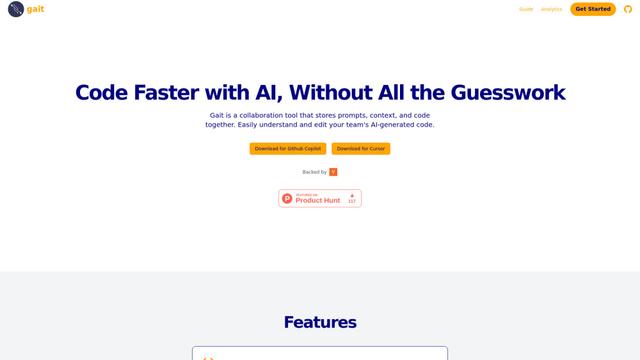
Gait
Gait is a collaboration tool that integrates AI-assisted code generation with version control, enabling teams to track, understand, and share AI-generated code context efficiently.
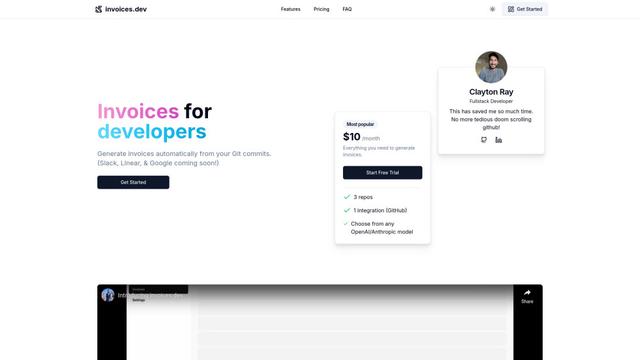
invoices.dev
invoices.dev is an automated invoicing platform that generates invoices directly from developers' Git commits, with integration capabilities for GitHub, Slack, Linear, and Google services.
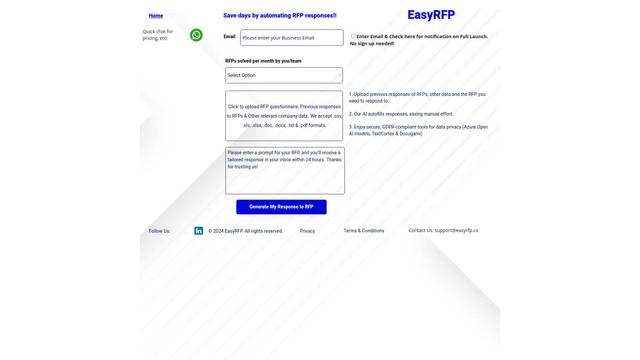
EasyRFP
EasyRFP is an AI-powered edge computing toolkit that streamlines RFP (Request for Proposal) responses and enables real-time field phenotyping through deep learning technology.

Cart.ai
Cart.ai is an AI-powered service platform that provides comprehensive business automation solutions including coding, customer relations management, video editing, e-commerce setup, and custom AI development with 24/7 support.
Popular AI Tools Like Cursor 3

GitHub Copilot Chat
GitHub Copilot Chat is an AI-powered coding assistant that provides natural language interactions, real-time code suggestions, and contextual support directly within supported IDEs and GitHub.com.
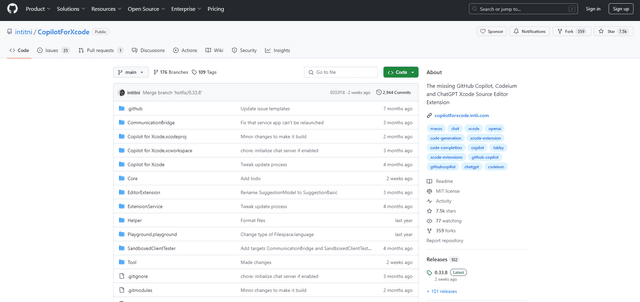
CopilotForXcode
CopilotForXcode is an Xcode Source Editor Extension that integrates GitHub Copilot, Codeium, and ChatGPT to provide AI-powered code suggestions, chat assistance, and prompt-to-code functionality within Xcode.

BrowserAI
BrowserAI is an open-source library that enables running local Large Language Models (LLMs) directly in web browsers with WebGPU acceleration, offering privacy-focused AI capabilities without requiring server infrastructure.
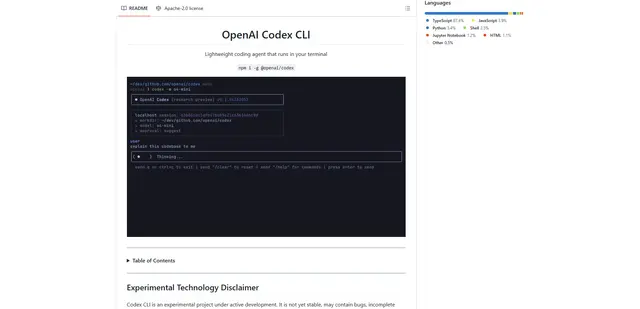
OpenAI Codex CLI
OpenAI Codex CLI is a lightweight, open-source coding agent that runs in your terminal, enabling developers to translate natural language into code execution while providing ChatGPT-level reasoning with the ability to run code, manipulate files, and iterate under version control.