
Agent Memory System
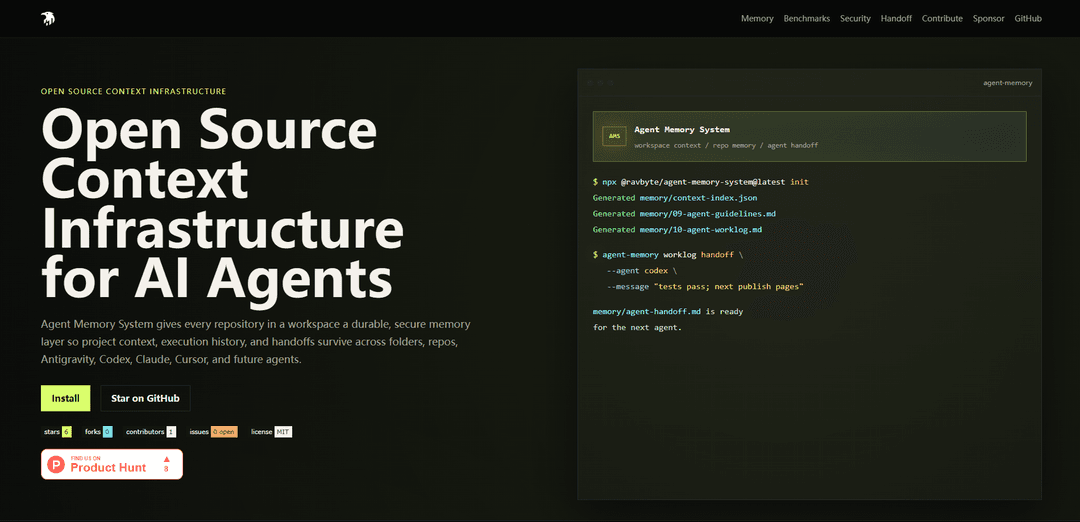
Agent Memory System is an open-source, security-first context and memory layer that scans repositories into durable Markdown/JSON indexes, maintains freshness via Git-aware updates and CI gates, and enables cross-agent handoffs with worklogs and dependency graph intelligence.
https://ravbyte-ai.github.io/agent-memory-system?ref=producthunt
Product Information
Updated:May 18, 2026
What is Agent Memory System
Agent Memory System is an open-source “context infrastructure” tool that adds a durable memory layer to code repositories so AI assistants can retain and recover project context across sessions and across tools. Maintained by RAVBYTE TECHNOLOGIES PRIVATE LIMITED (MIT licensed and open to community contributions), it generates a structured `memory/` folder (e.g., context index, guidelines, worklogs, and handoff notes) that any agent—Codex, Claude, Cursor, Antigravity, and others—can read to quickly understand a codebase, recent execution history, and the current state of work.
Key Features of Agent Memory System
Agent Memory System is an open-source “context infrastructure” layer that scans repositories (and whole workspaces with multiple repos) to generate durable, agent-readable memory artifacts—indexes, guidelines, architectural maps, and work logs—so AI coding agents (Codex, Claude, Cursor, etc.) can navigate codebases faster, resume work across sessions, and hand off tasks without re-reading everything. It emphasizes automatic upkeep via git-aware maintenance, graph-based dependency intelligence to understand change blast radius, and security guardrails that avoid leaking secrets while still preserving useful operational context.
Workspace & repo scanning to structured memory: One-command scanning detects manifests, APIs, configs, tests, storage hints, docs, and key structure across many folders/repos, then writes portable Markdown memory files plus a topic index (e.g., context-index.json) any agent can consume.
Git-aware maintenance & freshness gates: A maintain mode (e.g., `--since main`) refreshes memory based on structural changes and validates outputs so context doesn’t drift; CI checks can require updated memory in PRs.
Cross-agent continuity (worklog + handoff): Captures checkpoints, commands, files touched, blockers, and next steps in a JSONL worklog and generates an agent-handoff document so a new agent can resume instantly with minimal recovery tokens.
Graph intelligence for blast-radius analysis: Built-in static analysis maps dependencies and architectural layers, enabling fast queries about what will break if an API or module changes and reducing trial-and-error navigation.
Agent-native conventions and skill wrapper: Provides portable guidance on what memory to read, when to refresh it, and how to perform handoffs—designed to work across multiple assistants and future agent hosts.
Security-first memory generation: Avoids generated/vendor paths, records environment variable names (not secret values), flags obvious secret patterns, and labels inferred content so agents know what requires verification.
Use Cases of Agent Memory System
Software engineering teams (multi-repo monorepos): Create a durable context layer for large workspaces so agents and developers can quickly find the right files, understand architecture, and reduce repeated “codebase re-discovery” across tasks.
AI-assisted code review & CI workflows: Use PR freshness gates to ensure memory stays aligned with code changes, improving review quality and reducing regressions caused by stale architectural assumptions.
Consulting & agency handoffs: Generate standardized handoff artifacts (worklog + handoff doc) so new engineers or new agents can pick up client projects without lengthy onboarding or repeated explanations.
Enterprise modernization & refactoring programs: Leverage dependency/architecture graphs to estimate blast radius, plan safe refactors, and guide agents toward the correct layers and modules in legacy systems.
Customer support / solutions engineering for developer products: Maintain a structured, safe-to-share internal memory of repo structure, common commands, and validated workflows so support engineers and agents can reproduce issues and propose fixes faster.
Pros
Open-source and agent-agnostic: designed to work across Codex, Claude, Cursor, and other/future agents via portable memory artifacts.
Strong continuity primitives: worklog + handoff reduce recovery time and token spend when resuming tasks or switching agents.
Security-conscious by design: avoids secret values and generated paths while still capturing operationally useful context.
Change-impact awareness: graph-based dependency intelligence helps agents reason about blast radius instead of guessing.
Cons
Requires operational discipline: teams may need to wire CI checks and run maintain workflows consistently to prevent drift.
Static analysis and scanning can miss runtime-only behavior: some architectural truths may still require verification in code/tests.
Memory artifacts can become noisy without tuning: large or fast-changing repos may need configuration/validation to keep outputs high-signal.
How to Use Agent Memory System
1) Initialize Agent Memory System in your repo: From the repository root, run: `npx @ravbyte/agent-memory-system@latest init`. This generates the `memory/` folder and key starter artifacts such as `memory/context-index.json`, `memory/09-agent-guidelines.md`, and `memory/10-agent-worklog.md`.
2) (Optional) Install the CLI globally for repeated use: If you prefer a persistent `agent-memory` command, run: `npm install -g @ravbyte/agent-memory-system@latest`.
3) Scan the repository to build/update the memory layer: Run a scan to map the repo (manifests, routes, APIs, configs, tests, storage hints, docs, etc.) and write Markdown + a topic index agents can read. Example: `agent-memory scan --json`.
4) Use the generated memory artifacts as your agent’s starting context: Point your coding agent (Codex/Claude/Cursor/etc.) at the `memory/` outputs—especially `memory/context-index.json`—so it can quickly find the right files and understand architecture without re-traversing the codebase.
5) Keep memory fresh as the repo changes (maintenance mode): After structural Git changes, refresh memory to avoid drift: `agent-memory maintain --since main`. This detects changes since the specified ref/branch and updates `memory/` accordingly, with validation so stale context doesn’t silently persist.
6) Record progress during an agent session (checkpoint worklog): As the agent completes meaningful work, write a checkpoint entry to the JSONL worklog so future sessions can resume accurately. Example: `agent-memory worklog checkpoint --agent codex --message "implemented scanner"`.
7) Create a handoff for the next agent/session: When you stop work (or want another agent to continue), generate a handoff summary: `agent-memory worklog handoff --agent codex --message "tests pass; next publish pages"`. This produces `memory/agent-handoff.md` for fast cross-session recovery.
8) Use the handoff to resume work in a new session: In the next session (same or different agent), start by reading `memory/agent-handoff.md` plus the relevant entries in `memory/agent-worklog.jsonl` (or the referenced files) to continue without re-explaining prior decisions, commands, and blockers.
9) Add CI/review discipline so memory stays accurate: Adopt a workflow where PRs that change structure also refresh `memory/` (via `agent-memory maintain --since main`) and run the project’s checks (typecheck/tests/build plus any memory validation gates) before merging, preventing stale context from entering reviews.
Agent Memory System FAQs
Agent Memory System is an open-source context infrastructure that gives repositories in a workspace a durable memory layer so project context, execution history, and handoffs persist across sessions and across agents/tools (e.g., Codex, Claude, Cursor).
Popular Articles

Atoms: A Multi-Agent AI Platform That Transforms Ideas into Launch-Ready Products
May 22, 2026

Nano Banana SBTI: What It Is, How It Works, and How to Use It in 2026
Apr 15, 2026

Atoms Review — The AI Product Builder Redefining Digital Creation in 2026
Apr 10, 2026

Kilo Claw: How to Deploy and Use a True "Do‑It‑For‑You" AI Agent(2026 Update)
Apr 3, 2026
Latest AI Tools Similar to Agent Memory System
Gait
Gait is a collaboration tool that integrates AI-assisted code generation with version control, enabling teams to track, understand, and share AI-generated code context efficiently.
invoices.dev
invoices.dev is an automated invoicing platform that generates invoices directly from developers' Git commits, with integration capabilities for GitHub, Slack, Linear, and Google services.
EasyRFP
EasyRFP is an AI-powered edge computing toolkit that streamlines RFP (Request for Proposal) responses and enables real-time field phenotyping through deep learning technology.

Cart.ai
Cart.ai is an AI-powered service platform that provides comprehensive business automation solutions including coding, customer relations management, video editing, e-commerce setup, and custom AI development with 24/7 support.
Popular AI Tools Like Agent Memory System

GitHub Copilot Chat
GitHub Copilot Chat is an AI-powered coding assistant that provides natural language interactions, real-time code suggestions, and contextual support directly within supported IDEs and GitHub.com.
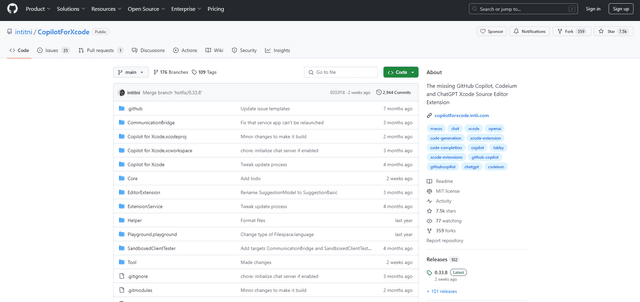
CopilotForXcode
CopilotForXcode is an Xcode Source Editor Extension that integrates GitHub Copilot, Codeium, and ChatGPT to provide AI-powered code suggestions, chat assistance, and prompt-to-code functionality within Xcode.

BrowserAI
BrowserAI is an open-source library that enables running local Large Language Models (LLMs) directly in web browsers with WebGPU acceleration, offering privacy-focused AI capabilities without requiring server infrastructure.
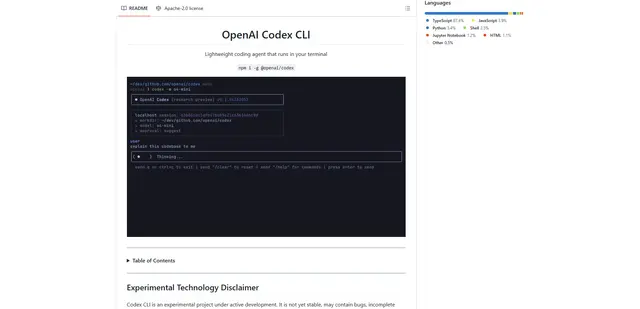
OpenAI Codex CLI
OpenAI Codex CLI is a lightweight, open-source coding agent that runs in your terminal, enabling developers to translate natural language into code execution while providing ChatGPT-level reasoning with the ability to run code, manipulate files, and iterate under version control.