
Agentmemory
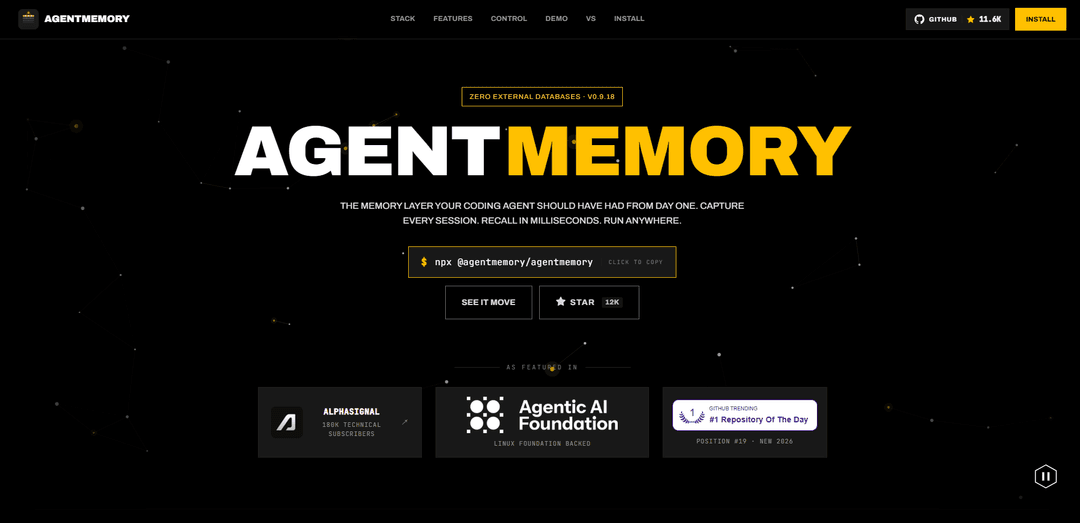
Agentmemory is a local-first, zero-external-database memory runtime for coding agents that auto-captures sessions via hooks, recalls context in milliseconds with BM25+vector+knowledge-graph retrieval, and continuously consolidates raw logs into durable semantic memories—exposed through MCP and HTTP with a built-in viewer.
https://agent-memory.dev/?ref=producthunt
Product Information
Updated:Jun 8, 2026
What is Agentmemory
Agentmemory is a persistent memory layer designed for AI coding agents that would otherwise forget everything between sessions. It runs locally as a single Node process (no Postgres/Redis/Kafka/vector DB required) and captures what happens during your agent’s work—prompts, tool calls, session events—so future sessions can reuse that context without you re-explaining architecture, preferences, or past decisions. It supports MCP and an HTTP-first API surface (each MCP tool has a REST twin), and ships with a real-time viewer and console so you can inspect sessions, memories, and system health while keeping all data on your machine.
Key Features of Agentmemory
Agentmemory is a local-first, one-process persistent memory runtime for AI coding agents that captures every session via auto-hooks, consolidates raw observations into durable semantic memories, and recalls relevant context in milliseconds using hybrid triple-stream retrieval (BM25 + vector + knowledge graph) with on-device reranking. It exposes a broad MCP surface (51 tools) with REST equivalents (121 endpoints), includes built-in viewer/console UIs, supports importing past transcripts, exporting to markdown/Obsidian, and can sync memories across nodes over authenticated HTTPS—while avoiding external databases like Redis/Postgres/Neo4j and keeping data on disk as JSON.
Auto-capture hooks (12 hooks): Automatically records prompts, tool calls, session lifecycle events (e.g., PreToolUse/PostToolUse/Stop), and compresses them into observations without requiring custom glue code.
Hybrid recall in milliseconds: Uses triple-stream retrieval (lexical BM25 + semantic vectors + knowledge-graph signals) and on-device reranking to surface the most relevant prior context (reported 95.2% R@5 on LongMemEval-S; p50 < 20ms on a laptop).
Consolidation pipeline (raw → semantic): Runs periodic sweeps that compress observations into semantic memories, merge duplicates, decay stale rows with retention scoring, and emit audit records on deletes for governance.
MCP-native + HTTP-first API: Provides 51 MCP tools (save/recall/search/sessions/governance/audit/export/graph) and mirrors each tool with REST endpoints under /agentmemory/* for easy integration and debugging.
Built-in UIs and observability: Ships a real-time viewer (port 3113) for live streams, session replay, memory browsing, and graph visualization, plus engine-level console and OpenTelemetry traces/logs for operational visibility.
Local-first storage + federation/export: Runs as a single Node process with on-disk JSON state (no external DBs), supports JSONL session import, Obsidian-ready markdown export, and authenticated peer-to-peer sync between agentmemory nodes.
Use Cases of Agentmemory
Software development continuity: Persist project conventions, prior architectural decisions, and past debugging outcomes across coding sessions so agents like Claude Code/Cursor/Codex can pick up work without re-explaining context.
Team knowledge capture for engineering orgs: Record and consolidate repeated troubleshooting steps, runbooks, and incident learnings into searchable semantic memories, reducing onboarding time and repeated investigation effort.
Multi-agent coordination in complex builds: Enable multiple agents/tools to share a consistent memory layer (via MCP/REST and optional federation) so parallel tasks can reference the same evolving project knowledge.
Regulated or privacy-sensitive environments: Keep memory local on disk with no external databases and use audit/governance surfaces to track deletions and manage retention—useful for enterprises with data locality requirements.
Personal productivity and note hydration: Export frontmatter-tagged markdown into an Obsidian vault to turn agent interactions into a navigable personal knowledge base with graph visualization.
Agent platform integration via APIs: Embed memory save/recall into custom developer tools or internal platforms using the REST endpoints (curl/browser/proxy-friendly) without being locked into a specific agent framework.
Pros
Local-first, single-process design with 0 external databases simplifies deployment and keeps data on the developer machine.
Strong integration surface: 12 auto-hooks, 51 MCP tools, and REST twins make it easy to wire into many agent clients and workflows.
Fast and robust retrieval via hybrid BM25+vector+graph with on-device reranking; includes built-in viewer and OTEL observability.
Cons
Running everything in one Node process may require careful resource management on small machines despite health improvements for tiny processes.
Some provider options and configurations (e.g., optional Claude agent SDK fallback) can introduce operational risks if misused (noted recursion risk).
Primarily optimized for coding-agent workflows; non-coding domains may need additional tailoring of capture/consolidation strategies.
How to Use Agentmemory
1) Start the local Agentmemory server: In a separate terminal, run: npx @agentmemory/agentmemory. This starts the memory runtime on http://localhost:3111 and the real-time viewer on http://localhost:3113.
2) Verify the server is healthy: Check the health endpoint: curl http://localhost:3111/agentmemory/health. Confirm it reports healthy before wiring any clients.
3) Open the real-time viewer (optional but recommended): Navigate to http://localhost:3113 to watch live observation streams, browse memories, replay sessions, and inspect the knowledge graph.
4) Connect an MCP-capable client (universal MCP config): Add an MCP server entry in your client’s MCP configuration using: command=npx, args=["-y","@agentmemory/mcp"], and env AGENTMEMORY_URL=http://localhost:3111. This exposes Agentmemory’s full MCP tool surface to the client.
5) (Hermes) Configure Agentmemory as an MCP server: In ~/.hermes/config.yaml, add an mcp_servers entry for agentmemory that runs npx with args ["-y","@agentmemory/mcp"], and set AGENTMEMORY_URL to http://localhost:3111 so Hermes can access the full set of memory tools.
6) (Hermes) Enable Agentmemory as the memory provider: In the same Hermes config, set memory.provider to agentmemory so Hermes uses Agentmemory for saving/recalling across sessions.
7) Use memory tools during work: From your MCP client, call Agentmemory tools to store and retrieve information (e.g., save key decisions/outcomes, then recall them later). Agentmemory also supports smart/hybrid recall and session browsing via its MCP tool surface.
8) Use the REST API directly (optional): If you prefer HTTP calls, use the REST endpoints under /agentmemory/* on localhost:3111 (each MCP tool has a REST twin). This is useful for scripting, debugging, or proxying from your own agent.
9) Import past sessions (optional): If you have existing coding-agent transcripts (e.g., JSONL), use Agentmemory’s session import capability to rehydrate prior sessions into the store so they become searchable and replayable.
10) Keep the server running while you use your agent: Leave the Agentmemory server running in the background. As you work, it captures sessions (via hooks/plugins where supported) and makes them available for fast recall in future sessions.
11) (Deeper Hermes integration) Install the Hermes plugin (optional): For hook-driven capture and richer integration (pre-context injection, turn capture, MEMORY.md mirroring, system prompt block), copy the Hermes integration plugin from the agentmemory repo into ~/.hermes/plugins/agentmemory.
12) Confirm capture + recall end-to-end: Run a short task in your agent, then use the viewer (3113) or a recall/search tool call to confirm the session was captured and can be retrieved in a later session without re-explaining prior context.
Agentmemory FAQs
agentmemory is a persistent memory runtime for AI coding agents that captures sessions, recalls relevant context quickly, and consolidates raw observations into longer-lived semantic memories. It is positioned as “the memory layer your coding agent should have had from day one,” and is not just a library or a vector store.
Popular Articles

Atoms: A Multi-Agent AI Platform That Transforms Ideas into Launch-Ready Products
May 22, 2026

Nano Banana SBTI: What It Is, How It Works, and How to Use It in 2026
Apr 15, 2026

Atoms Review — The AI Product Builder Redefining Digital Creation in 2026
Apr 10, 2026

Kilo Claw: How to Deploy and Use a True "Do‑It‑For‑You" AI Agent(2026 Update)
Apr 3, 2026
Latest AI Tools Similar to Agentmemory
Gait
Gait is a collaboration tool that integrates AI-assisted code generation with version control, enabling teams to track, understand, and share AI-generated code context efficiently.
invoices.dev
invoices.dev is an automated invoicing platform that generates invoices directly from developers' Git commits, with integration capabilities for GitHub, Slack, Linear, and Google services.
EasyRFP
EasyRFP is an AI-powered edge computing toolkit that streamlines RFP (Request for Proposal) responses and enables real-time field phenotyping through deep learning technology.

Cart.ai
Cart.ai is an AI-powered service platform that provides comprehensive business automation solutions including coding, customer relations management, video editing, e-commerce setup, and custom AI development with 24/7 support.
Popular AI Tools Like Agentmemory

GitHub Copilot Chat
GitHub Copilot Chat is an AI-powered coding assistant that provides natural language interactions, real-time code suggestions, and contextual support directly within supported IDEs and GitHub.com.
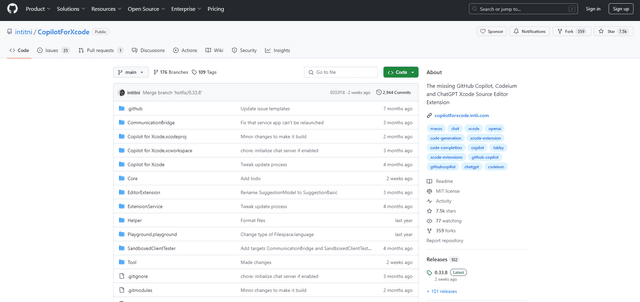
CopilotForXcode
CopilotForXcode is an Xcode Source Editor Extension that integrates GitHub Copilot, Codeium, and ChatGPT to provide AI-powered code suggestions, chat assistance, and prompt-to-code functionality within Xcode.
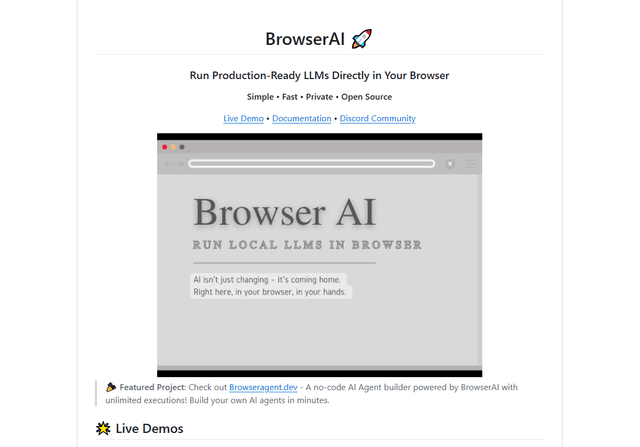
BrowserAI
BrowserAI is an open-source library that enables running local Large Language Models (LLMs) directly in web browsers with WebGPU acceleration, offering privacy-focused AI capabilities without requiring server infrastructure.
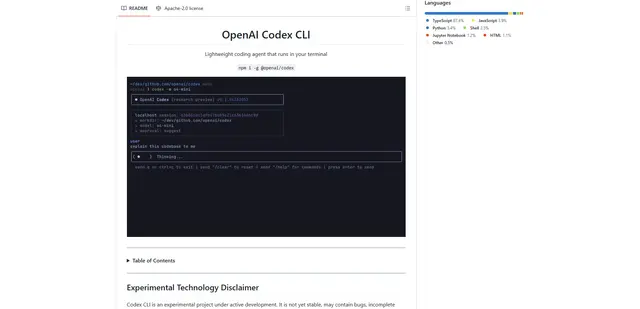
OpenAI Codex CLI
OpenAI Codex CLI is a lightweight, open-source coding agent that runs in your terminal, enabling developers to translate natural language into code execution while providing ChatGPT-level reasoning with the ability to run code, manipulate files, and iterate under version control.