
Tiden
Tiden is an intent-verification platform for coding agents that turns product requirements into versioned specs, connects them to tests, and verifies that AI-generated code delivers what was requested.
https://tiden.ai/?ref=producthunt
Product Information
Updated:Nov 23, 2026
What is Tiden
Tiden helps engineering teams maintain quality as they ship software written with coding agents such as Claude Code, Cursor, Copilot, and Codex. Rather than treating passing tests as the sole measure of correctness, it keeps a versioned record of product intent alongside the code and tracks whether each promised behavior has evidence from tests. Tiden is designed for teams that need to review, validate, and release agent-written changes without relying entirely on manual checking after every coding session.
Key Features of Tiden
Tiden is an intent-verification and continuous quality system for teams shipping AI-agent-written code. It maps product behavior into versioned specifications, connects requirements to tests, tracks whether promised outcomes are proven, and evaluates changes and releases against those specifications. It is designed to work alongside coding agents such as Claude Code, Cursor, Copilot, and Codex, while integrating with engineering tools including GitHub, Jira, Linear, Notion, Azure DevOps, and error-tracking systems.
Automated specification mapping: Tiden reads a codebase and documents product behavior as specs, organizing them by components and identifying specs that do not yet have test coverage.
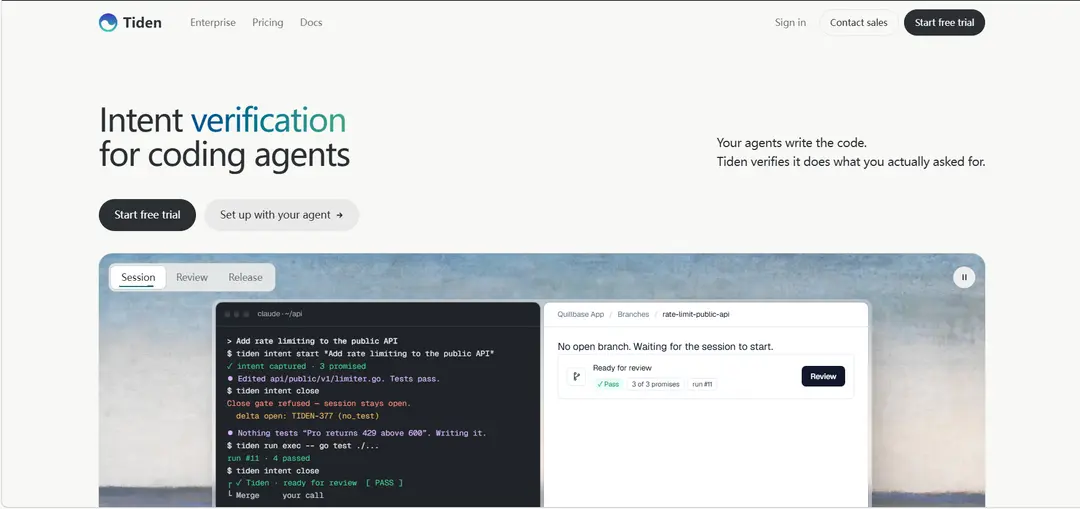
Promise-to-test verification: It turns an agent task into explicit promises, such as expected API behavior, and keeps work open until each promise is backed by passing tests.
Versioned specs beside code: Specifications evolve with code changes, creating a durable record of intended behavior rather than relying on an individual coding-agent session or chat history.
Change and pull-request evidence: For each branch or change, Tiden shows what was promised, what code changed, which tests prove the behavior, and whether any commitments remain open.
Release-level quality verdicts: It provides release and component-level pass/fail visibility, coverage status, risk indicators, and production issues that lack associated test coverage.
Engineering-tool integrations: Tiden connects with source control, issue trackers, documentation tools, and error-tracking systems to map requirements and operational signals into one quality workflow.
Use Cases of Tiden
AI-assisted software delivery: Engineering teams using Claude Code, Cursor, Copilot, or Codex can verify that agent-generated features meet stated requirements instead of only passing agent-written tests.
API contract enforcement: Platform and backend teams can define verifiable promises for rate limits, response codes, headers, authorization rules, and tier-specific behavior.
SaaS billing and entitlement changes: Subscription businesses can track and test billing-tier rules, usage caps, feature access, and other revenue-critical behavior as code evolves.
Regulated or high-risk product development: Teams in fintech, healthcare, enterprise security, or other controlled environments can maintain an auditable connection between requirements, implementation, and test evidence.
Multi-team monorepo quality management: Organizations with web, API, billing, search, and authentication components can view specs, test gaps, and release readiness across a large codebase.
Production incident follow-up: When an error appears in production, teams can trace it to a release, use an agent to implement a fix, and add the missing regression test.
Pros
Focuses on verifying product intent, not merely whether a test suite passes.
Creates traceability between requirements, code changes, tests, and release status.
Supports agent-heavy development workflows and works alongside common coding agents.
Helps expose untested behavior and production issues that are not covered by tests.
Cons
Its effectiveness depends on accurate generated or maintained specifications and meaningful tests.
Adopting it may require teams to change workflows around tasks, pull requests, and release reviews.
The available information emphasizes GitHub and selected integrations, so compatibility with every development stack is not established.
Automated verification can reduce review effort but does not fully replace human judgment for product, security, or architectural decisions.
How to Use Tiden
1. Install Tiden: Run the installation command from a terminal: `curl -fsSL https://tiden.ai/install.sh | bash`.
2. Connect your source repository: Connect Tiden to the GitHub repository used by your engineering team. Tiden will inspect the repository and begin building a product map from the codebase.
3. Connect supporting engineering tools: Optionally connect the tools where product intent and operational signals live, such as Jira, Linear, Notion, Azure DevOps, and error tracking. This gives Tiden additional context for requirements, issues, and production errors.
4. Review the generated product snapshot: Allow Tiden to read the code and produce versioned specs describing product behavior by component. Review the snapshot to see discovered specifications and identify behaviors that do not yet have test coverage.
5. Start agent work from an intent: When assigning work to a coding agent, define the requested behavior as a clear intent or spec. For example, specify public API rate limits, expected 429 responses, and required `Retry-After` headers.
6. Turn requirements into promises: Break the intent into individual, verifiable promises. Each promise should describe one expected outcome, such as a free tier returning HTTP 429 above 60 requests per minute.
7. Implement and test each promise: Use your coding agent to make the code changes and add or update tests that prove every promise. Tiden tracks whether each promise has evidence from a passing test.
8. Resolve open promises before closing work: Check Tiden's session or branch status. Do not close the task while promises remain open; complete the implementation or add the missing test evidence until all promises are delivered.
9. Review the branch-level intent evidence: Before merging, review Tiden's branch view to compare what changed in Git with the relevant specs and tests. Keep normal code review with human reviewers while using Tiden to validate intent and proof.
10. Merge and review spec updates: After every merge, including merges performed without Tiden actively used in the coding session, review the spec update Tiden drafts. Confirm that the versioned product specifications still match the code's actual behavior.
11. Check release verdicts: Use Tiden's release view to assess each component's status, coverage, and risk. Review the single release verdict along with any uncovered warnings or components that need attention.
12. Use production errors to improve coverage: When an error appears in production, trace it back to the affected release and component. Ask your coding agent to fix the problem and add a test, then let Tiden connect that new proof to the relevant specification.
Tiden FAQs
Tiden is an intent-verification tool for coding agents. It keeps product specifications versioned alongside code and helps teams verify that agent-written changes implement what was requested.
Tiden Video
Popular Articles

Proferex: A Cloud-Based Ad Tracking and Campaign Optimization Platform
Nov 4, 2026

How to Create Viral Talking Baby Podcast Videos with AI: Step-by-Step Guide
Nov 2, 2026

Vosko AI: Localize and Dub Videos for Global Audiences
Oct 15, 2026
Atoms: A Multi-Agent AI Platform That Transforms Ideas into Launch-Ready Products
Oct 13, 2026
Latest AI Tools Similar to Tiden
ExoTest
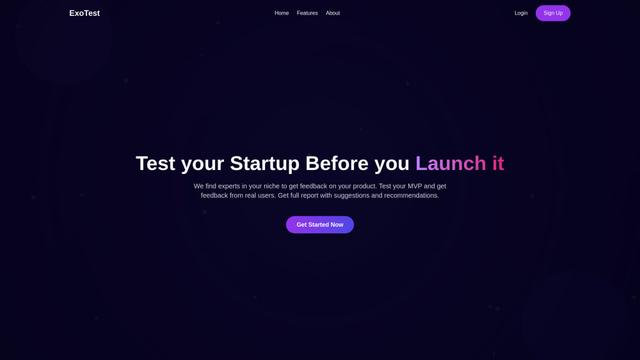
ExoTest is an AI-driven product testing platform that connects startups with expert testers in their specific niche to provide comprehensive feedback and actionable insights before product launch.
AI Dev Assess
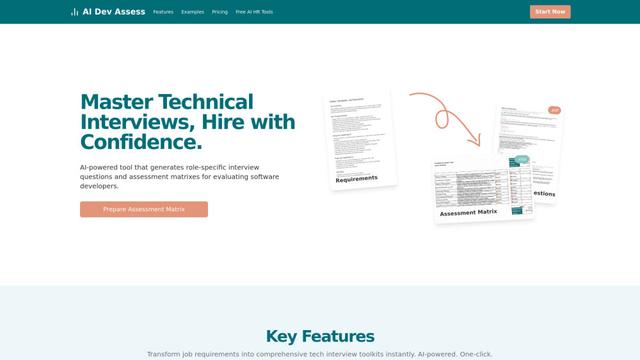
AI Dev Assess is an AI-powered tool that automatically generates role-specific interview questions and assessment matrices to help HR professionals and technical interviewers evaluate software developer candidates efficiently.
Tyne
Tyne is a professional AI-powered software and consulting company that helps businesses streamline their everyday needs through data analysis, yield improvement systems, and AI solutions.
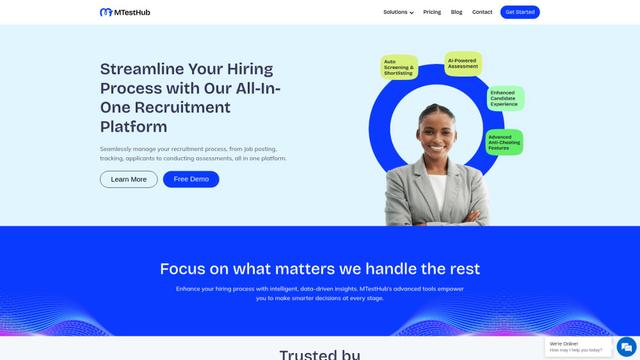
MTestHub
MTestHub is an all-in-one AI-powered recruitment and assessment platform that streamlines hiring processes with automated screening, skill evaluations, and advanced anti-cheating measures.
Popular AI Tools Like Tiden
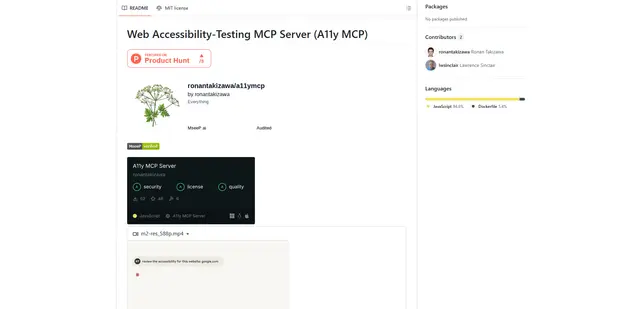
Web Accessibility Testing MCP
A11y MCP is a Model Context Protocol server that enables AI language models to perform automated web accessibility testing by integrating with Deque's Axe-core API and Puppeteer to analyze web content for WCAG compliance.
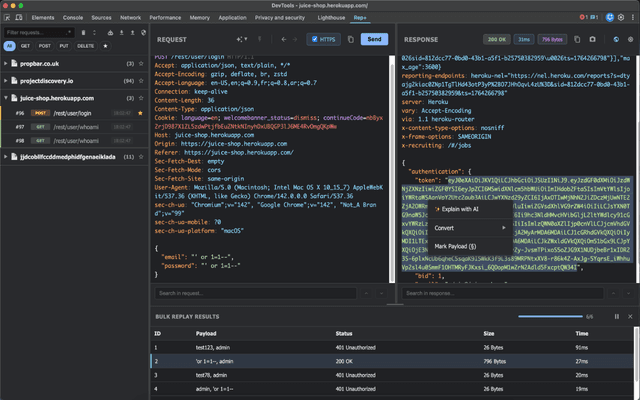
rep+
rep+ is a powerful Chrome DevTools extension that brings Burp Suite Repeater functionality directly into your browser, enabling HTTP request testing, security analysis, and AI-powered attack suggestions without proxy setup.
Gatling AI Assistant for VS Code
Gatling AI Assistant is an AI-powered extension for Visual Studio Code that helps developers create and manage load testing scenarios using Gatling's load testing framework.
KaneAI
KaneAI is the world's first end-to-end AI-powered software testing agent that enables users to create, debug, and evolve tests using natural language.