
Gemini 3.1 Flash-Lite
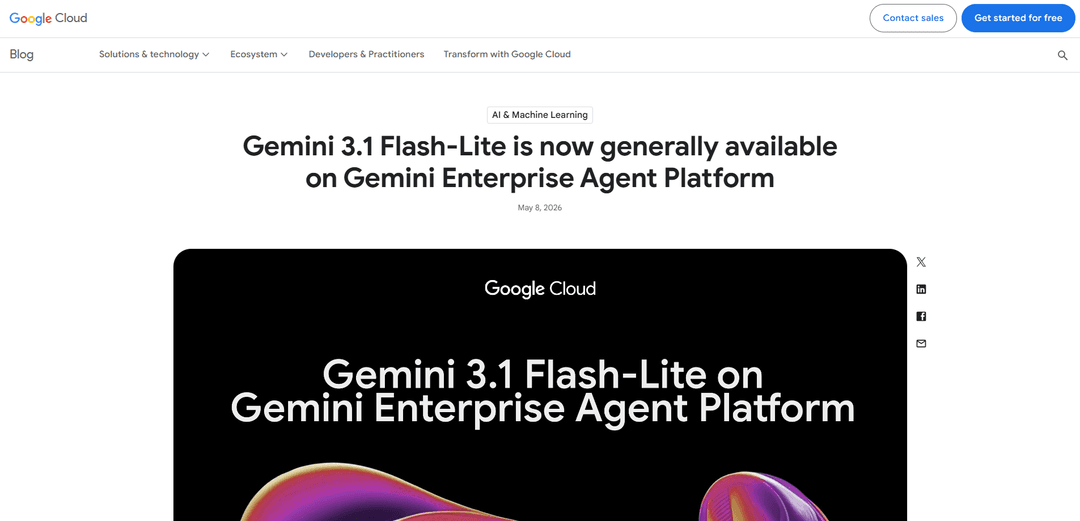
Gemini 3.1 Flash-Lite is Google’s fastest and most cost-efficient Gemini 3 series model, built for ultra-low latency, high-volume workloads while maintaining the precision needed for agentic tasks like tool calling and orchestration.
https://cloud.google.com/blog/products/ai-machine-learning/gemini-3-1-flash-lite-is-now-generally-available?ref=producthunt
Product Information
Updated:Aug 16, 2026
Gemini 3.1 Flash-Lite Monthly Traffic Trends
Gemini 3.1 Flash-Lite reached 45M visits with a modest 3.3% increase. Without specific updates to this model, the growth likely reflects broader momentum from Gemini Enterprise and Gemini 3.7 Flash GA releases, which drive general ecosystem awareness. Overall, this aligns with normal market fluctuation amid strong Google Cloud AI infrastructure demand.
What is Gemini 3.1 Flash-Lite
Gemini 3.1 Flash-Lite is a generally available (GA) generative AI model from Google Cloud designed to deliver strong intelligence at scale with unmatched cost-efficiency and very low latency. Positioned as the lightweight, high-throughput option within the Gemini 3 family, it’s intended for production deployments where response time, concurrency, and per-request cost matter as much as output quality. Flash-Lite is used across real-world enterprise scenarios—such as developer tooling, customer support automation, creative pipelines, and financial operations—where teams need fast, reliable model responses without paying for heavier “thinking-tier” models on every request.
Key Features of Gemini 3.1 Flash-Lite
Gemini 3.1 Flash-Lite is Google’s fastest and most cost-efficient Gemini 3-series model, now generally available, optimized for ultra-low latency and high-volume production workloads. It’s positioned for scalable, latency-sensitive “agentic” systems, offering reliable tool calling and orchestration while supporting multimodal inputs (text and images). It’s designed to serve as a lightweight but capable model for routing, classification, and automation layers, helping teams run large automated pipelines with strong instruction following and predictable performance at a low cost.
Ultra-low latency at scale: Built for high-concurrency, latency-sensitive deployments; cited performance includes sub-second p95 for classifiers/tool calls and ~1.8s p95 for full reply generation under heavy load.
Cost-efficient token pricing: Designed for unmatched cost-efficiency in production, with referenced pricing of $0.25 per 1M input tokens and $1.50 per 1M output tokens, enabling high-volume usage without runaway spend.
Agentic readiness (tool calling & orchestration): Provides the precision needed for agent workflows—selecting tools, routing intents, choosing playbooks, and deciding when to escalate to humans—supporting automated pipelines end-to-end.
Multimodal input support: Handles both text and image inputs, enabling workflows like multimodal safety checks and media-aware automation in creative pipelines.
High instruction fidelity & structured output reliability: Optimized for production patterns such as structured question answering, classification, and routing; sources cite high structured-output compliance and strong intent routing accuracy in orchestration roles.
Production availability on Google Cloud: Generally available via Google Cloud offerings (e.g., Vertex AI / Gemini Enterprise Agent Platform), with options like Provisioned Throughput for predictable capacity planning.
Use Cases of Gemini 3.1 Flash-Lite
IDE copilots and real-time developer agents: Powers low-latency code completion and agentic developer tooling in IDE environments where responsiveness is critical (e.g., real-time developer support and coding assistance).
High-volume customer service automation: Runs text-channel customer support agents across SMS/WhatsApp/Instagram at massive scale, handling tool selection, playbook classification, and human escalation while controlling costs.
Creative and gaming pipelines: Enables multimodal safety checks (text+image), inline translation for global communities, and prompt refinement for asset generation (e.g., thumbnails and content pipeline consistency).
Financial services: real-time research and workflow triage: Supports instant answers during live calls (e.g., investment banking research/data lookups) and parallel structured email triage to route messages to downstream agents with the right context.
Model routing and orchestration layer: Serves as a fast classifier to route requests to larger models based on complexity, reducing overall latency and cost in multi-model production stacks.
Translation and content moderation at scale: Fits high-frequency, lightweight tasks such as translation and moderation where speed and cost dominate, including global community support and safety gating.
Pros
Very low latency suitable for interactive and high-concurrency production workloads.
Strong cost-efficiency enables large-scale automation and routing layers without high spend.
Agentic capabilities (tool calling/orchestration) make it practical for real production pipelines.
Multimodal (text+image) support expands applicability beyond pure text tasks.
Cons
Best suited to straightforward/high-frequency tasks; complex deep-reasoning workloads may still require larger Flash/Pro-tier models.
Tight performance targets in production may require capacity planning (e.g., Provisioned Throughput) for predictable scaling.
Cloud/API access focus means it’s primarily developer/enterprise oriented rather than a consumer-app model.
How to Use Gemini 3.1 Flash-Lite
1) Choose the right use case for Flash-Lite: Use Gemini 3.1 Flash-Lite for ultra-low latency, high-volume, cost-sensitive workloads such as: classification/routing, simple data extraction, translation, content moderation, tool-calling/orchestration, and lightweight multimodal checks (text+image).
2) Pick an access channel (Gemini API via AI Studio, or Vertex AI / Gemini Enterprise Agent Platform): Flash-Lite is available to developers via the Gemini API in Google AI Studio, and to enterprises via Vertex AI (now transitioning into the Gemini Enterprise Agent Platform). Choose based on whether you want quick developer iteration (AI Studio) or enterprise governance and deployment (Vertex/Agent Platform).
3) Create or select a project and obtain credentials: In Google AI Studio, create/get an API key for the Gemini API. For enterprise deployments, use your Google Cloud project setup for Vertex AI / Agent Platform and ensure the relevant APIs and billing are enabled per your organization’s standard process.
4) Call the model by name in your application: When you invoke the Gemini API/SDK, set the model to "gemini-3.1-flash-lite". This explicitly targets Flash-Lite for low-latency, high-throughput requests.
5) Start with a basic text generation request: Send a simple prompt (e.g., summarize, classify, rewrite, translate) to validate connectivity and latency. Keep prompts short and structured for best speed and predictable outputs at scale.
6) Use Flash-Lite for model routing (classifier → route to bigger models when needed): Implement a two-stage pattern: (a) Flash-Lite classifies task complexity or intent (e.g., 'simple vs complex', 'needs tools?', 'needs long reasoning?'); (b) route simple tasks to Flash-Lite, and escalate complex tasks to Flash/Pro models. This is a common production pattern for cost/latency control.
7) Run parallel structured questions for triage workflows: For message/email triage, ask multiple structured questions in parallel (e.g., 'Is this automated?', 'Is it related to an active deal?', 'Which downstream agent should handle it?'). Use the answers to decide which downstream agents/tools to invoke and what context to pass along.
8) Add tool calling / orchestration for agentic tasks: Use Flash-Lite to select tools, choose playbooks, decide escalation to humans, and orchestrate multi-step workflows where each step must be fast and inexpensive. Keep tool schemas tight and outputs constrained to reduce retries and latency.
9) Use multimodal inputs for lightweight safety checks or media understanding: For workflows that include images (e.g., safety checks before content generation), send both text and image inputs. Control vision token usage and latency using the "media_resolution" parameter (low/medium/high/ultra high) depending on how much visual detail you need.
10) Tune latency vs quality using thinking controls (when applicable): For Gemini 3 models, use the "thinking_level" parameter (minimal/low/medium/high) to balance response quality with latency and cost. For maximum speed/cost efficiency, prefer "minimal" where it meets quality requirements.
11) Estimate and manage cost for high-volume traffic: Use published pricing as a baseline: $0.25 per 1M input tokens and $1.50 per 1M output tokens for Gemini 3.1 Flash-Lite. Track average prompt/response token sizes and multiply by call volume to forecast spend; keep outputs concise to control output-token costs.
12) Productionize: monitor latency, success rate, and concurrency behavior: Measure p95 latency, error rates, and tool-call success under load. Flash-Lite is designed for heavy concurrent traffic; validate your own workload with load tests and implement retries/timeouts appropriate for latency-sensitive systems.
13) Expand to common Flash-Lite tasks (translation, moderation, UI generation, simulations): Once the baseline integration is stable, add additional endpoints/workflows that benefit from speed and cost-efficiency: translation pipelines, content moderation filters, generating UI snippets, and lightweight simulations.
14) Use document inputs when needed (e.g., PDF summarization): If your workflow includes documents, pass the file bytes (e.g., a PDF) along with a prompt like 'Summarize this document'. This is useful for high-volume document triage and extraction tasks where speed matters.
15) Consult official docs for the latest model details and platform-specific setup: Use the official Gemini 3.1 Flash-Lite documentation and the latest pricing page to confirm current parameters, quotas, and platform-specific instructions (Gemini API in AI Studio vs Vertex AI / Gemini Enterprise Agent Platform).
Gemini 3.1 Flash-Lite FAQs
Gemini 3.1 Flash-Lite is Google’s fastest and most cost-efficient model in the Gemini 3 series, designed for ultra-low latency and high-volume production workloads while maintaining the precision needed for agentic tasks such as tool calling and orchestration.
Popular Articles

Atoms: A Multi-Agent AI Platform That Transforms Ideas into Launch-Ready Products
May 22, 2026

Nano Banana SBTI: What It Is, How It Works, and How to Use It in 2026
Apr 15, 2026

Atoms Review — The AI Product Builder Redefining Digital Creation in 2026
Apr 10, 2026

Kilo Claw: How to Deploy and Use a True "Do‑It‑For‑You" AI Agent(2026 Update)
Apr 3, 2026
Analytics of Gemini 3.1 Flash-Lite Website
Gemini 3.1 Flash-Lite Traffic & Rankings
45M
Monthly Visits
#576
Global Rank
#26
Category Rank
Traffic Trends: Nov 2024-Oct 2025
Gemini 3.1 Flash-Lite User Insights
00:08:32
Avg. Visit Duration
11.17
Pages Per Visit
35.08%
User Bounce Rate
Top Regions of Gemini 3.1 Flash-Lite
US: 21.23%
IN: 10.07%
BR: 5.14%
KR: 3.23%
GB: 3.04%
Others: 57.29%
Latest AI Tools Similar to Gemini 3.1 Flash-Lite
Gait
Gait is a collaboration tool that integrates AI-assisted code generation with version control, enabling teams to track, understand, and share AI-generated code context efficiently.
invoices.dev
invoices.dev is an automated invoicing platform that generates invoices directly from developers' Git commits, with integration capabilities for GitHub, Slack, Linear, and Google services.
EasyRFP
EasyRFP is an AI-powered edge computing toolkit that streamlines RFP (Request for Proposal) responses and enables real-time field phenotyping through deep learning technology.

Cart.ai
Cart.ai is an AI-powered service platform that provides comprehensive business automation solutions including coding, customer relations management, video editing, e-commerce setup, and custom AI development with 24/7 support.
Popular AI Tools Like Gemini 3.1 Flash-Lite

GitHub Copilot Chat
GitHub Copilot Chat is an AI-powered coding assistant that provides natural language interactions, real-time code suggestions, and contextual support directly within supported IDEs and GitHub.com.
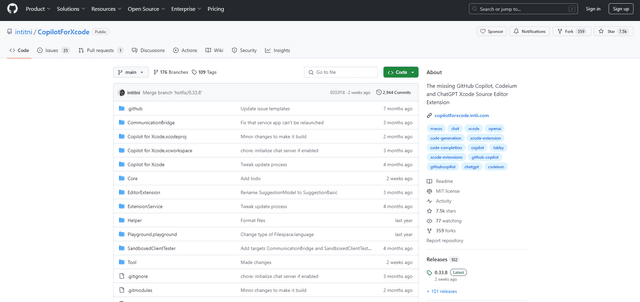
CopilotForXcode
CopilotForXcode is an Xcode Source Editor Extension that integrates GitHub Copilot, Codeium, and ChatGPT to provide AI-powered code suggestions, chat assistance, and prompt-to-code functionality within Xcode.
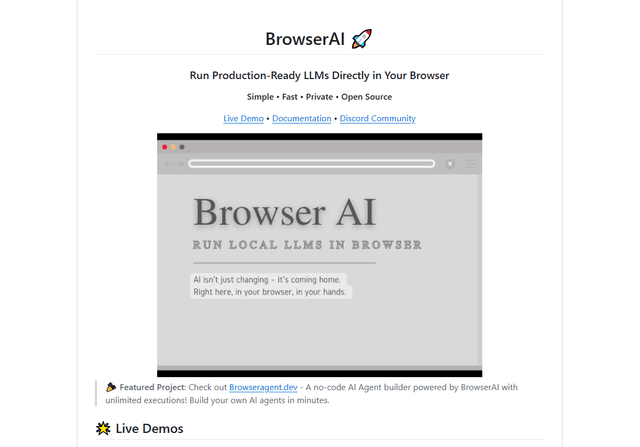
BrowserAI
BrowserAI is an open-source library that enables running local Large Language Models (LLMs) directly in web browsers with WebGPU acceleration, offering privacy-focused AI capabilities without requiring server infrastructure.
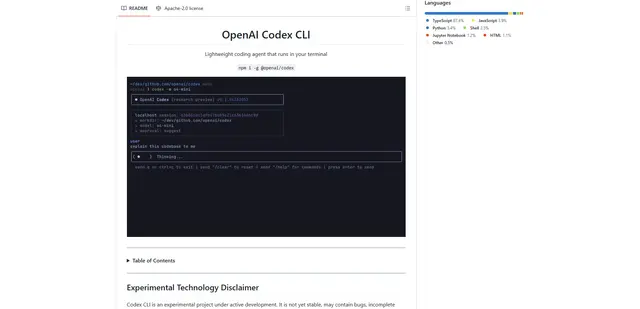
OpenAI Codex CLI
OpenAI Codex CLI is a lightweight, open-source coding agent that runs in your terminal, enabling developers to translate natural language into code execution while providing ChatGPT-level reasoning with the ability to run code, manipulate files, and iterate under version control.