
Weavable
WebsiteFree Trial
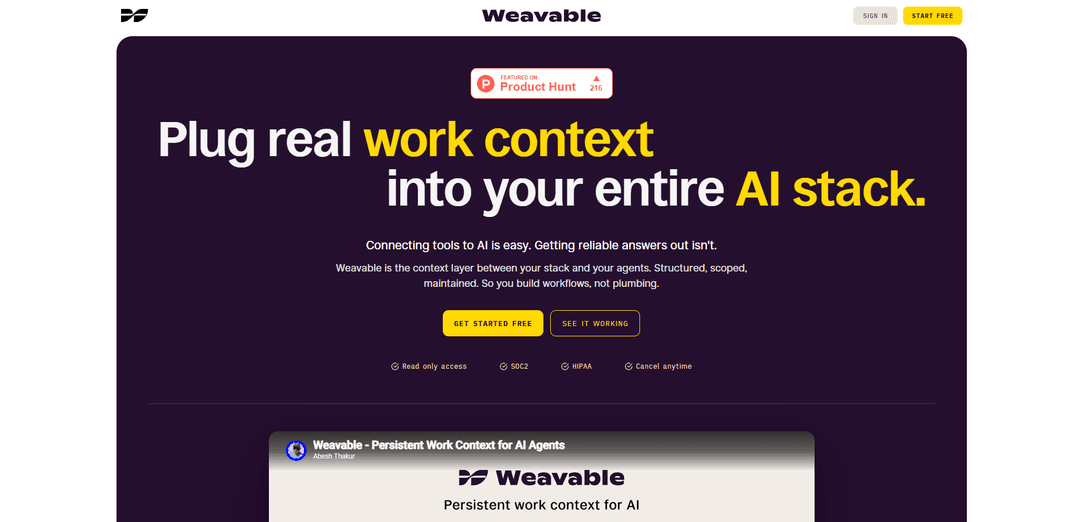
Weavable is a SOC2/HIPAA-ready context layer that connects 20+ work tools via read-only OAuth and exposes a single MCP endpoint, delivering structured, scoped, continuously maintained context for more reliable AI-agent answers with fewer tokens.
https://weavable.ai/?ref=producthunt
Product Information
Updated:May 18, 2026
What is Weavable
Weavable is a “persistent work context” platform designed to sit between your organization’s tools and your AI agents. Instead of letting models pull raw, fragmented data from systems like Slack, Jira, and HubSpot and decide relevance on the fly, Weavable helps teams define a stable context perimeter once—what tools, projects, channels, and pipelines matter for a workflow—and then keeps that context current over time. It’s built for teams that want dependable agent behavior across clients (e.g., Claude, Cursor, ChatGPT, or internal agents) without hosting their own MCP server, vector database, or ingestion pipeline, and it emphasizes read-only access, scoping, and auditability.
Key Features of Weavable
Weavable is a “context layer” that sits between your company’s tools and AI agents, turning scattered, raw tool data into structured, scoped, continuously maintained work context. It connects 20+ tools via a single OAuth flow, lets teams define a data perimeter for each workflow, and then builds a live cross-tool graph that tracks changes over time (changelog-based) so agents get consistent, relevant context with lower token usage and more deterministic outputs. Weavable exposes this as a single MCP endpoint usable across clients like Claude, Cursor, and ChatGPT, with enterprise controls such as audit logs, REST access, and SOC2 Type II + HIPAA assurances via read-only, scoped access.
Tool connectivity via one OAuth flow: Connect 20+ workplace tools in minutes without hosting your own MCP server or managing credentials; Weavable centralizes access setup for workflows and teams.
Scoped context definition (data perimeter): Select the specific tools, projects, channels, and pipelines a workflow should include, so models only see what’s relevant and permitted—reducing context flooding and drift.
Cross-tool entity resolution & connected graph: Automatically maps relationships across systems (e.g., tickets, threads, deals) so agents reason over a unified graph rather than disconnected API fragments.
Continuous changelog, not point-in-time snapshots: Tracks what changed, when, and how it relates across tools over time, enabling answers based on accumulated history rather than a single query-time pull.
Single portable MCP endpoint for any AI client: Expose one MCP endpoint that can be used across Claude, Cursor, ChatGPT, or internal agents, making the same maintained context reusable across teams and clients.
Governance & trust controls: Read-only OAuth with explicit scoping, query logging/audit trail, and enterprise options like SSO/SAML and private instances; positioned as SOC2 Type II + HIPAA certified and not used for training.
Use Cases of Weavable
Engineering delivery & incident context: Unify Jira tickets, Git commits, CI/CD runs, and team chat into a consistent context graph so coding agents or copilots can answer “what changed and what’s blocked” reliably.
Sales/account intelligence across tools: Link CRM deals, support tickets, and customer Slack threads by account and timeline to power account briefings, renewal risk summaries, and consistent “what’s happening with Acme” updates.
Customer support & escalation workflows: Provide agents a scoped, cross-tool view of conversations, prior issues, and active work so AI assistants generate more accurate responses and escalation summaries without over-sharing data.
Compliance-minded knowledge access (regulated teams): Enable teams in healthcare/finance or other regulated settings to give AI agents only approved, read-only slices of operational data with audit logs and controlled sharing.
Organization-wide internal copilots: Standardize context for internal AI assistants across departments by sharing a maintained context endpoint (instead of per-user/per-app connections), improving consistency across clients.
Pros
Deterministic, scoped context can reduce answer drift and context-window overload compared to raw tool connections.
Cross-tool graph + continuous changelog improves “what changed” and relationship-aware reasoning over time.
Single MCP endpoint and centralized OAuth simplify rollout across multiple AI clients and team members.
Read-only, scoped-by-design access with SOC2 Type II + HIPAA positioning and audit logging supports higher-trust deployments.
Cons
Read-only access means it won’t execute write actions (e.g., create tickets, update CRM) directly—may require additional tooling for full agentic automation.
Value depends on supported integrations and correct scoping/entity resolution; gaps in tool coverage could limit usefulness for some stacks.
Teams may still need governance decisions (what to include/exclude) to avoid omitting critical context or over-restricting workflows.
How to Use Weavable
1) Create an account and start a free trial: Go to https://weavable.ai/ and choose “Get started free” (the site indicates a 30-day free trial for the Individual plan). Complete signup to access the Weavable app.
2) Connect your tools via OAuth: In Weavable, use the single OAuth flow to connect the tools you want Weavable to read from (the site notes 20+ tools can be connected). No separate per-user OAuth or self-hosted server is required.
3) Define (scope) the work context for a workflow: Choose exactly which tools and which parts of those tools matter for the workflow (e.g., specific projects, channels, pipelines). This scoping defines the data perimeter—what AI can and cannot see.
4) Let Weavable build and maintain the connected context graph: After scoping, Weavable resolves entities across tools and maps relationships (e.g., linking a deal, a ticket, and a Slack thread). It also tracks changes continuously via a changelog so the context stays current over time.
5) Plug Weavable into your AI client using the MCP endpoint: Use Weavable’s single MCP endpoint inside the AI client(s) you already use (the site lists Claude, Cursor, ChatGPT, or internal agents). This makes the same scoped, pre-processed context available across clients.
6) Query your work using the scoped context: Ask workflow questions in your AI client (e.g., “what’s happening with Acme?”). The model reasons over Weavable’s scoped, ranked, connected graph rather than raw, unfiltered tool outputs.
7) Share context with teammates (without sharing credentials): For team usage, share the Weavable context endpoint so others get the exact access you defined. Revoke access centrally when needed, instead of managing per-user tool credentials.
8) Use logs and programmatic access when needed: Use Weavable’s audit trail (query logging) for traceability, and use the REST API to access contexts programmatically if you want to integrate Weavable into scheduled automations or internal systems.
9) Keep workflows stable as upstream tools change: Rely on Weavable’s “zero maintenance” approach: it absorbs upstream changes (renamed channels, restructured projects, schema changes) so your AI workflows don’t break when your tools evolve.
10) Configure enterprise controls (optional): If you need organization-level controls, use the Teams/Custom options described on the site (e.g., shared team contexts, SSO/SAML via Okta/Google Workspace, access logs, private instances).
Weavable FAQs
Weavable is a persistent work-context layer for AI agents that sits between your tools and your AI clients/agents, providing structured, scoped, maintained context so workflows get more reliable answers.
Weavable Video
Popular Articles

Atoms: A Multi-Agent AI Platform That Transforms Ideas into Launch-Ready Products
May 22, 2026

Nano Banana SBTI: What It Is, How It Works, and How to Use It in 2026
Apr 15, 2026

Atoms Review — The AI Product Builder Redefining Digital Creation in 2026
Apr 10, 2026
Kilo Claw: How to Deploy and Use a True "Do‑It‑For‑You" AI Agent(2026 Update)
Apr 3, 2026