
Tinfoil
Tinfoil is a verifiably private AI chat and inference platform that keeps prompts confidential using secure hardware enclaves, client-side encryption, and in-browser integrity/attestation verification.
https://chat.tinfoil.sh/?ref=producthunt

Product Information
Updated:May 18, 2026
What is Tinfoil
Tinfoil is a privacy-focused AI service that offers both a consumer chat app (Tinfoil Private Chat) and a developer-friendly inference API designed so that sensitive prompts and files remain inaccessible to the provider. It emphasizes “verifiable privacy,” pairing powerful open-source models with a security architecture that prevents Tinfoil, cloud providers, and network intermediaries from reading user data. Users can try the web chat at chat.tinfoil.sh, and developers can integrate via an API base URL (api.tinfoil.sh) to build private AI applications.
Key Features of Tinfoil
Tinfoil is a verifiably private AI chat and inference platform that uses secure hardware enclaves (e.g., AMD SEV-SNP / Intel TDX with modern NVIDIA GPUs) plus cryptographic verification (attestation and code integrity via Sigstore/TUF-style measurements) to ensure that only the model running inside the enclave can read user prompts. It offers an OpenAI-compatible API and a consumer chat app (chat.tinfoil.sh) with features like encrypted local-first chat storage, optional encrypted cloud backups and multi-device sync, shareable conversation links designed to preserve privacy, and premium UX features such as higher rate limits, speech-to-text, and projects for chatting with files.
Verifiable privacy via secure enclaves: Runs models inside hardware-backed confidential environments and exposes real-time verification (hardware attestation + integrity checks) so users can verify the inference stack is genuine and unmodified.
Zero-access AI chat experience: Designed so that neither Tinfoil, cloud providers, nor intermediaries can read chat content—only the model in the verified enclave can access plaintext prompts.
OpenAI-compatible developer API: Provides an OpenAI-style chat completions interface (with SDKs) to build apps where user prompts remain confidential from the inference provider.
Client-side encrypted, local-first storage: Chats are stored locally by default and can be persisted with encryption on the user device (e.g., AES-GCM-256) with keys controlled by the user.
Encrypted backups and multi-device sync: Extends end-to-end privacy to cloud persistence and syncing so users can access chats across devices without giving the provider access to content.
Productivity features for chat workflows: Includes premium features like generous rate limits, speech-to-text voice input, and “projects” to chat with files.
Use Cases of Tinfoil
Regulated enterprise assistants (finance/health/legal): Deploy confidential AI assistants for sensitive documents and conversations where prompts and outputs must remain private and verifiable for compliance and risk control.
Confidential developer tooling: Power secure code assistants or internal copilots that can reason over proprietary codebases without exposing source code or prompts to the model host.
Private consumer AI for sensitive queries: Use the chat app for personal topics (medical, financial, HR, therapy-like conversations) with stronger guarantees that providers cannot read the content.
Privacy-preserving AI features in SaaS products: Embed Tinfoil’s OpenAI-compatible endpoint into existing apps (search, summarization, support, analytics) to offer “confidential AI” modes to customers.
Government and on-prem-like security in the cloud: Support agencies or contractors who want cloud-scale AI while maintaining on-prem-style confidentiality through attestation and enclave-based isolation.
Pros
Verifiable security model (attestation + code integrity) reduces blind trust in the provider
OpenAI-compatible API and SDKs simplify adoption for existing AI applications
End-to-end privacy principles extend to storage via client-side encryption, backups, and multi-device sync
Cons
Privacy guarantees depend on users correctly verifying attestations and trusting the verification tooling/supply chain
Some advanced features (higher limits, projects, voice input) are gated behind a premium subscription
Enclave-based deployments can constrain debugging/observability and may limit certain customizations compared with standard hosting
How to Use Tinfoil
1) Use Tinfoil Chat in the browser: Open https://chat.tinfoil.sh. Start a “New Chat” and type your prompt. Your chats are stored temporarily in the current browser tab unless you create an account for persistent storage. Review the Terms of Service and Privacy Policy links on the page.
2) (Optional) Sign in for persistent chat storage: From the chat UI, create an account or log in so conversations can be stored beyond the current browser tab/session (the page notes that otherwise chats are only saved locally/temporarily).
3) Install the Tinfoil CLI (if you want command-line access): Install the `tinfoil` command-line tool (requires Go). If you hit permission errors during install or use, run commands with `sudo` as needed. After installation, run `tinfoil --help` to see available commands (e.g., `chat`, `attestation`, `http`, `proxy`, `audio`, `tts`).
4) Chat from the CLI: Run `tinfoil chat -m <model-name> "<your prompt>"`. You must specify the model with `-m`. You can use either a friendly model name (e.g., `deepseek`) or a full versioned name (e.g., `deepseek-r1-0528`) when available.
5) Verify an enclave manually (attestation): Use the attestation verifier to confirm an enclave is running the expected code: `tinfoil attestation verify -e inference.tinfoil.sh -r tinfoilsh/confidential-model-router`. The tool prints INFO logs for each verification step (fetching release, fetching Sigstore bundle, verifying measurements, etc.).
6) Use the API via the Python client (OpenAI-compatible): Set your API key (e.g., `export TINFOIL_API_KEY=...`). Then: `from tinfoil import TinfoilAI; import os; client=TinfoilAI(api_key=os.getenv('TINFOIL_API_KEY')); resp=client.chat.completions.create(model='llama3-3-70b', messages=[{'role':'user','content':'Hi'}]); print(resp.choices[0].message.content)`.
7) Use the API via the Python async client (streaming): Use `AsyncTinfoilAI` and stream tokens: `from tinfoil import AsyncTinfoilAI; client=AsyncTinfoilAI(api_key=os.getenv('TINFOIL_API_KEY')); stream=await client.chat.completions.create(model='llama3-3-70b', messages=[{'role':'user','content':'Say this is a test'}], stream=True); async for chunk in stream: ...`.
8) Use the API with explicit enclave + repo (Python): If you need to target a specific enclave/repo: `client=TinfoilAI(enclave='models.default.tinfoil.sh', repo='tinfoilsh/default-models-nitro', api_key='<API_KEY>'); resp=client.chat.completions.create(model='model-name', messages=[{'role':'user','content':'Hi'}])`.
9) Use the API from JavaScript/TypeScript: Install/import the SDK and call chat completions: `import { TinfoilAI } from 'tinfoil'; const client=new TinfoilAI({ enclave:'models.default.tinfoil.sh', repo:'tinfoilsh/default-models-nitro', apiKey:'<API_KEY>' }); const completion=await client.chat.completions.create({ model:'model-name', messages:[{ role:'user', content:'Hello!' }] }); console.log(completion.choices[0].message.content);`.
10) Use the API from Swift: Create a client and request a completion: `import TinfoilKit; let client=TinfoilAI(apiKey:'<API_KEY>', enclave:'models.default.tinfoil.sh', repo:'tinfoilsh/default-models-nitro'); let completion=try await client.chat.completions.create(messages:[.user(content:'Hello!')], model:'model-name'); print(completion.choices[0].message.content)`.
11) Use the API from Go: Create a secure client and call chat completions (OpenAI-style params): `client := tinfoil.NewSecureClient('models.default.tinfoil.sh','tinfoilsh/default-models-nitro'); chatCompletion, err := client.Chat.Completions.New(ctx, openai.ChatCompletionNewParams{ Messages: openai.F([]openai.ChatCompletionMessageParamUnion{ openai.UserMessage('Say this is a test'), }), Model: openai.F('model-name'), })`.
12) (Optional) Run other CLI features: Explore additional CLI commands depending on your use case: `tinfoil http` (verified HTTP requests), `tinfoil proxy` (local HTTP proxy), `tinfoil audio` (transcribe with Whisper), `tinfoil tts` (text-to-speech). Use `tinfoil <command> --help` for exact flags.
Tinfoil FAQs
Tinfoil Chat (TFC) is a free and open-source (FOSS) peer-to-peer messaging system that uses a high-assurance hardware architecture to protect users from passive collection, man-in-the-middle (MITM) attacks, and remote key exfiltration.
Popular Articles

Atoms: A Multi-Agent AI Platform That Transforms Ideas into Launch-Ready Products
May 22, 2026

Nano Banana SBTI: What It Is, How It Works, and How to Use It in 2026
Apr 15, 2026

Atoms Review — The AI Product Builder Redefining Digital Creation in 2026
Apr 10, 2026

Kilo Claw: How to Deploy and Use a True "Do‑It‑For‑You" AI Agent(2026 Update)
Apr 3, 2026
Latest AI Tools Similar to Tinfoil
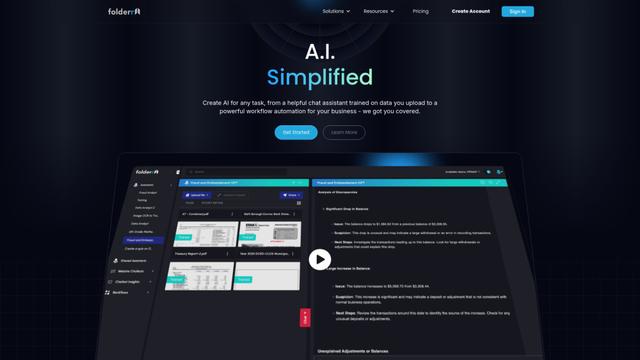
Folderr
Folderr is a comprehensive AI platform that enables users to create custom AI assistants by uploading unlimited files, integrating with multiple language models, and automating workflows through a user-friendly interface.
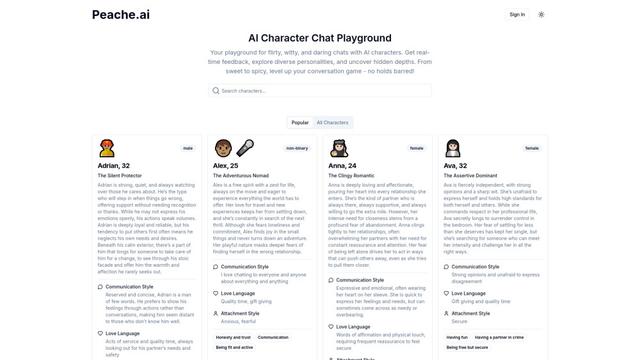
Peache.ai
Peache.ai is an AI character chat playground that enables users to engage in flirty, witty, and daring conversations with diverse AI personalities through real-time interactions.

TalkPersona
TalkPersona is an AI-powered video chatbot that provides real-time human-like conversation through a virtual talking face with natural voice and lip-sync capabilities.

Thaly AI
Thaly AI is an AI-powered sales assistant that automates customer conversations and lead qualification to help businesses scale their sales operations while saving time.
Popular AI Tools Like Tinfoil

GPT‑5.5 | ChatGPT Official
GPT‑5.5 in ChatGPT is OpenAI’s latest work-focused model designed to understand complex goals, use tools effectively, check its work, and carry multi-step tasks (coding, research, documents, spreadsheets) through to completion with stronger safeguards.
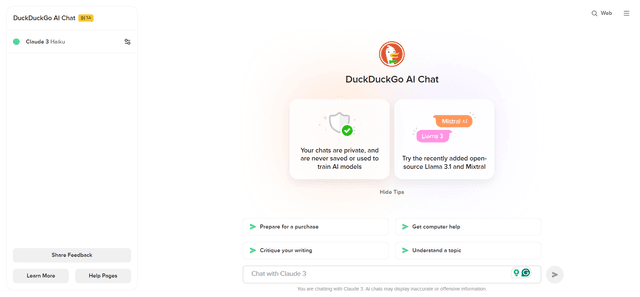
DuckDuckGo AI Chat
DuckDuckGo AI Chat is a free, anonymous way to access popular AI chatbots like GPT-3.5, Claude, and others while preserving user privacy.

Arch
Arch is an intelligent Layer 7 gateway built on Envoy Proxy that provides secure handling, robust observability, and seamless integration of prompts with APIs for building fast, robust, and personalized AI agents.

Off-grid LLM over Radio
A platform that integrates Large Language Models (LLMs) with Meshtastic mesh communication networks to enable off-grid AI interactions and automated task execution through radio communication.