
Monid
WebsiteFreemium
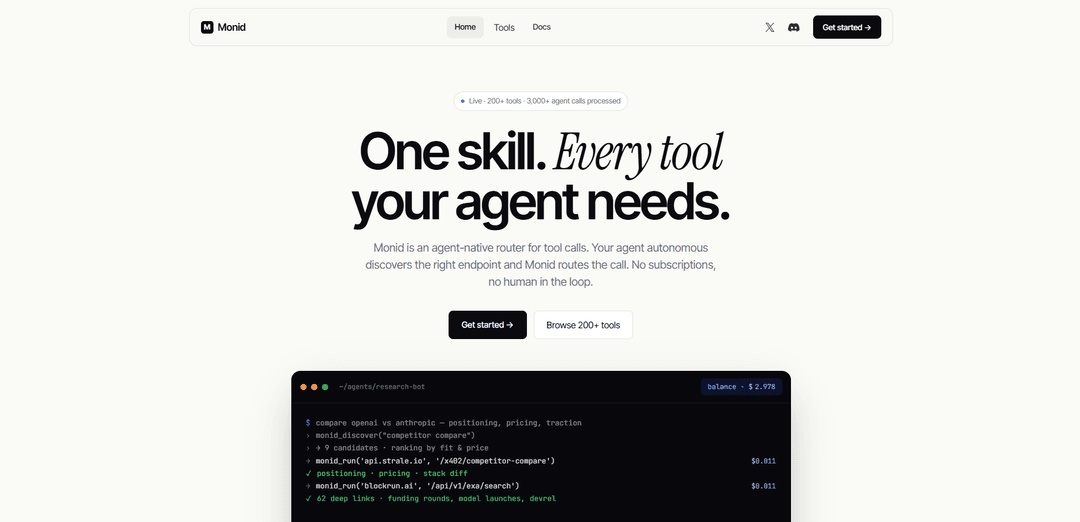
Monid is an agent-native router that lets AI agents discover, pay for, and call 200+ data and automation tools across many providers using a single balance and a drop-in skill/MCP integration.
https://monid.ai/?ref=producthunt
Product Information
Updated:May 18, 2026
What is Monid
Monid is a “tool router” for AI agents—often described as an OpenRouter for agent tools—that removes the need to manually wire up dozens of APIs, subscriptions, and keys. Instead of developers picking and integrating each vendor, an agent can describe the data or action it needs (e.g., social posts, reviews, product listings, news), and Monid helps the agent find suitable endpoints and execute calls through one unified system. Monid supports a wide range of web-access and data providers (including scraping and data extraction services) and is designed to work in agent environments via a skill, CLI, or MCP support.
Key Features of Monid
Monid is an agent-native router for tool/API calls that lets an AI agent discover the right data endpoints via natural-language queries, inspect schemas, and execute calls through a single metered balance. It abstracts away provider-specific API keys and subscriptions, returns structured/normalized JSON responses, and can be used via a CLI, a “skill,” or as an MCP server so agents can access web data sources (e.g., social, reviews, product listings) and automate research and operations workflows end-to-end.
Natural-language endpoint discovery: Agents can search for the best-fit tools/providers by describing the task (e.g., “twitter posts”), and Monid returns candidate endpoints with pricing and input schemas.
Single balance, pay-per-call metering: Usage is debited per request from one shared wallet/balance across many providers—no seat licenses, subscriptions, or separate billing setups.
Schema inspection & typed inputs/outputs: Supports inspecting endpoint schemas before running, and delivers JSON-typed, structured results to make automation and downstream parsing reliable.
Provider-agnostic routing layer: Acts like an “OpenRouter for agent tools,” routing calls to the appropriate endpoint so agents can choose tools by quality/fit rather than API quirks.
Agent-friendly integrations (Skill, MCP, CLI): Works in environments like IDE agents and terminals via the Monid skill, remote MCP compatibility, and CLI commands (discover/inspect/run).
Broad web data access via 200+ tools: Unlocks many data sources across 30+ providers for tasks like social scraping, reviews monitoring, product/market research, and enrichment.
Use Cases of Monid
E-commerce trend & competitor research: An agent pulls signals from Instagram/TikTok/Amazon and other sources to identify DTC trends and summarize market opportunities automatically.
Creator content intelligence: Creators/teams fetch top-performing Reddit/Instagram posts in a niche, detect emerging formats, and generate repurposed content briefs.
B2B sales lead gen & enrichment: A research SDR agent qualifies inbound leads, enriches contacts (e.g., from LinkedIn-style sources), and drafts outbound emails with minimal tooling overhead.
Review monitoring for local services: Restaurants/clinics route Google/Yelp/Facebook reviews into an agent that flags 1-star reviews quickly and posts context to Slack.
Automated news + social listening: An agent discovers and runs news and social endpoints (e.g., Google News + X scraping) to produce weekly updates with citations and sentiment cues.
Pros
Consolidates many tools/providers into one balance and workflow, reducing subscription sprawl and key management.
Agent-friendly discovery + schema inspection speeds up building reliable automations.
Pay-per-call pricing is efficient for intermittent workloads and experimentation.
Cons
Coverage/quality depends on third-party providers and endpoints available in the registry.
Costs can become unpredictable at scale if agents make many calls without strong budgeting/guardrails.
Some targets (social platforms, reviews) may have access limits or policy constraints depending on the underlying provider.
How to Use Monid
1) Create an account and get an API key: Go to https://app.monid.ai/ to sign up/sign in, then generate/copy your Monid API key from the dashboard.
2) Top up your Monid balance: In the Monid dashboard, add funds to your shared balance (Monid meters usage per call and debits this balance).
3) Install and set up Monid (CLI option): Install the Monid CLI, then configure it with your API key so commands can authenticate to Monid.
4) Discover endpoints with natural language (CLI): Use discovery to find tools/endpoints that match your task. Example: `monid discover -q "twitter posts"` (returns matching providers, pricing, and input schemas).
5) Inspect an endpoint to see required inputs (CLI): Pick a candidate tool and inspect its schema/parameters. Example: `monid inspect -p apify -e /apidojo/tweet-scraper`.
6) Run the endpoint and receive structured JSON results (CLI): Execute the endpoint through Monid with a JSON input payload. Example: `monid run -p apify -e /apidojo/tweet-scraper -i '{"searchTerms":["AI"],"maxItems":10}'`.
7) Use Monid directly via API (HTTP option): Call Monid from code/agents using HTTP with your API key. Example discovery request: `curl -X POST https://api.monid.ai/v1/discover -H "Authorization: Bearer <API Key>" -H "Content-Type: application/json" -d '{"query":"twitter posts","limit":5}'`.
8) Connect Monid to your agent via Skill or MCP: Add the Monid skill to an MCP-capable agent (e.g., Claude Code, Cursor, Windsurf, Claude Desktop, etc.) or use Monid’s remote MCP. Follow the setup guide referenced on the site: https://monid.ai/skill.md.
9) Let the agent route tool calls end-to-end: In your agent, ask for a task (e.g., “find news of OpenAI from this week”). The agent can: (a) discover relevant endpoints, (b) run them through Monid, (c) pay per call from your balance, and (d) return normalized, JSON-typed results.
Monid FAQs
Monid is an agent-native router for tool/API calls. An AI agent can describe what it needs in natural language, and Monid discovers the right endpoint and routes the call.
Monid Video
Popular Articles

Atoms: A Multi-Agent AI Platform That Transforms Ideas into Launch-Ready Products
May 22, 2026

Nano Banana SBTI: What It Is, How It Works, and How to Use It in 2026
Apr 15, 2026

Atoms Review — The AI Product Builder Redefining Digital Creation in 2026
Apr 10, 2026

Kilo Claw: How to Deploy and Use a True "Do‑It‑For‑You" AI Agent(2026 Update)
Apr 3, 2026