
DeepSeek V4
DeepSeek V4 is DeepSeek’s new open-source flagship MoE model series (Pro and Flash) featuring up to a 1M-token context window, hybrid long-context attention for efficiency, and strong reasoning/coding and agentic capabilities across web, app, and API.
https://www.deepseek.com/
Product Information
Updated:Apr 24, 2026
DeepSeek V4 Monthly Traffic Trends
DeepSeek achieved 546.6M visits with a 142.5% growth in traffic. The R1 and V3 model releases significantly enhanced the chatbot's capabilities, making it highly competitive and cost-effective. The media attention and national support in China also contributed to its rapid user base expansion.
What is DeepSeek V4
DeepSeek V4 is a next-generation large language model family from DeepSeek, released as a preview to gather real-world feedback and delivered in two Mixture-of-Experts (MoE) variants: DeepSeek-V4-Pro and DeepSeek-V4-Flash. The series is positioned as DeepSeek’s flagship for advanced reasoning, coding, and agent workflows, while remaining open source/open weight in line with DeepSeek’s broader approach to democratizing high-performance AI. A defining capability is its very large context window—up to one million tokens—aimed at repository-level understanding, long document processing, and multi-step task execution with higher consistency over extended inputs.
Key Features of DeepSeek V4
DeepSeek V4 is a preview flagship open-source Mixture-of-Experts (MoE) model family aimed at high-end reasoning, coding, and agentic workflows, featuring an ultra-long 1,000,000-token context window. The series includes DeepSeek-V4-Pro (1.6T total parameters, ~49B activated) and DeepSeek-V4-Flash (284B total parameters, ~13B activated), with “Max” modes that allocate a larger thinking budget for stronger reasoning. It introduces a long-context efficiency-focused hybrid attention design (e.g., CSA + HCA) to reduce inference FLOPs and KV-cache usage at 1M context, and it is positioned for repository-scale code understanding, tool/agent integration, and cost-efficient deployment compared to many closed models.
1M-token long context: Supports up to one million tokens of context, enabling whole-repo / large-document ingestion and long-horizon agent workflows without aggressive chunking.
MoE architecture (Pro & Flash variants): Two MoE models: V4-Pro (1.6T params, ~49B activated) and V4-Flash (284B params, ~13B activated), balancing quality vs. latency/cost by activating only a subset of experts per token.
Max reasoning-effort modes: Pro-Max emphasizes stronger knowledge and reasoning; Flash-Max can approach Pro-level reasoning when given a larger thinking budget, trading speed for quality.
Hybrid attention for long-context efficiency: Combines compressed sparse attention mechanisms (e.g., CSA and HCA) to cut compute and KV-cache overhead at very long context lengths (reported large reductions vs. V3.2 at 1M tokens).
Two-stage post-training (experts → consolidation): Trains domain-specific experts via SFT and RL (GRPO), then consolidates capabilities through on-policy distillation to unify strengths across domains.
Agent/tooling orientation: Positioned for agentic tasks and integration with common agent tools, targeting workflows like multi-step debugging, codebase refactors, and automated task execution.
Use Cases of DeepSeek V4
Repository-scale coding & refactoring: Ingest large codebases in one pass to perform cross-file reasoning, consistent refactors, dependency-aware edits, and large-scale modernization (e.g., framework upgrades).
Production debugging & incident response: Analyze lengthy logs, traces, configs, and runbooks together; propose fixes and mitigation steps while maintaining global context across multiple services.
Enterprise knowledge assistants: Answer questions over large internal corpora (policies, specs, tickets, wikis) with fewer retrieval/chunking steps, improving continuity for long conversations.
Agentic automation for developer workflows: Drive tool-using agents that plan and execute multi-step tasks (code search, patch generation, test runs, PR drafting), especially where long context matters.
Large-document analysis in regulated industries: Review and compare long legal/finance/healthcare documents (contracts, filings, guidelines) with long-range consistency checks and structured summaries.
Pros
Ultra-long 1M-token context enables whole-repo and large-document workflows with less chunking.
MoE design provides strong capability at lower activated-parameter compute than dense models, improving cost/performance.
Max modes offer flexible quality/latency trade-offs for complex reasoning and agentic tasks.
Cons
Preview status may imply changing APIs, stability, and incomplete ecosystem tooling compared to mature releases.
Text-only in current preview (multimodal capability is stated as in-progress in some reports).
1M-context operation can still be resource-intensive in practice (memory/latency), even with compression optimizations.
How to Use DeepSeek V4
1) Choose how you want to use DeepSeek V4 (Chat vs API): For quick interactive use, go to the web chat at https://chat.deepseek.com/ (or use the DeepSeek mobile app). For integration into your product, use the API via https://platform.deepseek.com/.
2) Use DeepSeek V4 in the web chat (no code): Open https://chat.deepseek.com/ and start a conversation with the latest flagship model (DeepSeek-V4). This is the fastest way to test prompts and long-context workflows.
3) Create an API key (for API usage): Sign in to the DeepSeek Platform at https://platform.deepseek.com/ and create an API key. Keep it secret and do not hardcode it in source code.
4) Store your API key securely: Put the key in an environment variable (recommended) or a secrets manager. You will send it as a Bearer token in the Authorization header.
5) Call the OpenAI-compatible API endpoint: DeepSeek V4’s API follows the OpenAI Chat Completions envelope. Set your base URL to https://api.deepseek.com/v1 and send requests to the chat-completions endpoint with Authorization: Bearer <YOUR_KEY>.
6) Select the correct V4 model ID: In your request payload, set the model field to the V4 model identifier shown in your DeepSeek dashboard/documentation (the exact slug can vary; verify it before running).
7) Pick the right model variant for cost/performance: Default to DeepSeek-V4-Flash for everyday tasks and predictable spend; use DeepSeek-V4-Pro for harder/complex tasks. Both support up to 1,000,000 tokens of context.
8) Tune generation settings for your task: For code/specs, use a lower temperature (commonly ~0.2). For creative writing/ideation, use a higher temperature (commonly ~0.5). Keep temperature low when you need maximum determinism.
9) Implement safe retries for reliability: Wrap API calls in a retry helper that handles 429 and 5xx with exponential backoff. Do not automatically retry 4xx errors (treat them as request/logic bugs).
10) Use streaming and tool calling when needed: If your client already supports OpenAI-style streaming and tool/function calling, it should work by swapping the base URL to DeepSeek’s. Use streaming for faster UX and tool calling for agent workflows.
11) (Optional) Use Anthropic message format if your stack is Anthropic-shaped: If your existing client uses Anthropic’s Messages API format, point it to https://api.deepseek.com/anthropic/v1/messages and send the Anthropic-shaped payload; it routes to the same underlying model.
12) Validate outputs and keep spend visible during iteration: Review generated code and critical outputs. For quick comparisons across providers, duplicate an existing OpenAI-shaped API collection (e.g., in Apidog), swap the base URL to https://api.deepseek.com/v1, swap the model ID, and run the same prompts to compare quality and cost.
DeepSeek V4 FAQs
DeepSeek V4 is DeepSeek’s latest flagship AI model (preview released in April 2026), available on web, app, and API. It features a 1M+ token context window, strong reasoning and agent capabilities, and open weights for local deployment.
Official Posts
Loading...Related Articles

Popular Articles

Vosko AI: Localize and Dub Videos for Global Audiences
Oct 15, 2026
Atoms: A Multi-Agent AI Platform That Transforms Ideas into Launch-Ready Products
Oct 13, 2026
Nano Banana SBTI: What It Is, How It Works, and How to Use It in 2026
Apr 15, 2026

Atoms Review — The AI Product Builder Redefining Digital Creation in 2026
Apr 10, 2026
Analytics of DeepSeek V4 Website
DeepSeek V4 Traffic & Rankings
385.8M
Monthly Visits
#106
Global Rank
#6
Category Rank
Traffic Trends: Jan 2025-Jun 2025
DeepSeek V4 User Insights
00:04:49
Avg. Visit Duration
3.31
Pages Per Visit
35.45%
User Bounce Rate
Top Regions of DeepSeek V4
CN: 35.47%
RU: 7.85%
US: 5.73%
BR: 5.01%
IN: 2.93%
Others: 43.01%
Latest AI Tools Similar to DeepSeek V4
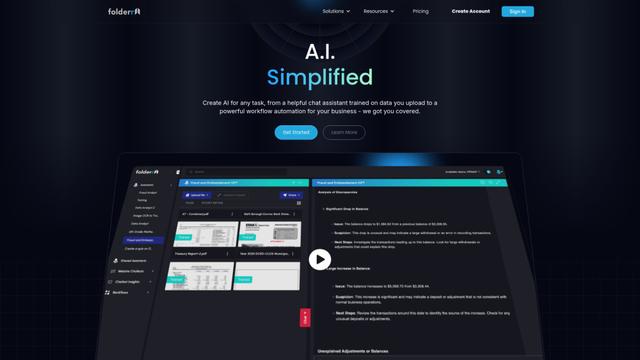
Folderr
Folderr is a comprehensive AI platform that enables users to create custom AI assistants by uploading unlimited files, integrating with multiple language models, and automating workflows through a user-friendly interface.
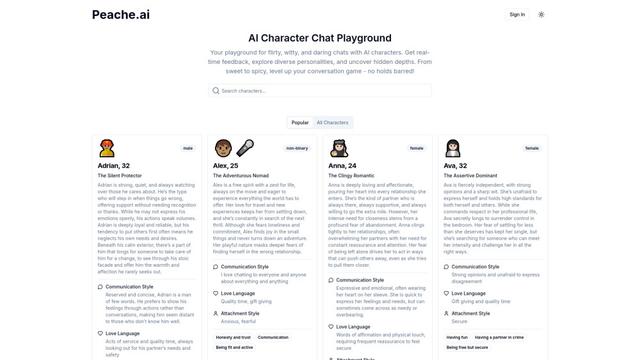
Peache.ai
Peache.ai is an AI character chat playground that enables users to engage in flirty, witty, and daring conversations with diverse AI personalities through real-time interactions.
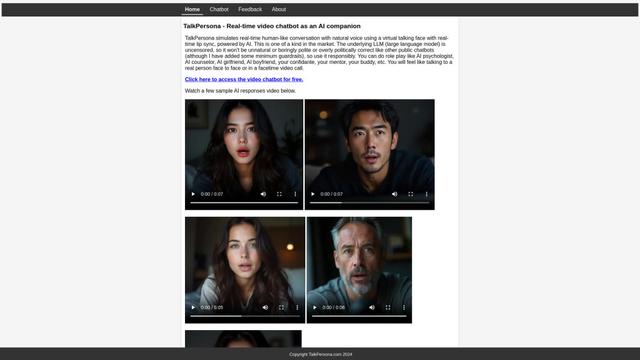
TalkPersona
TalkPersona is an AI-powered video chatbot that provides real-time human-like conversation through a virtual talking face with natural voice and lip-sync capabilities.
Thaly AI
Thaly AI is an AI-powered sales assistant that automates customer conversations and lead qualification to help businesses scale their sales operations while saving time.
Popular AI Tools Like DeepSeek V4
GPT‑5.5 | ChatGPT Official
GPT‑5.5 in ChatGPT is OpenAI’s latest work-focused model designed to understand complex goals, use tools effectively, check its work, and carry multi-step tasks (coding, research, documents, spreadsheets) through to completion with stronger safeguards.
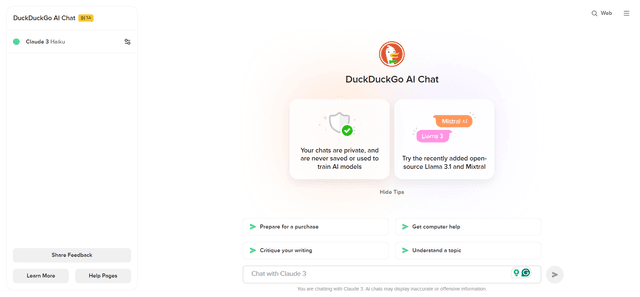
DuckDuckGo AI Chat
DuckDuckGo AI Chat is a free, anonymous way to access popular AI chatbots like GPT-3.5, Claude, and others while preserving user privacy.

Arch
Arch is an intelligent Layer 7 gateway built on Envoy Proxy that provides secure handling, robust observability, and seamless integration of prompts with APIs for building fast, robust, and personalized AI agents.
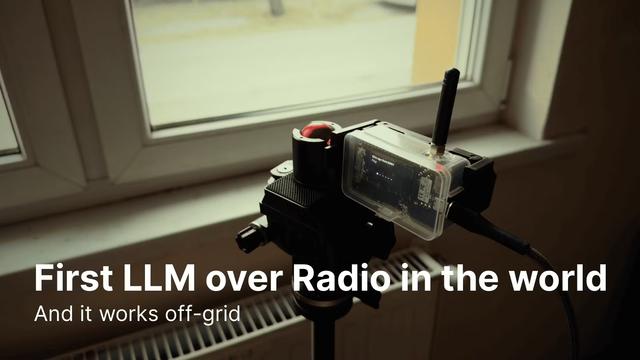
Off-grid LLM over Radio
A platform that integrates Large Language Models (LLMs) with Meshtastic mesh communication networks to enable off-grid AI interactions and automated task execution through radio communication.