
AgentLoop
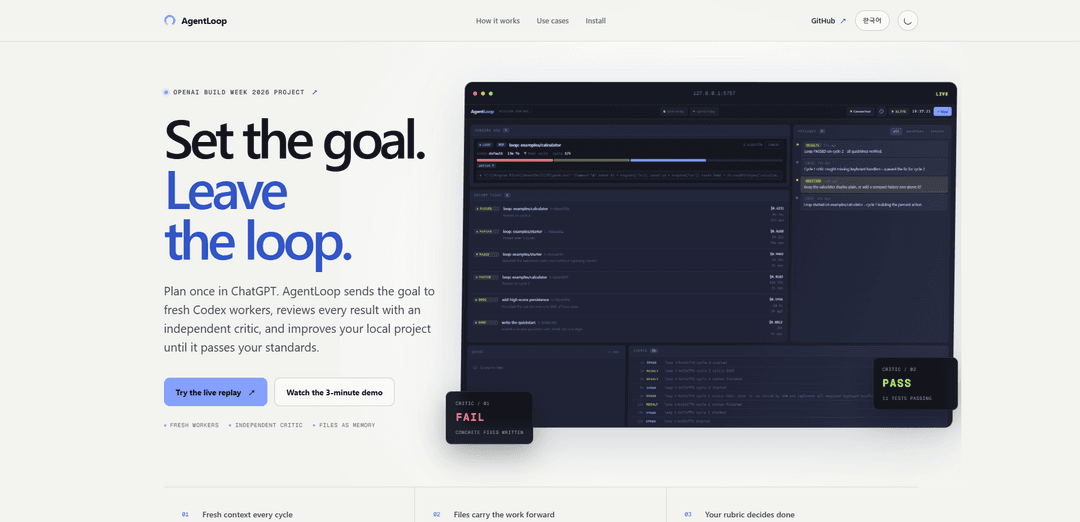
AgentLoop is a local-first agent workflow that turns a bounded goal into shipped code by running fresh Codex workers each cycle, enforcing an independent critic rubric, and using your project files as durable memory with full observability and control.
https://agentloop.tools/?ref=producthunt
Product Information
Updated:Aug 8, 2026
What is AgentLoop
AgentLoop is a developer-first system for automating the “relay work” of iterative coding with AI—planning once, then repeatedly handing off between implementation, review, and fixes until your standards are met. Built as an OpenAI Build Week project and released as a local tool (MIT-licensed), it runs where your code lives and is designed for real software tasks like features, migrations, refactors, and hardening passes. Instead of relying on a long, drifting chat context, AgentLoop keeps the goal and acceptance criteria stable (e.g., in goal.md and GUIDELINES.md) and produces auditable cycle logs so you can see exactly what happened and stop or steer when needed.
Key Features of AgentLoop
AgentLoop is a local-first, developer-oriented agent workflow tool that removes the “human relay” between planning and execution by running repeated worker→critic cycles until a user-defined rubric is met. You define a bounded goal and “definition of done” (e.g., in GUIDELINES.md), then AgentLoop dispatches fresh Codex-based workers each cycle to implement changes directly in your real repository, runs checks/tests, and uses an independent critic to review results and feed concrete fixes into the next iteration. It emphasizes observability (live dashboard, transcripts, verdicts, replay), reliability (fresh context each cycle + files as memory), and control (cycle budgets, cancelation, rubric-driven stop conditions), with an architecture that keeps planning separate from local execution via MCP and aims to stay engine-pluggable.
Fresh worker every cycle: Each iteration runs in a clean, fresh context to reduce compounding prompt drift, while still progressing via the project’s files as the durable source of truth.
Independent critic with rubric-based verdicts: A separate critic reviews the worker’s output against your standards (stored in files like GUIDELINES.md) and returns concrete fixes; the loop continues until the critic outputs a PASS/ship-level verdict.
Local-first execution in your real repo: Runs where your code lives (requires Node.js 18+, Git, authenticated Codex CLI) so changes, tests, and evidence are produced directly in the actual project environment—no hosted workspace required.
Observable, replayable agent cycles: Provides a dashboard and logs to inspect every cycle’s transcript, tool outcomes, costs, and file handoffs, plus replay tooling to understand what happened and why.
Bounded goals, budgets, and stop conditions: You set a clear goal and acceptance criteria, cap iterations with a cycle budget, and can cancel runs—keeping autonomy constrained and production-friendly.
MCP boundary and engine-pluggable direction: Uses MCP to keep planning separate from local execution and maintain a clean boundary for swapping/adding engines over time (Codex-first today, broader support implied as a roadmap).
Use Cases of AgentLoop
Autonomous feature delivery in software teams: Ship end-to-end features (UI + API + tests + docs) by giving AgentLoop a bounded goal; workers implement, critics enforce quality, and the loop iterates until the rubric says PASS.
Bug fixing with regression hardening: Triage and fix defects where “green tests” aren’t enough: the critic can catch subtle issues, require regression coverage, and drive iterative improvements until verified.
Security and quality hardening passes: Run a focused hardening goal (e.g., input handling, edge cases, robustness) with critic-driven review to ensure changes meet explicit standards and add tests for discovered weaknesses.
Codebase migrations and refactors: Execute multi-step refactors or migrations that normally require babysitting (edit files, run tests, adjust based on failures) by letting the loop handle repeated cycles and evidence collection.
Developer productivity for solo builders and startups: Replace large amounts of custom orchestration and manual back-and-forth between planning tools and coding agents with a repeatable worker/critic loop and clear observability.
Pros
Rubric-driven reliability: independent critic and explicit GUIDELINES.md-style standards help prevent “done” from being based only on passing tests.
Local-first and transparent: runs in the real repo with strong observability (dashboard, transcripts, replay), making it easier to trust and audit changes.
Fresh-context cycles reduce drift: restarting workers each cycle can improve consistency and reduce compounding mistakes over long runs.
Cons
Setup and dependency constraints: requires Node.js 18+, Git, and an authenticated Codex CLI; usefulness depends on having that environment working.
Iteration cost and time: loop-based autonomy can consume more cycles (and therefore tokens/compute) than single-pass workflows, especially on complex tasks.
Not ideal for deterministic workflows: fixed, predictable sequences may be better served by simple pipelines without the overhead of an agent loop.
How to Use AgentLoop
1) Define a bounded goal and acceptance criteria: Write down exactly what you want AgentLoop to accomplish (a feature, migration, hardening pass, polish) and make it bounded. Also define your “definition of done” as a rubric (what must be true for a PASS). The AgentLoop site suggests planning once (e.g., in ChatGPT) and then handing AgentLoop a clear goal plus standards.
2) Put your rubric in GUIDELINES.md: Create or update a file named GUIDELINES.md in your project (or in the AgentLoop working directory, depending on how you run it). This file is treated as the persistent standard: it is read each cycle and used by the critic to decide PASS/FAIL (e.g., “All tests must pass”, “Add regression coverage for every defect”, “Docs match the result”).
3) Prepare your local environment: Ensure you have Node.js 18+, Git, and an authenticated Codex CLI available (AgentLoop’s local-first instructions explicitly require these).
4) Clone AgentLoop: Run: git clone --branch v1.1.0 --depth 1 https://github.com/aiedwardyi/AgentLoop.git
5) Enter the AgentLoop directory: Run: cd AgentLoop
6) Start the local daemon where your code lives: Run the daemon process (as shown in the official instructions): node src\daemon.js. This starts AgentLoop locally so it can operate on files in the real project environment.
7) Provide the work request (goal) to AgentLoop: Give AgentLoop a concrete goal statement (example from the site: “Add CSV export across the UI, API, and regression suite.”). Keep it bounded and aligned with the rubric in GUIDELINES.md so the critic can evaluate completion.
8) Set a cycle/iteration budget (recommended): Configure a small cycle budget so the loop can’t run indefinitely (the site shows an example “cycle budget: 3”). This mirrors common agent-loop best practice: cap iterations/turns or budget to control cost and runtime.
9) Let AgentLoop run its worker→critic cycles: AgentLoop will repeatedly: (a) send the goal to a fresh worker process, (b) have the worker edit local files and run project commands/tests, (c) have an independent critic review results against GUIDELINES.md, and (d) feed critic feedback into the next cycle if it fails.
10) Use files as the persistent memory between cycles: AgentLoop’s design emphasizes “fresh context every cycle” while “files carry the work forward.” Ensure the worker is writing evidence into the repo (code changes, tests, docs, logs) so the next cycle can build on it without relying on long chat history.
11) Monitor progress and observability outputs: Track cycle-by-cycle verdicts (PASS/FAIL), transcripts, and cost/receipts via the dashboard/replay features described on the site. This is how you keep visibility while running unattended.
12) Stop or cancel if needed: If the run is going off track or you want to halt early, cancel from the dashboard (the site explicitly mentions canceling from the dashboard).
13) Confirm completion by the critic’s final verdict: A run is considered done when the critic’s final line reports “VERDICT: PASS” according to GUIDELINES.md. AgentLoop’s flow is explicitly rubric-driven: your standards decide done.
14) Review the final changes and ship: Once PASS, review the resulting code/tests/docs changes in your local project and proceed with your normal shipping workflow (commit, PR, release), using the cycle logs and critic receipts as supporting evidence.
AgentLoop FAQs
AgentLoop is a local-first agent loop tool (an OpenAI Build Week 2026 project) that lets you set a bounded goal and acceptance standards once, then it runs repeated cycles using fresh Codex workers plus an independent critic to improve your local project until it meets your rubric.
AgentLoop Video
Popular Articles

Vosko AI: Localize and Dub Videos for Global Audiences
Oct 14, 2026

Atoms: A Multi-Agent AI Platform That Transforms Ideas into Launch-Ready Products
Oct 13, 2026

Nano Banana SBTI: What It Is, How It Works, and How to Use It in 2026
Apr 15, 2026

Atoms Review — The AI Product Builder Redefining Digital Creation in 2026
Apr 10, 2026
Latest AI Tools Similar to AgentLoop
Gait
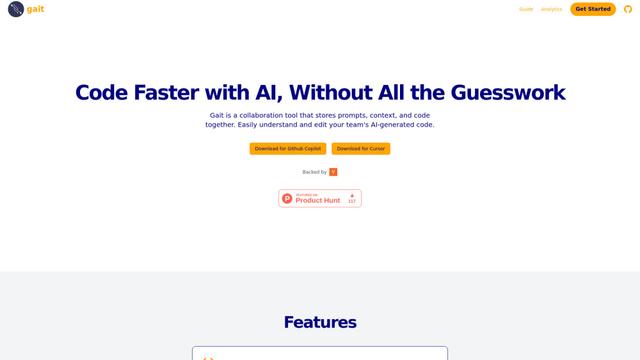
Gait is a collaboration tool that integrates AI-assisted code generation with version control, enabling teams to track, understand, and share AI-generated code context efficiently.
invoices.dev
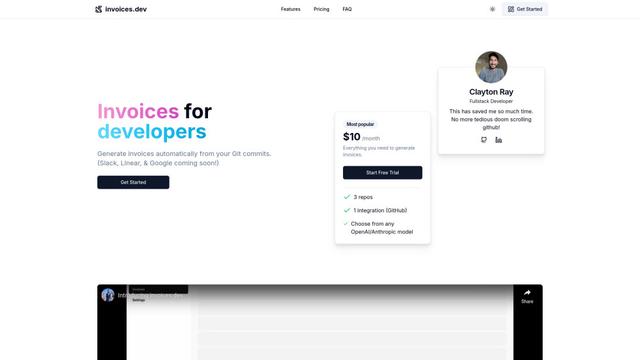
invoices.dev is an automated invoicing platform that generates invoices directly from developers' Git commits, with integration capabilities for GitHub, Slack, Linear, and Google services.
EasyRFP
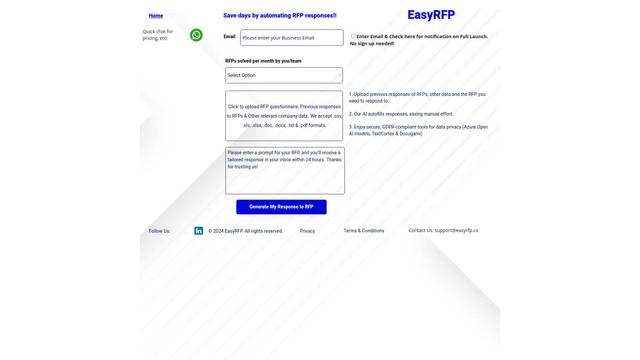
EasyRFP is an AI-powered edge computing toolkit that streamlines RFP (Request for Proposal) responses and enables real-time field phenotyping through deep learning technology.

Cart.ai
Cart.ai is an AI-powered service platform that provides comprehensive business automation solutions including coding, customer relations management, video editing, e-commerce setup, and custom AI development with 24/7 support.
Popular AI Tools Like AgentLoop

GitHub Copilot Chat
GitHub Copilot Chat is an AI-powered coding assistant that provides natural language interactions, real-time code suggestions, and contextual support directly within supported IDEs and GitHub.com.
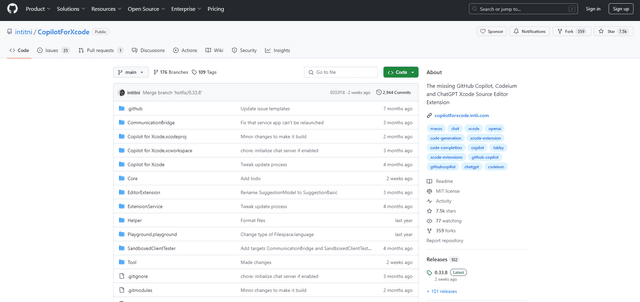
CopilotForXcode
CopilotForXcode is an Xcode Source Editor Extension that integrates GitHub Copilot, Codeium, and ChatGPT to provide AI-powered code suggestions, chat assistance, and prompt-to-code functionality within Xcode.
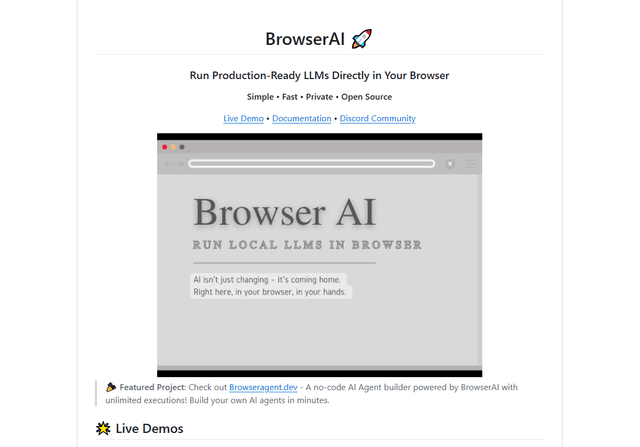
BrowserAI
BrowserAI is an open-source library that enables running local Large Language Models (LLMs) directly in web browsers with WebGPU acceleration, offering privacy-focused AI capabilities without requiring server infrastructure.
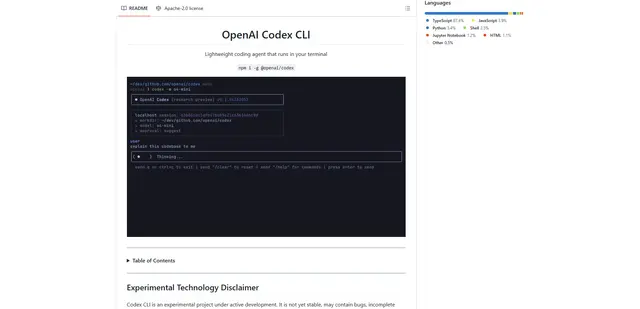
OpenAI Codex CLI
OpenAI Codex CLI is a lightweight, open-source coding agent that runs in your terminal, enabling developers to translate natural language into code execution while providing ChatGPT-level reasoning with the ability to run code, manipulate files, and iterate under version control.