
CRML
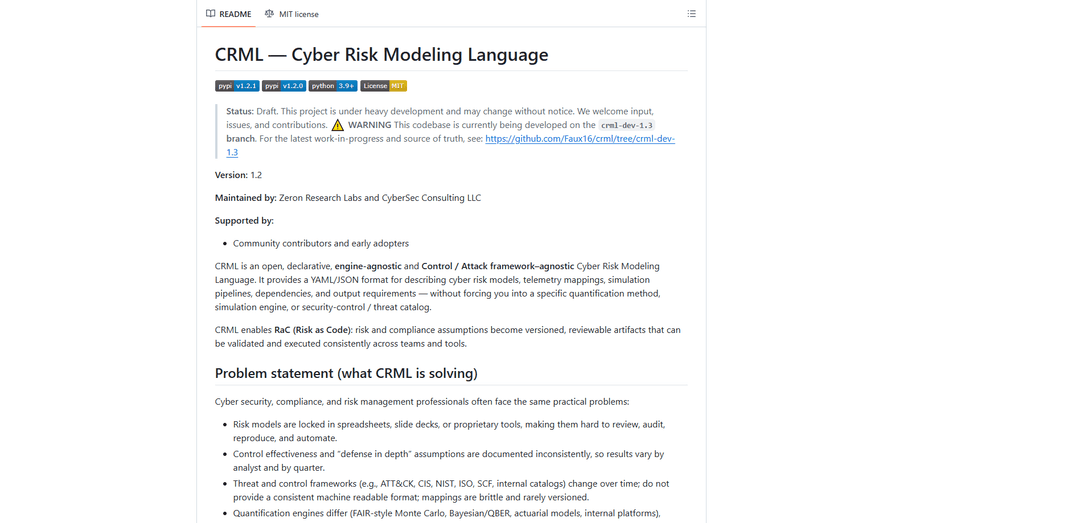
CRML is an open, declarative, implementation-agnostic language for expressing cyber risk models that enables organizations to standardize, validate and automate their risk assessment processes through code.
https://github.com/Faux16/crml?ref=producthunt
Produktinformationen
Aktualisiert:Feb 15, 2026
Was ist CRML
CRML (Cyber Risk Modeling Language) is a specialized language designed to address the challenges in cyber security risk management. It provides a YAML/JSON format for describing cyber risk models, telemetry mappings, simulation pipelines, dependencies, and output requirements without forcing users into specific quantification methods, simulation engines, or security-control frameworks. Developed and maintained by Zeron Research Labs and CyberSec Consulting LLC, CRML enables 'Risk as Code' (RaC), where risk and compliance assumptions become versioned, reviewable artifacts that can be validated and executed consistently across teams and tools.
Hauptfunktionen von CRML
CRML (Cyber Risk Modeling Language) is an open-source, declarative language designed for expressing and standardizing cyber risk models. It provides a YAML/JSON format for describing risk models, telemetry mappings, simulation pipelines, dependencies, and output requirements without being tied to specific quantification methods or security frameworks. The language enables Risk as Code (RaC), making risk and compliance assumptions versioned, reviewable artifacts that can be consistently validated and executed across different teams and tools.
Control Effectiveness Modeling: Allows quantification of how security controls reduce risk, including defense-in-depth scenarios and effectiveness parameters
Framework Agnostic Integration: Supports multiple security frameworks (ATT&CK, CIS, NIST, ISO, SCF) with flexible mapping capabilities and version control
Multi-Currency Support: Enables modeling across different currencies with automatic conversion functionality
Validation and Reproducibility: Provides strict JSON Schema validation and ensures models are reproducible across different tools and teams
Anwendungsfälle von CRML
Security Investment Analysis: Compare and justify security spending by modeling risk scenarios with and without specific security controls or investments
Regulatory Compliance: Create audit-ready documentation and evidence of risk calculations for regulatory requirements and compliance reporting
Enterprise Risk Management: Standardize risk assessment across different business units and integrate cyber risk with enterprise risk planning
Insurance and Financial Planning: Model potential cyber risks and their financial impacts for insurance coverage decisions and financial planning
Vorteile
Implementation-agnostic design allows flexibility in choosing simulation engines
Human-readable YAML format makes it easy to review and audit
Standardized approach enables consistent risk modeling across organization
Nachteile
Project is still under heavy development and may change without notice
Requires technical expertise to implement and maintain
Limited to organizations with mature risk management practices
Wie verwendet man CRML
Install CRML packages: Install either the full CLI package with 'pip install crml-engine' or just the language library with 'pip install crml-lang'. For SCF support, use 'pip install "crml-lang[scf]"'
Create CRML YAML model file: Create a YAML file defining your cyber risk model with required fields like crml_scenario version, meta information, and scenario details including frequency and severity parameters
Validate CRML file: Use the CLI command 'crml-lang validate <your-file.yaml>' or Python code 'from crml_lang import validate; report = validate("your-file.yaml", source_kind="path")' to validate your YAML model
Run simulation: Execute simulation using CLI with 'crml simulate <your-file.yaml> --runs 10000' or Python code 'from crml_engine.runtime import run_simulation; result = run_simulation("your-file.yaml", n_runs=10000)'
Use CRML Studio (optional): For visual interface: 1) Install with 'pip install crml-engine', 2) Navigate to web/ directory, 3) Run 'npm install', 4) Start with 'npm run dev', 5) Open http://localhost:3000
Import external frameworks (optional): Import security frameworks like SCF using CLI command 'crml-lang scf-import-catalog path/to/SCF_file.xlsx output-catalog.yaml'
Review and iterate: Check simulation results, validate outputs, and refine model parameters as needed. Use version control to track changes to your CRML files
CRML FAQs
CRML (Cyber Risk Modeling Language) is an open, declarative, engine-agnostic language for expressing cyber risk models, telemetry mappings, simulation pipelines, dependencies, and output requirements. It provides a YAML/JSON format for describing cyber risk models without forcing specific quantification methods or security frameworks.
Beliebte Artikel

Atoms: Eine Multi-Agenten-KI-Plattform, die Ideen in startbereite Produkte verwandelt
May 22, 2026

Nano Banana SBTI: Was es ist, wie es funktioniert und wie man es im Jahr 2026 einsetzt
Apr 15, 2026

Atoms Review – Der KI-Produkt-Builder, der die digitale Erstellung im Jahr 2026 neu definiert
Apr 10, 2026

Kilo Claw: Wie man einen echten "Do-It-For-You" KI-Agenten bereitstellt und verwendet (2026 Update)
Apr 3, 2026
Neueste KI-Tools ähnlich wie CRML
Gait
Gait ist ein Collaboration-Tool, das KI-unterstützte Codegenerierung mit Versionskontrolle integriert und es Teams ermöglicht, KI-generierten Codekontext effizient zu verfolgen, zu verstehen und zu teilen.
invoices.dev
invoices.dev ist eine automatisierte Rechnungsplattform, die Rechnungen direkt aus den Git-Commits der Entwickler generiert und Integrationsmöglichkeiten für GitHub, Slack, Linear und Google-Dienste bietet.
EasyRFP
EasyRFP ist ein KI-gestütztes Edge-Computing-Toolkit, das RFP (Request for Proposal)-Antworten optimiert und eine Echtzeit-Feldphänotypisierung durch Deep-Learning-Technologie ermöglicht.

Cart.ai
Cart.ai ist eine KI-gestützte Dienstleistungsplattform, die umfassende Lösungen zur Automatisierung von Geschäftsprozessen bietet, einschließlich Programmierung, Kundenbeziehungsmanagement, Videobearbeitung, E-Commerce-Setup und benutzerdefinierter KI-Entwicklung mit 24/7 Unterstützung.
Beliebte KI-Tools wie CRML

GitHub Copilot Chat
GitHub Copilot Chat ist ein KI-gestützter Codierungsassistent, der Interaktionen in natürlicher Sprache, Echtzeit-Codevorschläge und kontextuelle Unterstützung direkt innerhalb unterstützter IDEs und GitHub.com bietet.
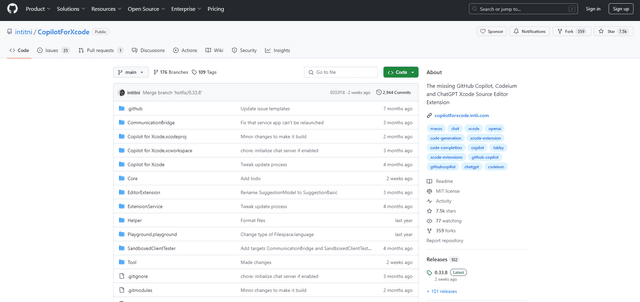
CopilotForXcode
CopilotForXcode ist eine Xcode-Quell-Editor-Erweiterung, die GitHub Copilot, Codeium und ChatGPT integriert, um KI-gestützte Codevorschläge, Chat-Unterstützung und Prompt-to-Code-Funktionalität innerhalb von Xcode bereitzustellen.
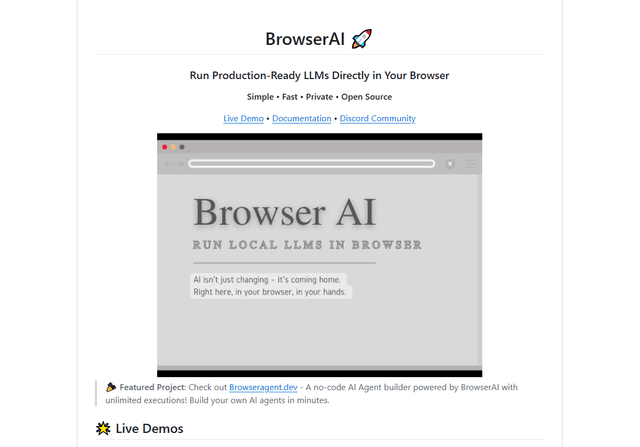
BrowserAI
BrowserAI ist eine Open-Source-Bibliothek, die die Ausführung lokaler Large Language Models (LLMs) direkt in Webbrowsern mit WebGPU-Beschleunigung ermöglicht und datenschutzorientierte KI-Funktionen bietet, ohne dass eine Serverinfrastruktur erforderlich ist.
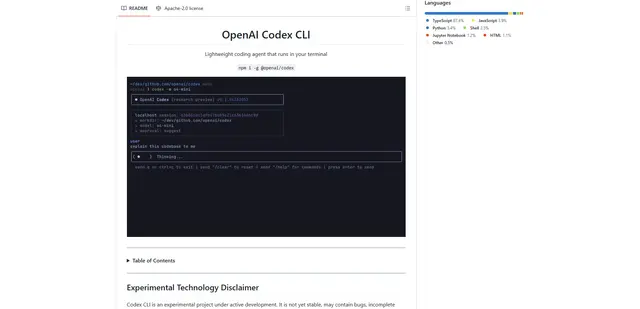
OpenAI Codex CLI
OpenAI Codex CLI ist ein schlanker Open-Source-Coding-Agent, der in Ihrem Terminal ausgeführt wird und es Entwicklern ermöglicht, natürliche Sprache in Codeausführung zu übersetzen und gleichzeitig ChatGPT-ähnliche Argumentation mit der Möglichkeit, Code auszuführen, Dateien zu bearbeiten und unter Versionskontrolle zu iterieren, bereitzustellen.