Transcribe Audio to Text
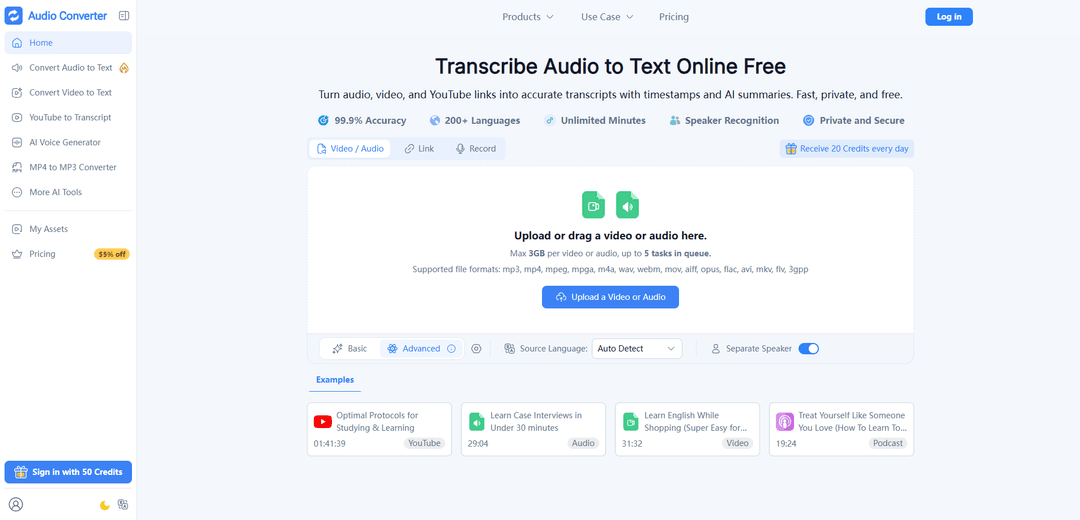
Transcribe Audio to Text is an AI-powered tool for turning spoken content into text without manual transcription. It can convert audio recordings, video files, and YouTube content into readable and editable transcripts, making it easier to capture information from conversations, interviews, meetings, podcasts, lectures, webinars, and other recordings.
https://audioconverter.ai/?utm_source=aipure
Product Information
Updated:Sep 18, 2026
What is Transcribe Audio to Text
Transcribe Audio to Text is an AI-powered transcription feature from Audio Converter AI designed to turn spoken content—such as lectures, meetings, interviews, podcasts, and videos—into editable written text quickly and easily. It supports common audio and video inputs (including uploaded files and URLs) and produces readable transcripts that can be used for notes, subtitles, documentation, content repurposing, and knowledge sharing. Built for students, educators, creators, and teams, it emphasizes speed, clarity, and workflow-friendly outputs like speaker identification, timestamps, and summaries.
Key Features of Transcribe Audio to Text
Audio Converter AI’s “Transcribe Audio to Text” converts audio/video (including URLs) into readable, editable transcripts quickly, with high-accuracy speech recognition, speaker labeling, and timestamps to make content searchable and easy to review. It also adds punctuation and paragraph breaks automatically, supports many languages for global teams and creators, and can generate AI summaries and action items to speed up note-taking and content repurposing. The product emphasizes privacy and security with encrypted processing and automatic file removal after processing, and offers a free plan with no credit card required.
High-accuracy transcription: Converts spoken audio into text with very high claimed accuracy (often cited around 99%+ for clear recordings), designed to handle lectures, meetings, interviews, podcasts, and videos.
Speaker recognition & labels: Automatically identifies different speakers and tags them (e.g., Speaker 1, Speaker 2), making multi-speaker conversations easier to follow and quote.
Timestamps for fast navigation: Adds timestamps (including word-level timestamps in some contexts) so users can jump to the exact moment in the recording and keep edits aligned with audio.
Auto formatting (punctuation & paragraphs): Improves readability by automatically inserting punctuation and detecting paragraph breaks, turning raw speech into structured text.
AI summaries & action items: Generates summaries and key takeaways (including action items) from transcripts to reduce manual note-taking and speed up review.
Multilingual support at scale: Supports a wide range of languages (commonly cited as 90–200+ depending on source), enabling transcription for international content and multilingual teams.
Use Cases of Transcribe Audio to Text
Education: lecture notes & study aids: Students and instructors can transcribe lectures/class recordings into searchable notes with timestamps and summaries for revision, course materials, and accessibility.
Business: meeting minutes & decisions: Teams can turn meetings and calls into speaker-labeled transcripts, then use summaries/action items to share outcomes and track follow-ups.
HR & recruiting: interview documentation: HR teams can transcribe interviews and training sessions to reduce admin work, improve consistency, and simplify review of key statements.
Media & content creation: repurposing workflows: Creators can convert podcasts/videos into editable transcripts to produce captions, blog posts, social snippets, and reusable content assets faster.
Research: qualitative analysis: Researchers can transcribe interviews and focus groups, search keywords, compare speakers, and extract themes without manual transcription.
Marketing: webinars & campaign insights: Marketers can transcribe webinars, customer interviews, and internal meetings to pull quotes, summarize insights, and plan content efficiently.
Pros
Fast conversion from audio/video to editable text with automated formatting (punctuation/paragraphs).
Speaker labels and timestamps make multi-speaker recordings easier to review and reference.
AI summaries/action items help users extract takeaways without re-listening.
Security-focused approach (encryption and automatic removal after processing) plus a free plan with no credit card required.
Cons
Accuracy can vary based on audio quality, background noise, accents, and speaker clarity.
Some advanced capabilities (e.g., longer files, more credits, expanded exports/features) may require an account or paid tier depending on usage limits.
How to Use Transcribe Audio to Text
1. Open Audio Converter AI: Go to https://audioconverter.ai/ in your browser to access the audio-to-text transcription tool.
2. Start a new transcription: Choose the option to transcribe audio/video to text (the site supports transcribing lectures, meetings, interviews, podcasts, and videos).
3. Upload your audio or video file: Upload the recording you want to convert into text. Audio Converter AI processes your file securely and generates an editable transcript.
4. Wait for processing to complete: Let the tool transcribe your file. The output is generated quickly and includes punctuation and paragraph breaks to improve readability.
5. Review the transcript with timestamps: Read through the transcript and use timestamps to jump to key moments in the recording for faster verification and navigation.
6. Check speaker labels (Speaker ID): If your recording includes multiple people, review the automatically detected speaker labels and confirm they match the correct speakers.
7. Use the AI summary (optional): Generate or review the AI summary to quickly capture key points and turn the transcript into notes, takeaways, or action items.
8. Export or reuse the transcript: Download or copy the final text for your workflow—such as creating notes, subtitles/captions, summaries, articles, or other reusable content assets.
9. Manage privacy and cleanup: After you finish, delete saved content if needed. The platform is designed with encryption and privacy controls, and files are automatically removed after processing.
Transcribe Audio to Text FAQs
Upload an audio or video file (or paste a URL, if available on the tool) and start transcription online. The transcript is generated automatically and can include punctuation, paragraph breaks, speaker labels, and timestamps.
Popular Articles
Atoms: A Multi-Agent AI Platform That Transforms Ideas into Launch-Ready Products
May 22, 2026

Nano Banana SBTI: What It Is, How It Works, and How to Use It in 2026
Apr 15, 2026

Atoms Review — The AI Product Builder Redefining Digital Creation in 2026
Apr 10, 2026

Kilo Claw: How to Deploy and Use a True "Do‑It‑For‑You" AI Agent(2026 Update)
Apr 3, 2026
Latest AI Tools Similar to Transcribe Audio to Text
Ticknotes
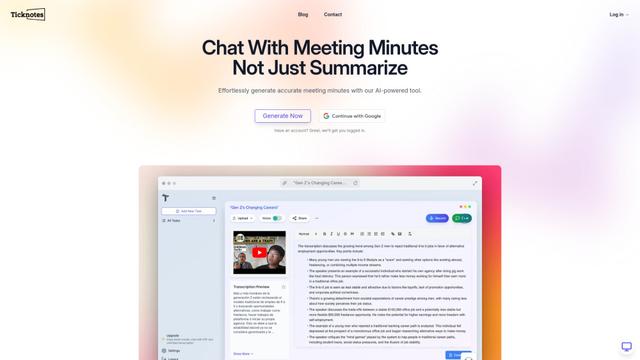
Ticknotes is an AI-powered meeting assistant that automatically records, transcribes, and generates personalized meeting summaries, action items, and key insights from audio, video, and text content.
Feta
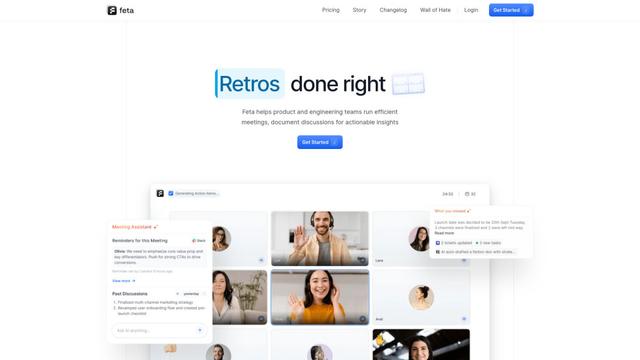
Feta is an AI-powered meeting tool that helps product and engineering teams run efficient meetings by capturing discussions, automating tasks, and providing actionable insights through smart summaries and integrations.
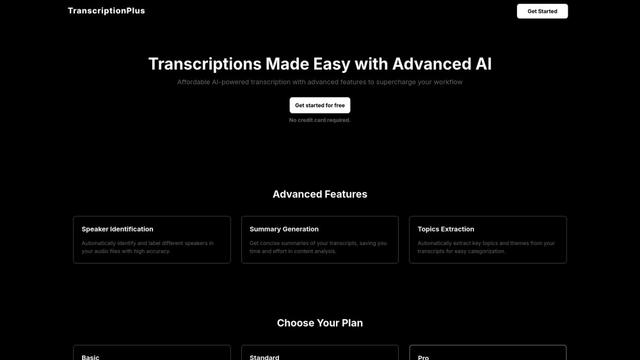
TranscriptionPlus
TranscriptionPlus is an AI-powered transcription service that offers accurate speech-to-text conversion with advanced features like speaker identification, summary generation, and multi-language support at affordable pricing tiers.
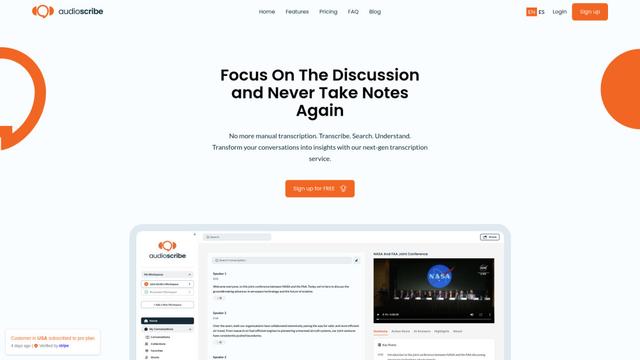
AudioScribe.io
AudioScribe.io is a revolutionary AI-powered transcription service that converts audio and video content into accurate text while offering advanced features like automated meeting recording, full-text search, and multi-language support.
Popular AI Tools Like Transcribe Audio to Text
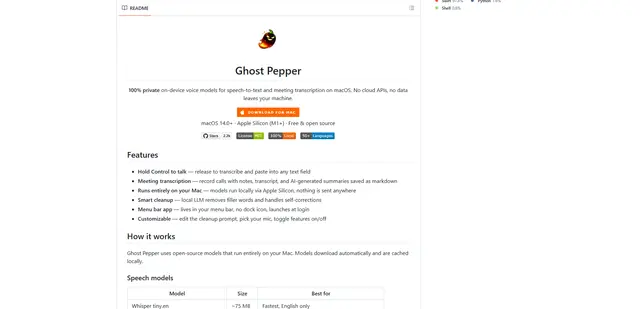
Ghost Pepper 🌶️
Ghost Pepper is a 100% local, privacy-focused speech-to-text and meeting transcription app for macOS that runs entirely on your Mac using open-source AI models, featuring hold-to-talk recording, intelligent text cleanup, and multi-language support without sending any data to the cloud.
Whisper AI
Whisper is an open-source automatic speech recognition system from OpenAI that approaches human-level accuracy and robustness for transcribing and translating speech in multiple languages.

Youtube to transcript
Youtube to Transcript is a Chrome extension that allows users to easily convert YouTube videos into text transcripts with features like multi-language support, AI-powered summarization, and downloadable formats.
inFin
inFin is a lightweight, user-friendly AI-powered voice notes app that offers unlimited recording, real-time transcription, and translation between Chinese and English, with offline capabilities and local storage for enhanced privacy.