
Traccia
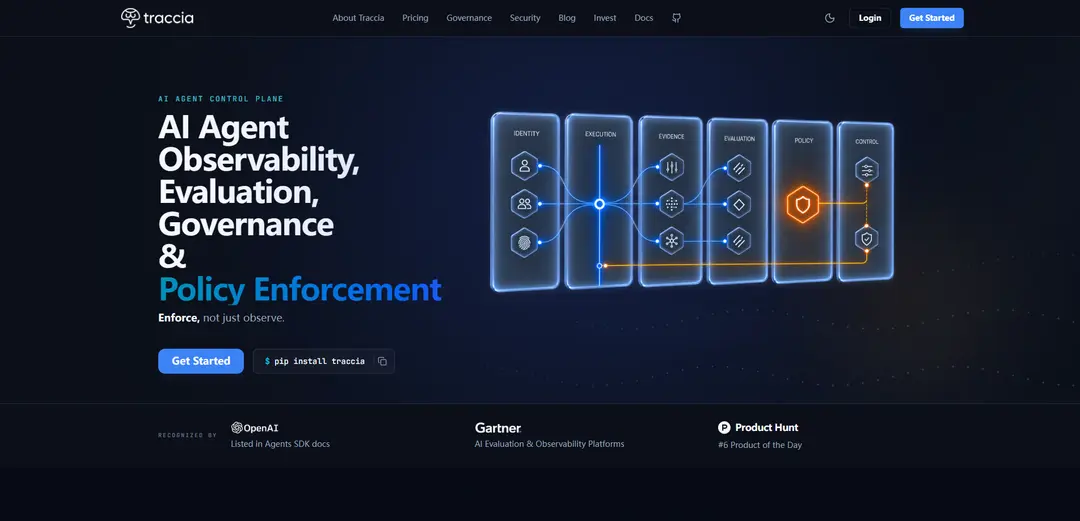
Traccia is an OpenTelemetry-native SDK and control plane for AI agents that unifies tracing, cost/token attribution, prompt registry & evals, PII detection, runtime policy enforcement, and audit-ready compliance evidence (e.g., EU AI Act).
https://traccia.ai/?ref=producthunt
Product Information
Updated:Sep 8, 2026
What is Traccia
Traccia is an agent observability, evaluation, governance, and policy-enforcement platform built on OpenTelemetry standards. It gives teams a single pane of glass to inventory and monitor AI agents across popular frameworks (including LangChain, CrewAI, and the OpenAI Agents SDK), while also tracking performance, errors, and LLM spend. Beyond monitoring, Traccia is designed for governance at scale: it supports sensitive-data controls, prompt versioning and evaluation workflows, and generates exportable evidence packs aligned to regulatory requirements such as the EU AI Act (with optional HIPAA-oriented controls).
Key Features of Traccia
Traccia is an OpenTelemetry-native Python SDK and control plane for observing, evaluating, governing, and enforcing policies across AI agents and LLM applications. It provides end-to-end tracing across agent workflows (LLM calls, tool use, decisions) and a unified agent registry across multiple frameworks, while also delivering accurate token and cost attribution via OTEL metrics that remain correct even when traces are sampled. Beyond observability, it adds runtime policy monitoring/enforcement (including hard blocks), PII/sensitive data detection with optional redaction, prompt registry and evals/experiments, and built-in compliance evidence exports aligned to EU AI Act articles with optional HIPAA-oriented controls.
OpenTelemetry-native end-to-end tracing: Captures full visibility into LLM calls, tool invocations, and agent decisions using OTEL standards, enabling distributed tracing across agentic workflows and services.
Multi-framework integrations and unified agent registry: Drop-in support for frameworks like LangChain, CrewAI, OpenAI Agents SDK, AutoGen, and LlamaIndex, plus a single inventory view of agents with ownership, environment, version, health, and execution status.
Accurate cost & token attribution (sampling-safe): Computes token and cost totals locally and emits OTEL-compliant metrics for every LLM call so spend tracking stays 100% accurate even when only a fraction of traces are exported (e.g., 10% sampling).
Policy monitoring and runtime enforcement: Detects governance violations via explicit annotations, provider-native signals, and heuristics—and can hard-block agents mid-execution to prevent runaway costs, infinite loops, or restricted-model usage.
PII/sensitive data detection and redaction controls: Flags exposure of sensitive data (e.g., credentials, patient/customer identifiers) in traces, with optional SDK-side pattern-based masking before export (init(redact_pii=True)).
Prompt registry, evals, and compliance evidence exports: Supports versioned prompts with production labels, datasets/scorers/experiments for evaluation, and audit-ready evidence packs mapped to EU AI Act requirements (with optional HIPAA-oriented controls).
Use Cases of Traccia
Enterprise agent operations (single pane of glass): Centralize monitoring of many agents across teams and frameworks, track health scores, errors, latency, throughput, and quickly identify which agent or workflow is causing incidents.
Finance and fintech cost governance: Attribute LLM spend to specific agents, tasks, models, and environments; enforce spend limits and stop runaway loops or excessive tool/LLM usage before costs escalate.
Healthcare and regulated workflows: Support compliance-oriented operations by detecting potential PHI/PII exposure, enabling redaction, and exporting evidence packs for audits (HIPAA-oriented controls are opt-in; no signed BAA indicated).
Customer support copilots and ticket automation: Trace end-to-end interactions (retrieval, tool calls, LLM responses), catch sensitive-data leaks, and enforce model/tool restrictions while maintaining reliable cost and token accounting.
AI product development and prompt iteration: Use prompt registry + evals/experiments to compare candidate prompts/models side-by-side with latency/tokens/cost, then promote changes with attached experiment evidence.
Pros
OpenTelemetry-native approach enables interoperability and avoids lock-in to a single agent framework.
Cost and token tracking remains accurate even under aggressive trace sampling via metrics emitted for every LLM call.
Goes beyond observability with runtime policy enforcement (hard blocks) to prevent issues before they reach production.
Compliance-oriented features (EU AI Act-mapped evidence, optional HIPAA controls) and PII redaction options support regulated deployments.
Cons
SOC 2 is stated as “in progress,” which may be a blocker for some enterprise procurement processes.
HIPAA capabilities are described as opt-in controls with shared-responsibility guidance and no signed BAA mentioned.
Deep cost/token automation is highlighted for OpenAI/Anthropic; other providers may rely more on generic HTTP/OTEL tracing with varying depth of coverage.
How to Use Traccia
1) Install Traccia (Python): Add the Traccia SDK to your project environment (e.g., with pip). Traccia is designed to be drop-in and OpenTelemetry-native, so you can start tracing quickly without changing your agent architecture.
2) (Optional) Create a traccia.toml for configuration: Place a traccia.toml in your project root to manage settings centrally. Traccia auto-loads configuration from traccia.toml when present, enabling type-safe configuration management (Pydantic validation) without hardcoding settings in code.
3) Initialize Traccia once at app startup: In your application entrypoint, call init() exactly once. This enables tracing, token/cost tracking, and governance features across your app. Example: `from traccia import init; init()`.
4) Enable PII redaction before export (recommended for production): If you may handle sensitive data, enable pattern-based masking at the SDK layer so sensitive strings are redacted before telemetry leaves your service. Example: `init(redact_pii=True)`.
5) Trace arbitrary Python functions with @observe: Use the `@observe()` decorator to instrument any function (business logic, tool calls, routing, etc.). Example: `from traccia import observe; @observe() def my_function(x, y): return x + y`.
6) Use framework integrations for agent-level visibility: If you use agent frameworks (LangChain, CrewAI, OpenAI Agents SDK, AutoGen, LlamaIndex), enable Traccia’s integrations so traces are captured at the level of chains/tools/agents/workflows (not just raw HTTP calls). This provides end-to-end tracing of LLM calls, tool use, and agent decisions.
7) OpenAI Agents SDK: confirm auto-instrumentation (or opt out): Traccia can auto-enable tracing for the OpenAI Agents SDK. If you need to disable it, opt out via one of: `init(openai_agents=False)`, environment variable `TRACCIA_OPENAI_AGENTS=false`, or `traccia.toml` with `openai_agents = false` under `[instrumentation]`.
8) Capture OpenAI Responses API spans (Agents SDK path): When using the OpenAI Responses API (commonly used by the Agents SDK), Traccia instruments it and emits spans such as `llm.openai.responses`, capturing model, truncated inputs/outputs, token usage, calculated cost, and response metadata.
9) Configure trace sampling without breaking cost accuracy: If you reduce trace volume with sampling (e.g., sample_rate=0.1), do not rely on traces alone for cost totals. Traccia emits OTEL-compliant metrics for token and cost tracking independent of trace sampling, keeping totals accurate even when only a fraction of traces are exported.
10) Export telemetry to an OpenTelemetry (OTLP) backend: Traccia is OTLP-compatible, so you can export traces/metrics to any OpenTelemetry backend (or Traccia’s own control plane). Configure your OTLP exporter endpoint and service identity (e.g., service.name) using your OpenTelemetry setup and/or Traccia configuration.
11) Use the Unified Agent Registry (control plane): In the Traccia UI/control plane, view all agents across frameworks in one place. Track agent version, environment, ownership, executions, health, errors, and throughput—intended to reduce switching between separate tools and dashboards.
12) Monitor cost & token attribution by agent/task/model: Use Traccia’s cost and token attribution to identify which agents and tasks drive spend. Traccia supports cost calculation across 2,500+ models and computes cost locally at span end, with metrics ensuring accuracy regardless of sampling.
13) Turn on policy monitoring & enforcement (governance): Configure governance rules to detect and respond to violations (e.g., restricted model usage, runaway costs, missing guardrails, or sensitive data exposure). Traccia supports multi-tier guardrail detection (explicit annotations, provider-native signals, and heuristics) and can hard-block agent execution mid-run.
14) Review PII & sensitive data detection findings: Inspect traces for flagged PII/sensitive data exposure (e.g., patient names, credentials, user data). Use annotations and enforcement to prevent leaks from reaching logs or downstream systems.
15) Use Prompt Registry & Playground for controlled prompt iteration: Create named prompts with immutable versions and a protected production label. Compare prompt variants and models side-by-side using latency, tokens, and cost, then load the live version from the SDK so traces link back to what shipped.
16) Run evaluations with datasets, scorers, and experiments: Curate test cases, grade outputs with built-in checks, LLM-as-judge, or custom scorers, and store immutable experiment reports. Compare baseline vs candidate and promote changes with evidence attached.
17) Generate compliance evidence packs (EU AI Act / HIPAA controls): From the Governance Hub, export audit-ready evidence packs. Traccia provides article-mapped EU AI Act evidence (e.g., Art. 12 governance event spans, Art. 14 human review, Art. 50 disclosure() support) and optional HIPAA-oriented controls for PHI-capable inventories and labeled exports.
18) Operationalize in production with security controls: Ensure no secrets are logged, apply configurable data truncation, use RBAC in the platform, and keep redaction enabled where needed. Traccia is positioned for enterprise readiness (SOC 2 Type II in progress) and supports governance at scale.
Traccia FAQs
Traccia is a platform for agent observability, evaluation, governance, and policy enforcement. It provides a unified dashboard to trace and monitor AI agents across frameworks, attribute cost/tokens, detect sensitive data exposure, enforce policies, run prompt/version management and evals, and export compliance evidence packs.
Traccia Video
Popular Articles
Atoms: A Multi-Agent AI Platform That Transforms Ideas into Launch-Ready Products
Oct 13, 2026

Nano Banana SBTI: What It Is, How It Works, and How to Use It in 2026
Apr 15, 2026

Atoms Review — The AI Product Builder Redefining Digital Creation in 2026
Apr 10, 2026
Kilo Claw: How to Deploy and Use a True "Do‑It‑For‑You" AI Agent(2026 Update)
Apr 3, 2026
Latest AI Tools Similar to Traccia

Hapticlabs
Hapticlabs is a no-code toolkit that enables designers, developers and researchers to easily design, prototype and deploy immersive haptic interactions across devices without coding.
Deployo.ai
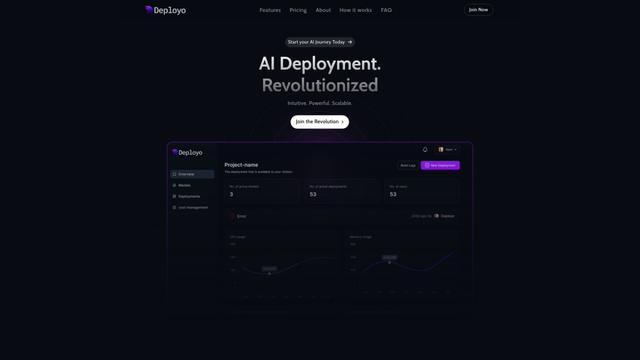
Deployo.ai is a comprehensive AI deployment platform that enables seamless model deployment, monitoring, and scaling with built-in ethical AI frameworks and cross-cloud compatibility.
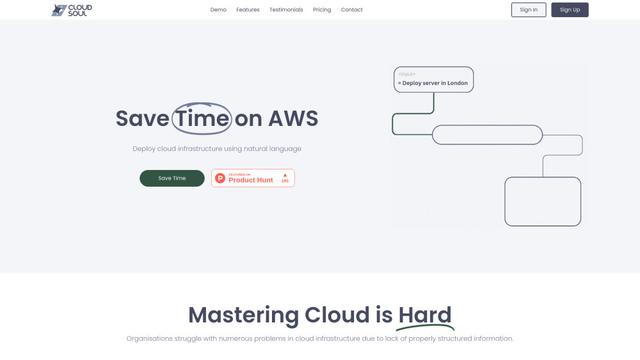
CloudSoul
CloudSoul is an AI-powered SaaS platform that enables users to instantly deploy and manage cloud infrastructure through natural language conversations, making AWS resource management more accessible and efficient.
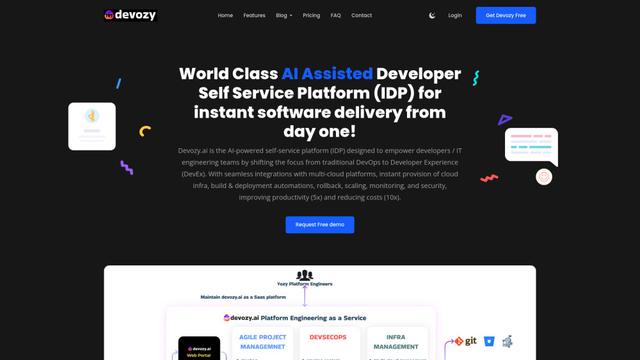
Devozy.ai
Devozy.ai is an AI-powered developer self-service platform that combines Agile project management, DevSecOps, multi-cloud infrastructure management, and IT service management into a unified solution for accelerating software delivery.
Popular AI Tools Like Traccia

A2A Protocol
A2A (Agent2Agent) Protocol is an open interoperability protocol developed by Google that enables seamless communication and collaboration between AI agents across different frameworks and vendors, regardless of their underlying architecture.
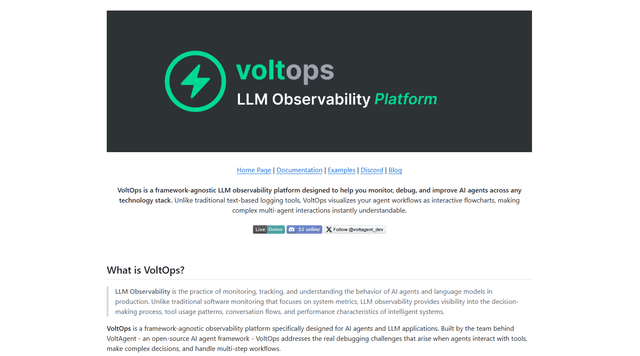
VoltOps
VoltOps is a framework-agnostic LLM observability platform that provides real-time visual monitoring, debugging, and optimization tools for AI agents across any technology stack.
Chaterm
Chaterm is an open-source AI-native terminal and SRE copilot that enables engineers to manage complex infrastructure through natural language, automating deployment, troubleshooting, and operations without memorizing commands.
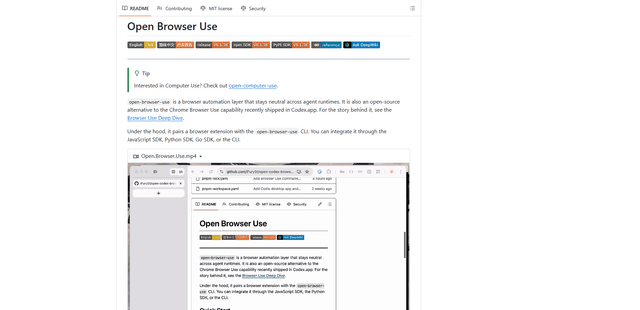
Open Browser Use
Open Browser Use is an open-source, agent-runtime-neutral browser automation layer that pairs a Chrome extension with a CLI/SDK/MCP to enable DOM-aware, CDP-powered tab control, navigation, and actions across different AI agent tools.