
Prelint
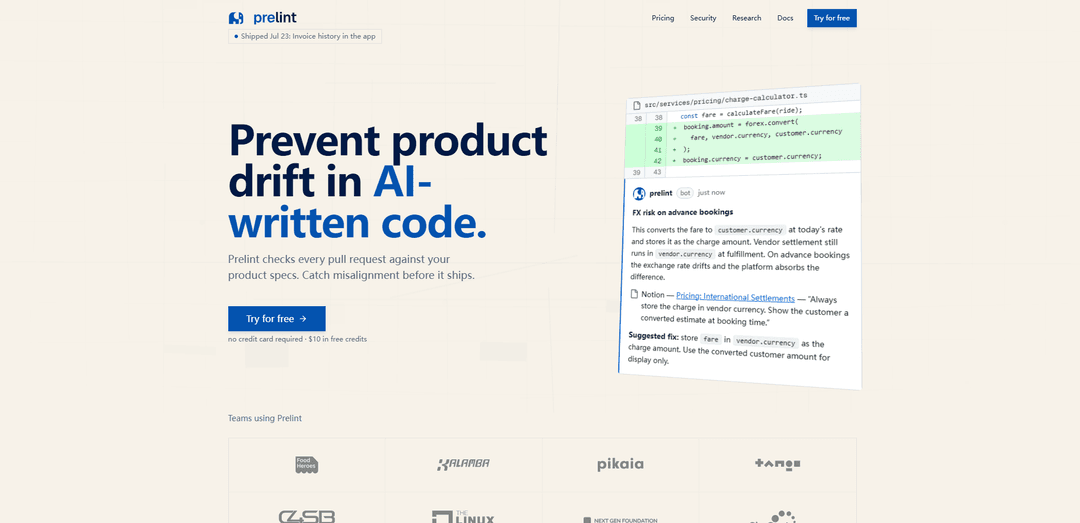
Prelint is a product-intent review tool that checks every pull request against your product specs to prevent roadmap, business-logic, and compliance drift before code ships.
https://prelint.com/?ref=producthunt
Product Information
Updated:Aug 8, 2026
What is Prelint
Prelint is a “product review for every pull request” platform designed for teams shipping fast—especially with AI coding agents. Instead of only reviewing whether code is correct, Prelint reviews whether the change matches what the company decided: product specs, business rules, compliance requirements, and tooling standards. It integrates with GitHub and GitLab, keeps specs version-controlled in the repo (e.g., Markdown or YAML), and posts automated review feedback directly on PRs so misalignment is caught early.
Key Features of Prelint
Prelint is a “product review” system that checks every pull request against your product intent—specs, business rules, compliance constraints, architecture/tooling decisions, and roadmap context—to catch product drift before changes ship. It integrates directly into GitHub/GitLab PR workflows, flags misalignment (e.g., pricing/FX risk, scope creep, terminology drift), and provides actionable suggestions so AI agents and developers can self-correct early. It emphasizes security and governance with tenant isolation, encryption, least-privilege access, and a promise not to train on customer code.
PR-based product intent enforcement: Automatically reviews each pull request for conflicts with product specs and organizational decisions—answering “Should this code exist?” rather than only “Does it work?”
Spec-driven drift detection: Compares code and spec changes to existing requirements to catch business-logic rewrites, roadmap misalignment, strategic drift, and scope creep (e.g., unnecessary i18n, premature public APIs).
Inline, actionable review comments: Posts findings directly on PRs (like a bot reviewer) with concrete explanations and suggested fixes to reduce back-and-forth and help agents self-correct.
Multi-source product context (knowledge graph): Absorbs product context such as specifications and documentation (and can connect to tools like Notion) to build a comprehensive understanding of constraints and intent.
Works with common spec formats and repo-native workflows: Supports GitHub and GitLab; specs can live alongside code in Markdown, YAML, or other structured formats—version-controlled and reviewable.
Security and data isolation controls: Runs per-organization isolated infrastructure, encrypts data in transit/at rest, uses least-privilege permissions, and states it does not train models on your code.
Use Cases of Prelint
Fintech & payments: pricing/settlement rule protection: Prevents silent changes to billing, discounts, FX handling, and settlement logic (e.g., storing charges in the wrong currency and introducing FX risk on advance bookings).
Healthcare & regulated apps: compliance guardrails in PRs: Flags data handling and retention/consent gaps early (e.g., logging sensitive identifiers without policy), reducing audit risk and compliance drift.
Enterprise SaaS: tooling and vendor standardization: Detects unauthorized infrastructure/tooling additions (e.g., adding a new messaging vendor when the org standardized elsewhere), preventing cost and operational fragmentation.
Marketplaces & logistics: domain language consistency: Stops terminology drift (e.g., “merchant” vs “vendor/seller/partner”) that creates duplicate concepts and confusion across teams and services.
AI-assisted development teams: keep agents on-spec: Lets coding agents iterate longer without human intervention by catching off-roadmap features, premature abstractions, and spec conflicts during the PR review cycle.
Pros
Catches product-level misalignment (intent/spec drift) that traditional code review, tests, and security scanners often miss.
Fits existing PR workflows (GitHub/GitLab) and keeps specs repo-native and version-controlled.
Actionable, fast feedback that helps both humans and AI agents self-correct before merge.
Strong stated security posture (tenant isolation, encryption, least privilege, no training on customer code).
Cons
Effectiveness depends on the quality, completeness, and freshness of product specs and documentation.
Primarily oriented around PR-based workflows; teams without disciplined PR/spec practices may see less value.
May generate review noise if specs are ambiguous or conflicting, requiring upfront spec hygiene to tune signal-to-noise.
How to Use Prelint
1) Put your product specs next to your code: Create or collect product constraints/specs in your repo (e.g., Markdown or YAML). Keep them version-controlled so they stay current and reviewable in pull requests.
2) Organize specs so they’re easy to review against: Group specs by domain (pricing, compliance, architecture/tooling decisions, domain language, roadmap/scope). The goal is to make it clear what rules are mandatory vs optional so Prelint can flag drift.
3) Connect Prelint to your Git provider: Install/configure Prelint for your GitHub or GitLab repositories so it can run automatically during pull request reviews.
4) Point Prelint at your spec sources: Configure which spec files in the repository should be treated as the source of truth for reviews (the product constraints Prelint checks PRs against).
5) (Optional) Import specs from Notion: From Prelint’s Sources page, connect your Notion workspace, select the pages/databases to share, then import them as compliance specs/review sources so Prelint can use them during reviews.
6) Open a pull request like normal: Have a developer or AI agent implement a feature or change a spec and open a PR. Prelint is designed to fit the existing PR workflow—no separate review process.
7) Let Prelint run an automated product review: Prelint checks the PR against your full product context (specs, business logic constraints, compliance rules, tooling decisions, domain language, and scope/roadmap). It posts findings inline on the PR.
8) Review and apply Prelint’s suggested fixes: When Prelint flags drift (e.g., pricing logic contradicts settlement specs), update the code/spec accordingly. Iterate until the PR aligns with the documented decisions.
9) Re-run by pushing updates to the same PR: Commit changes to address the feedback; Prelint re-checks the PR automatically so you can confirm alignment before merging.
10) Merge once product intent and implementation match: After Prelint’s review is clean (or acceptable), proceed with your normal engineering review and merge process.
11) Keep specs updated as decisions change: When product decisions evolve, update the spec files in the repo (or imported sources) so future PRs are checked against the latest constraints.
12) (Optional) Use Prelint for ongoing product Q&A: Use Prelint to answer “why does it work this way?” questions grounded in the specs, reducing back-and-forth and preventing future drift.
Prelint FAQs
Prelint reviews intent — not implementation. It checks every pull request against your product specs, compliance rules, business constraints, and tooling decisions, and flags misalignment when code violates what the company decided.
Prelint Video
Popular Articles

Vosko AI: Localize and Dub Videos for Global Audiences
Oct 15, 2026

Atoms: A Multi-Agent AI Platform That Transforms Ideas into Launch-Ready Products
Oct 13, 2026

Nano Banana SBTI: What It Is, How It Works, and How to Use It in 2026
Apr 15, 2026

Atoms Review — The AI Product Builder Redefining Digital Creation in 2026
Apr 10, 2026
Latest AI Tools Similar to Prelint
Gait
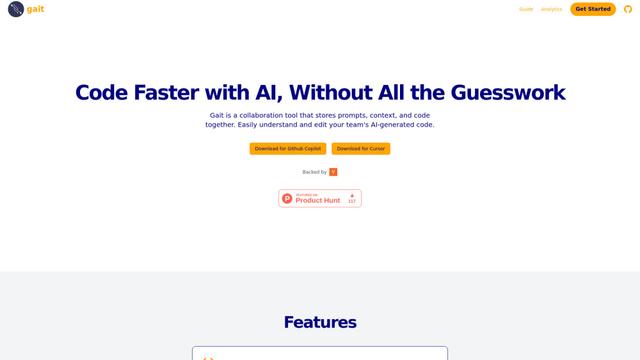
Gait is a collaboration tool that integrates AI-assisted code generation with version control, enabling teams to track, understand, and share AI-generated code context efficiently.
invoices.dev
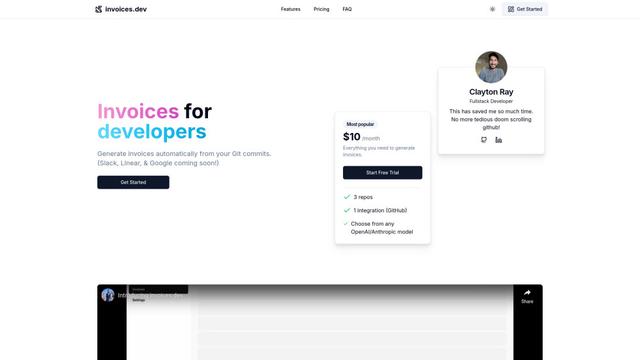
invoices.dev is an automated invoicing platform that generates invoices directly from developers' Git commits, with integration capabilities for GitHub, Slack, Linear, and Google services.
EasyRFP
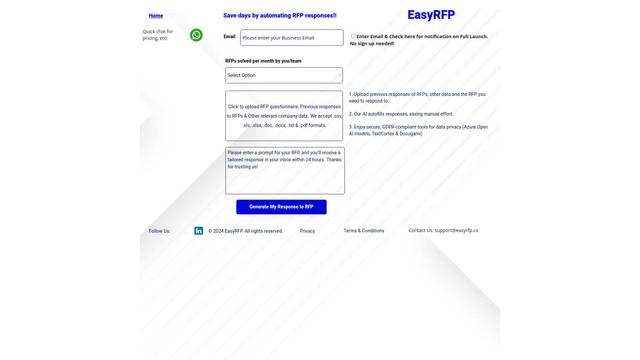
EasyRFP is an AI-powered edge computing toolkit that streamlines RFP (Request for Proposal) responses and enables real-time field phenotyping through deep learning technology.

Cart.ai
Cart.ai is an AI-powered service platform that provides comprehensive business automation solutions including coding, customer relations management, video editing, e-commerce setup, and custom AI development with 24/7 support.
Popular AI Tools Like Prelint

GitHub Copilot Chat
GitHub Copilot Chat is an AI-powered coding assistant that provides natural language interactions, real-time code suggestions, and contextual support directly within supported IDEs and GitHub.com.
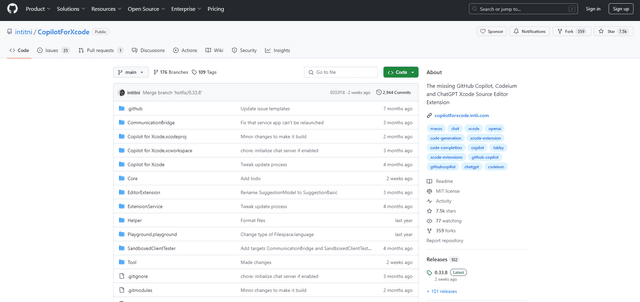
CopilotForXcode
CopilotForXcode is an Xcode Source Editor Extension that integrates GitHub Copilot, Codeium, and ChatGPT to provide AI-powered code suggestions, chat assistance, and prompt-to-code functionality within Xcode.
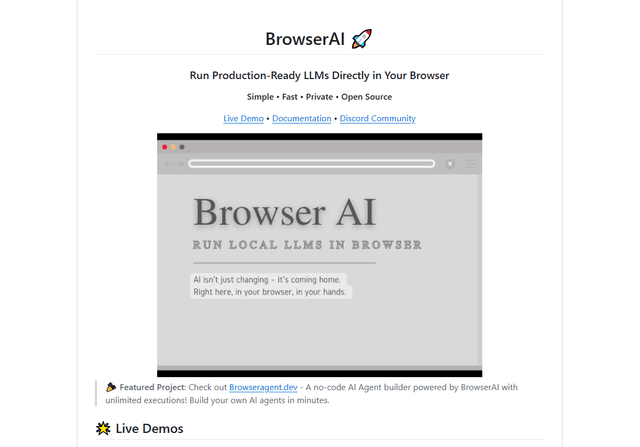
BrowserAI
BrowserAI is an open-source library that enables running local Large Language Models (LLMs) directly in web browsers with WebGPU acceleration, offering privacy-focused AI capabilities without requiring server infrastructure.
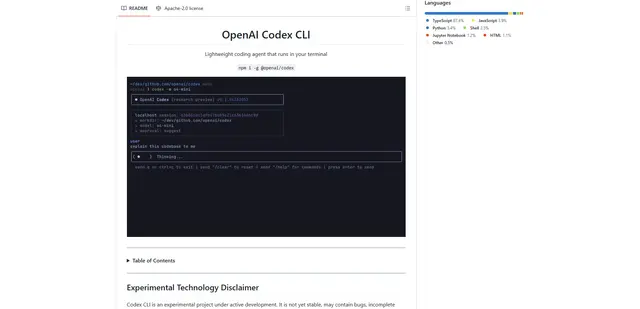
OpenAI Codex CLI
OpenAI Codex CLI is a lightweight, open-source coding agent that runs in your terminal, enabling developers to translate natural language into code execution while providing ChatGPT-level reasoning with the ability to run code, manipulate files, and iterate under version control.