
Plouton AI
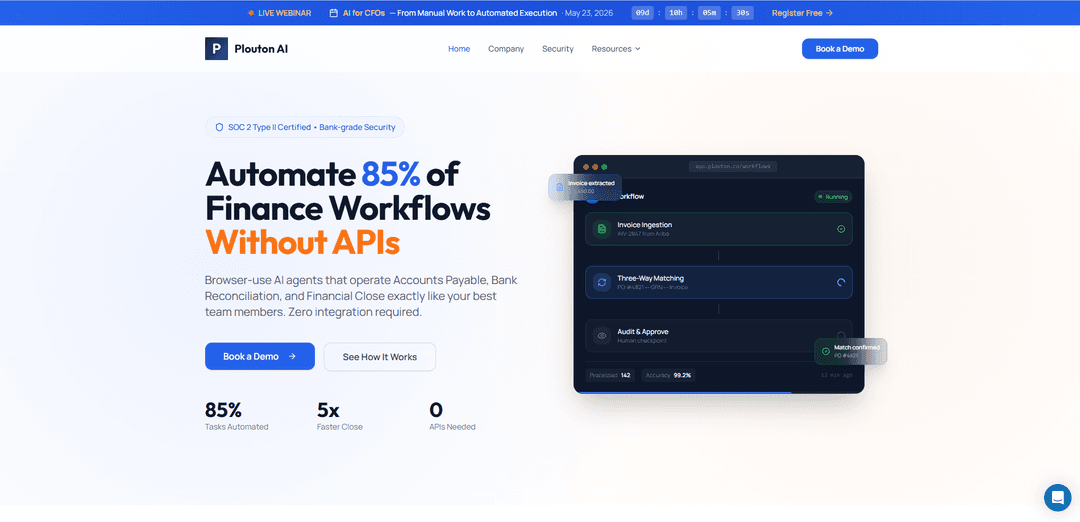
Plouton AI is a SOC 2 Type II–certified, browser-based AI agent platform that automates accounts payable, bank reconciliation, and month-end close in existing finance portals with no APIs, full auditability, and bank-grade security.
https://plouton.co/?ref=producthunt
Product Information
Updated:May 18, 2026
What is Plouton AI
Plouton AI is a finance automation product that uses browser-operating AI agents to handle high-volume, judgment-heavy workflows such as Accounts Payable, Bank Reconciliation, and Financial Close. Instead of requiring new integrations or API access, it works directly inside the tools finance teams already use (e.g., ERPs and accounting platforms) to reduce manual effort while maintaining enterprise requirements like security, transparency, and audit trails. The platform is positioned to automate a large portion of finance operations work while keeping humans in control via configurable review checkpoints.
Key Features of Plouton AI
Plouton AI provides SOC 2 Type II–certified, browser-based AI agents that automate core finance operations—accounts payable, bank reconciliation, and month-end close—by working directly inside existing ERPs and web portals without requiring APIs or traditional integrations. The platform follows a continuous control loop (connect, act, audit), extracting structured data from unstructured documents, executing workflows end-to-end, and producing regulator-ready audit trails with screen recordings and configurable human review checkpoints.
No-API browser automation: AI agents operate directly in existing ERP and vendor portals (e.g., SAP, Oracle, NetSuite, QuickBooks, Xero, Workday) without needing APIs or custom integrations.
Accounts payable workflow automation: Automates invoice ingestion and extraction from varied formats, performs three-way matching (invoice/PO/receipt), detects variances, and supports payment scheduling with exception handling.
Continuous bank reconciliation: Performs ongoing transaction matching across accounts and entities, flags discrepancies early, categorizes exceptions, and generates audit-ready documentation.
Accelerated month-end close: Systematizes close activities such as automated journal entry preparation, intercompany eliminations, variance analysis, and compliance verification to reduce close time.
Auditability and observability by design: Captures every action with screen recordings, supports configurable human-in-the-loop review gates, and produces regulator-ready audit trails with transparent reasoning.
Enterprise security posture: Built for sensitive financial data with SOC 2 Type II certification, bank-grade encryption, GDPR compliance, and a high-availability uptime SLA.
Use Cases of Plouton AI
Mid-market and enterprise finance teams (multi-system ops): Automate cross-portal finance work (AP, reconciliations, close) when data and workflows are spread across ERPs, bank portals, and internal tools—without waiting for integration projects.
Shared services centers / BPO finance operations: Standardize and scale high-volume invoice processing and reconciliations across many clients/entities, with consistent controls, recordings, and audit trails.
E-commerce and payments-heavy businesses: Reconcile high-frequency transactions across PSPs and finance systems (e.g., Stripe plus an ERP), detect mismatches quickly, and reduce revenue leakage and manual effort.
Multi-entity organizations and holding companies: Support consolidation workflows such as intercompany eliminations and multi-entity reconciliation to reduce close complexity and accelerate reporting timelines.
Regulated industries needing strong controls (e.g., fintech, healthcare, insurance): Use audit-first automation with screen recordings and human review checkpoints to maintain compliance while reducing manual processing and operational risk.
Pros
Eliminates dependency on APIs/integrations by working directly in the browser across legacy and modern systems
Strong auditability (screen recordings, review checkpoints, regulator-ready trails) suitable for controlled finance environments
Targets high-effort finance workflows (AP, reconciliation, close) with measurable outcomes (faster close, high accuracy, high automation)
Cons
Browser-driven automation can be sensitive to UI changes in third-party portals, potentially requiring ongoing maintenance
May require careful governance and configuration of human review checkpoints to align with internal controls and risk tolerance
Best fit is finance operations; organizations seeking broader automation beyond finance may need additional tools
How to Use Plouton AI
1) Confirm fit and pick a workflow to automate: Decide which finance workflow you want Plouton AI to run first (Accounts Payable, Bank Reconciliation, or Month-End Close). Choose a high-volume, repetitive process that your team currently performs in web portals (e.g., SAP/Oracle/NetSuite/QuickBooks/Xero/Sage/Workday/Dynamics/Stripe/Plaid/Expensify).
2) Book a demo / onboarding session: Go to https://plouton.co/ and use the “Book a demo” onboarding flow. Share which systems/portals you use and the exact workflow steps your team follows today (since Plouton operates in the browser and does not require APIs).
3) Prepare access to the portals the agent will use: List every portal the workflow touches (ERP, bank portal, payment provider, expense tool, etc.). Ensure you can authenticate to each one and that the accounts have the minimum permissions needed to complete the workflow steps.
4) Connect (authenticate) Plouton AI to your systems via the browser: In the Plouton AI setup, authenticate across the required legacy and modern systems. Plouton’s agents operate directly in portals (no API integrations) and can extract structured data from unstructured documents.
5) Define the workflow runbook (your current SOP): Provide the step-by-step procedure your best team member follows (what to open, what to check, what fields to fill, what rules to apply, and what constitutes an exception). This becomes the basis for the agent’s browser actions and decision reasoning.
6) Configure checkpoints for human review (optional but recommended): Set where a human must review/approve before the agent proceeds (e.g., before submitting payments, posting journal entries, or closing reconciliations). Plouton supports configurable human review checkpoints.
7) Run the workflow in “Connect → Act → Audit” mode: Start an automation run. The agent will (1) Connect: log into portals and gather required data/documents, (2) Act: reconcile, complete forms, submit entries, and trigger downstream steps based on conditions, and (3) Audit: record actions and produce an audit trail.
8) Use Accounts Payable automation (if selected): Have the agent ingest invoices (any format), extract invoice data, perform three-way matching (invoice/PO/receipt), detect variances, handle exceptions with auditable reasoning, and schedule payments according to your rules.
9) Use Bank Reconciliation automation (if selected): Have the agent continuously match transactions across statements and ledgers, flag discrepancies early, categorize exceptions, and produce audit-ready documentation for reconciled items and outstanding issues.
10) Use Month-End Close automation (if selected): Have the agent automate preparation and verification steps such as drafting/posting journal entries, intercompany eliminations, variance analysis, and compliance verification to reduce close time from days to hours.
11) Review audit artifacts for every run: After each run, review the captured evidence: screen recordings of actions taken, the reasoning behind decisions, and the regulator-ready audit trail. Use these artifacts for internal controls and compliance.
12) Iterate on exceptions and scale to more workflows: Identify recurring exceptions and refine the workflow rules/runbook. Once stable, expand to additional portals/entities and add more finance processes that scale poorly manually.
Plouton AI FAQs
Plouton AI provides browser-based AI agents that automate finance operations workflows such as Accounts Payable, bank reconciliation, and month-end close.
Plouton AI Video
Popular Articles

Atoms: A Multi-Agent AI Platform That Transforms Ideas into Launch-Ready Products
May 22, 2026

Nano Banana SBTI: What It Is, How It Works, and How to Use It in 2026
Apr 15, 2026

Atoms Review — The AI Product Builder Redefining Digital Creation in 2026
Apr 10, 2026

Kilo Claw: How to Deploy and Use a True "Do‑It‑For‑You" AI Agent(2026 Update)
Apr 3, 2026
Latest AI Tools Similar to Plouton AI
TurboDoc
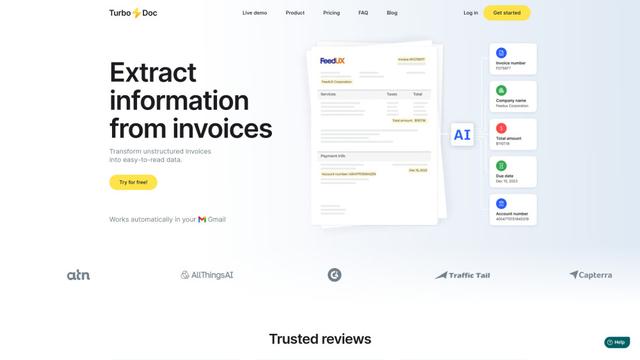
TurboDoc is an AI-powered invoice processing software that automatically extracts and transforms unstructured invoice data into organized, easy-to-read structured data through Gmail integration and intelligent document processing.
Smart Invoices
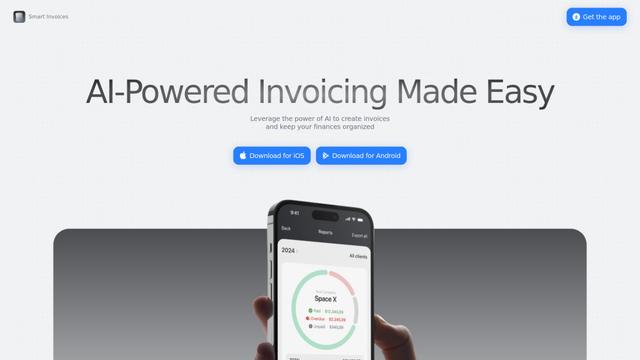
Smart Invoices is an AI-powered invoicing application that enables businesses to create, manage, and track professional invoices quickly while offering features like automated calculations, client integration, and cloud synchronization.

Spendtally
Spendtally is a smart expense tracking app that helps users manage their finances by scanning receipts, providing spending insights, and offering personalized recommendations for better deals and healthier shopping choices.

Simplify Money App
FreemiumAI Accounting Tools
Simplify Money is an AI-powered personal finance app that helps users track spending, set budgets, manage debt, and achieve financial goals through personalized insights and guidance.
Popular AI Tools Like Plouton AI
Trillion
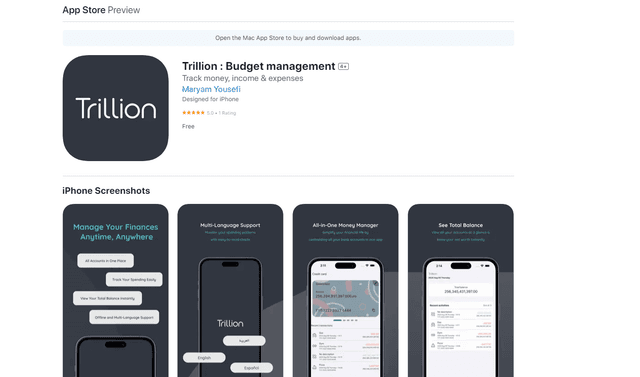
Trillion is an all-in-one personal finance app that helps users track expenses, set budgets, and manage finances across multiple currencies and accounts with an ad-free, multilingual interface.

Receipt Snapper And Scanner
Receipt Snapper And Scanner is a mobile app that allows users to instantly capture, categorize, and organize receipts through photo scanning with automatic data extraction and smart organization features.

Intuit
FreemiumAI Accounting Tools
Intuit is a global financial technology platform that provides financial management and compliance software and services for consumers, small businesses, and accounting professionals.
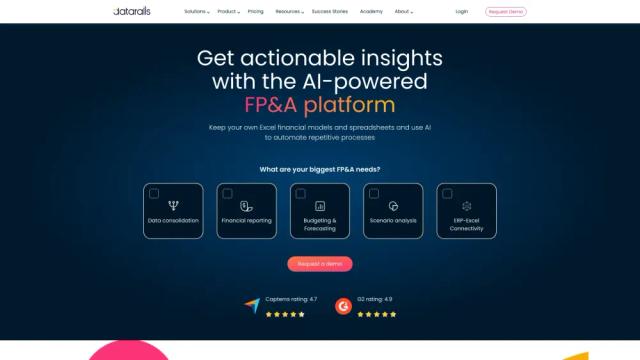
Datarails
Datarails is an AI-powered financial planning and analysis (FP&A) platform that automates financial reporting and planning while allowing finance teams to continue using familiar Excel spreadsheets.