OtoScore US
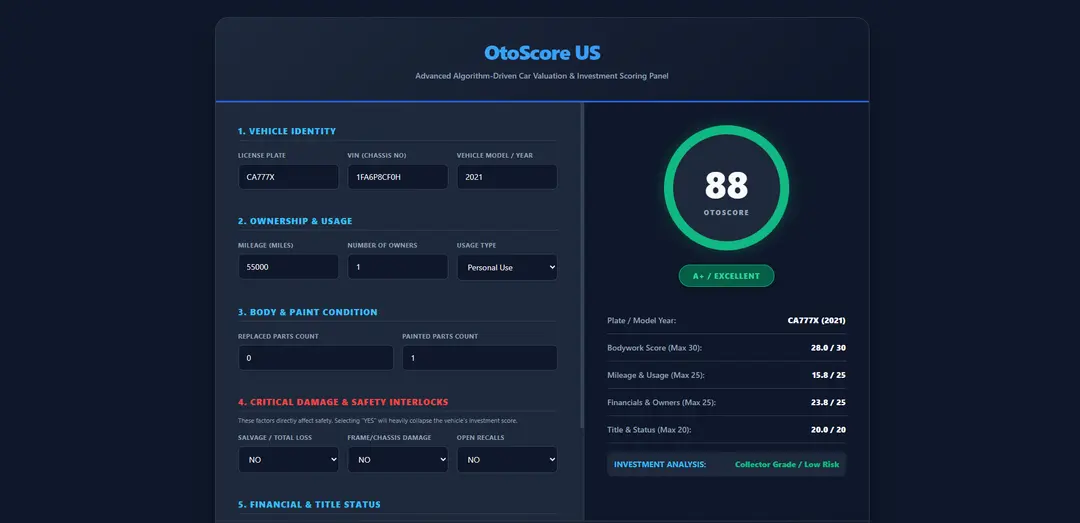
OtoScore US is a professional vehicle valuation panel that collects key identity, condition, safety, and title/financial inputs to generate an easy-to-read OtoScore with category breakdowns and an investment-grade risk analysis.
https://otoscore-us.netlify.app/?ref=producthunt
Product Information
Updated:Aug 8, 2026
What is OtoScore US
OtoScore US is a web-based vehicle evaluation tool designed to help users quickly estimate a car’s overall value and investment quality using a structured, form-driven assessment. It guides you through core vehicle details (like license plate, VIN, and model year) and then summarizes results into a single OtoScore with supporting sub-scores, giving a clear snapshot of how the vehicle stacks up across major value drivers. The output is positioned as an informational estimate rather than a certified appraisal or safety inspection.
Key Features of OtoScore US
OtoScore US is a web-based vehicle valuation and risk-scoring panel that converts key identity, usage, condition, safety, and title/financial inputs (e.g., plate/VIN, mileage, owners, replaced/painted parts, salvage/frame damage/recalls, damage record amount, and title status) into an overall “OtoScore” with sub-scores and an investment-grade style assessment (e.g., A+ / Excellent, Collector Grade / Low Risk). It’s designed to quickly standardize how a vehicle is screened and compared, while clearly flagging safety-critical factors that can heavily reduce the score.
Structured vehicle data intake: Captures core identifiers and descriptors such as license plate, VIN (chassis no), model/year, mileage, number of owners, and usage type in a consistent format.
Condition and bodywork scoring: Includes body and paint condition inputs (replaced parts count, painted parts count) to quantify exterior/repair history impact on overall quality.
Safety-critical risk flags: Explicit YES/NO inputs for salvage/total loss, frame/chassis damage, and open recalls that can heavily collapse the investment score due to safety implications.
Financial and title status evaluation: Accounts for damage record amount (USD) and title status to reflect ownership/legal/financial risk in the final score.
Composite score with sub-score breakdown: Outputs an overall OtoScore plus category sub-scores (e.g., Bodywork, Mileage & Usage, Financials & Owners, Title & Status) for transparent decision-making and comparisons.
Investment-style rating and analysis: Provides a plain-language grade and interpretation (e.g., A+ / Excellent; “Collector Grade / Low Risk”) to support quick go/no-go decisions.
Use Cases of OtoScore US
Used-car dealership intake screening: Standardize appraisal triage for trade-ins and auction buys by scoring condition, title, and safety flags before committing to purchase or reconditioning.
Auto finance and lending pre-qualification: Support risk-aware lending decisions by combining ownership history, title status, and damage indicators into a consistent vehicle quality/risk signal.
Insurance underwriting and claims triage: Use salvage/frame damage/recall and damage-record inputs to quickly identify higher-risk vehicles or those needing deeper inspection and documentation.
Fleet procurement and lifecycle management: Compare candidate vehicles for fleets (delivery, rideshare, rental) using mileage/usage and condition scoring to optimize total cost of ownership.
Private buyer decision support: Help consumers organize inspection findings and vehicle history into an easy-to-understand score and category breakdown to negotiate or walk away.
Pros
Clear, structured inputs that standardize vehicle evaluation across users
Transparent breakdown into sub-scores plus an overall grade for quick comparisons
Strong emphasis on safety-critical flags (salvage, frame damage, recalls) that materially affect risk
Cons
Score is explicitly informational and not a certified appraisal or safety inspection
Accuracy depends on the completeness and truthfulness of entered data
Limited detail shown on the exact scoring methodology/weighting beyond category caps and the “heavy collapse” warning
How to Use OtoScore US
1. Open OtoScore US: Go to https://otoscore-us.netlify.app/ to access the Professional Vehicle Valuation Panel.
2. Fill in Vehicle Identity: Enter the vehicle’s LICENSE PLATE, VIN (CHASSIS NO), and VEHICLE MODEL / YEAR.
3. Fill in Ownership & Usage: Provide MILEAGE (MILES), NUMBER OF OWNERS, and select the USAGE TYPE.
4. Fill in Body & Paint Condition: Enter the REPLACED PARTS COUNT and PAINTED PARTS COUNT to reflect bodywork and paint history.
5. Review Critical Damage & Safety Interlocks carefully: For SALVAGE / TOTAL LOSS, FRAME/CHASSIS DAMAGE, and OPEN RECALLS, select YES/NO as applicable. These factors directly affect safety, and selecting "YES" will heavily collapse the vehicle’s investment score.
6. Fill in Financial & Title Status: Enter the DAMAGE RECORD AMOUNT ($ USD) and choose the TITLE STATUS.
7. Read your OtoScore result: Review the overall OtoScore (example shown as 88) and its grade (example: A+ / EXCELLENT).
8. Review category breakdowns: Check the component scores: Bodywork Score (Max 30), Mileage & Usage (Max 25), Financials & Owners (Max 25), and Title & Status (Max 20).
9. Interpret the Investment Analysis: Use the INVESTMENT ANALYSIS summary (example: "Collector Grade / Low Risk") to understand the vehicle’s estimated investment risk/quality based on the inputs.
10. Note the limitation disclaimer: Treat the score as an informational estimate only; it is not a certified appraisal or a safety inspection.
OtoScore US FAQs
OtoScore US is a professional vehicle valuation panel that provides an informational vehicle score and investment-style analysis based on vehicle identity, usage, condition, damage/safety factors, and financial/title status.
Popular Articles

Atoms: A Multi-Agent AI Platform That Transforms Ideas into Launch-Ready Products
May 22, 2026

Nano Banana SBTI: What It Is, How It Works, and How to Use It in 2026
Apr 15, 2026

Atoms Review — The AI Product Builder Redefining Digital Creation in 2026
Apr 10, 2026

Kilo Claw: How to Deploy and Use a True "Do‑It‑For‑You" AI Agent(2026 Update)
Apr 3, 2026
Latest AI Tools Similar to OtoScore US
TubeVoice
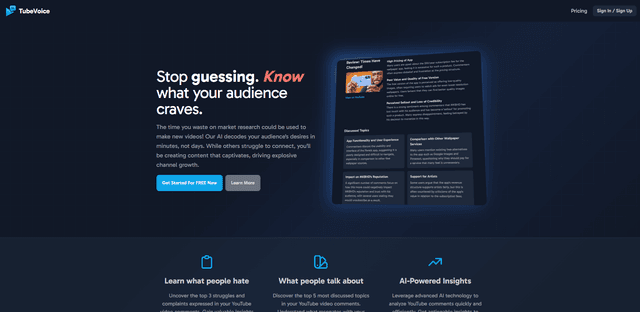
TubeVoice is an AI-powered YouTube comment analyzer that helps content creators understand their audience by providing insights from video comments through automated analysis.
ReviewPower
ReviewPower is an all-in-one platform that aggregates and analyzes trusted reviews from G2 and Capterra to help businesses gain valuable insights from customer feedback.

Insightfull
Insightfull is an AI-powered health tracking platform that helps users monitor symptoms, analyze health data, and receive personalized insights through symptom tracking, food logging, and medication management features.
SERPrecon
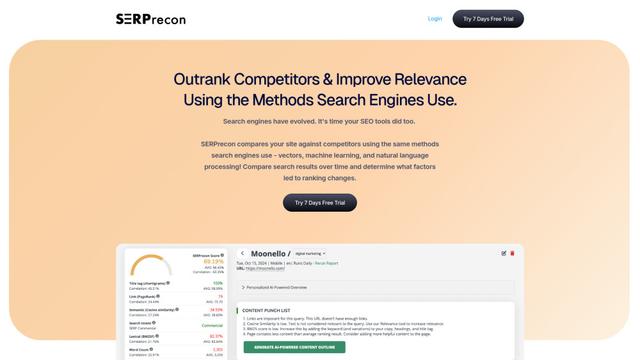
SERPrecon is an advanced SEO tool that leverages vectors, machine learning, and natural language processing to help users analyze and outrank competitors by using the same methods as modern search engines.
Popular AI Tools Like OtoScore US
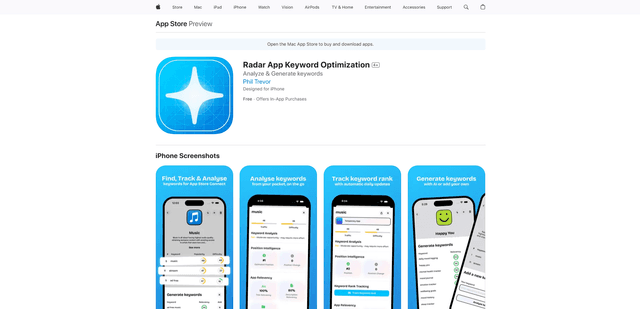
Radar
App Radar is a comprehensive app store optimization (ASO) tool that leverages AI-powered keyword research, competitor analysis, and automated tools to help improve app visibility and rankings across the Apple App Store and Google Play Store.
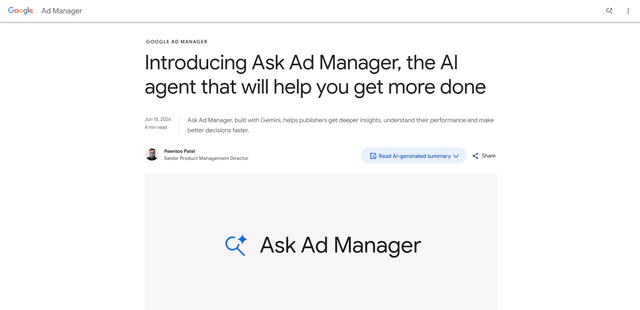
Ask Ad Manager by Google Ads
Ask Ad Manager is a Gemini-powered conversational agent inside Google Ad Manager that helps publishers troubleshoot issues in real time, generate custom performance reports from prompts, and navigate directly to the right settings using their own Ad Manager data.
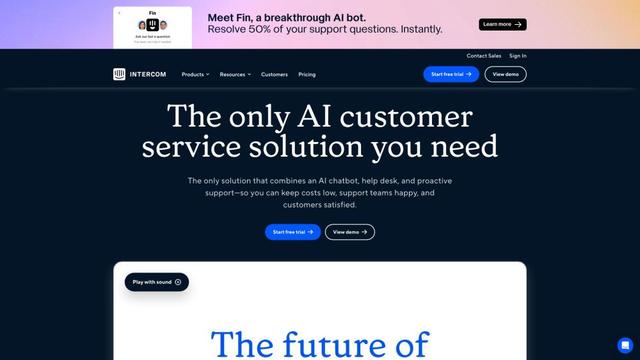
Intercom
Intercom is an AI-powered customer service platform that provides instant support, enhances agent productivity, and delivers insights to support leaders.
Branded
Branded is a market research company that uses AI and advanced sampling techniques to provide high-quality consumer insights and data.