
Naptick AI
WebsiteAppPaid
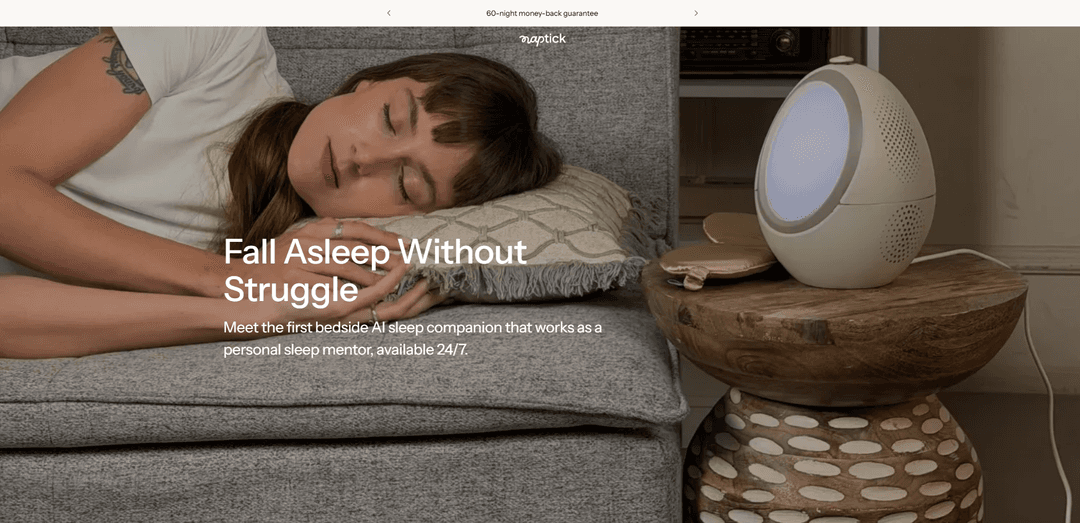
Naptick AI is an AI-powered bedside sleep companion that combines guided sleep audio, adaptive light, room-environment sensors, wearable integrations, and phone-reducing tools like app locking and voice journaling to help you fall asleep faster and wake up refreshed.
https://launch.naptick.com/?ref=producthunt
Product Information
Updated:May 18, 2026
What is Naptick AI
Naptick AI (often referred to as Naptick) is a bedside device and companion app built to improve what happens before and around sleep—especially the hard transition from being awake and mentally “on” to actually switching off. Instead of focusing only on post-sleep analytics, it provides real-time, proactive support through calming soundscapes and guided routines, an AI sleep companion for coaching and journaling, and built-in room sensing to surface environmental factors that can quietly disrupt rest. It’s positioned as an all-in-one “sleep operating system,” designed to replace phone-centered bedtime habits with a calmer, screen-free routine.
Key Features of Naptick AI
Naptick AI is an AI-powered bedside sleep companion designed to help you fall asleep faster and improve your night by combining guided sleep audio, an AI coach (“Napp”), phone-reducing tools, and real-time bedroom environment sensing. It provides voice-first support (including voice journaling), personalized guidance informed by lifestyle context and wearable integrations, and room insights (e.g., CO₂, VOCs, particulates, temperature, humidity, noise, and light) to identify and fix environmental factors that disrupt sleep. The system emphasizes actionable, habit-based recommendations over complex dashboards and can include NAPTICK+ content and features depending on the purchase tier.
AI sleep coach (“Napp”): Voice-first companion that offers calming guidance for racing thoughts, bedtime support, daily nudges, and personalized insights based on your routine (e.g., caffeine, jet lag) and trends.
1,000+ sleep soundscapes: Large audio library including guided meditations, deep-sleep tracks, nature sounds, and white/pink/brown noise, with context-aware selection to match your night.
Live room environment sensing: Tracks key bedroom conditions—CO₂, VOCs, PM2.5/PM10, temperature, humidity, noise, and light—to reveal hidden sleep disruptors and prompt improvements.
Phone-reducing bedtime tools: App-locking and screen-free routines plus voice journaling to reduce late-night scrolling and help build a consistent wind-down habit.
Ambient light + gentle wake support: Uses calming/amber lighting cues for wind-down and a softer wake experience (e.g., sunrise-style) to avoid “alarm shock” and reinforce sleep routines.
Wearable integrations + simplified insights: Works with wearable sleep data to translate signals into clear, actionable takeaways (e.g., how screen time or naps relate to REM/HRV) rather than overwhelming charts.
Use Cases of Naptick AI
Insomnia / racing-thoughts wind-down: Individuals who struggle to switch off can use AI-guided calming, voice journaling, and adaptive audio/light routines to shorten sleep onset.
Screen-time reduction for students and professionals: People prone to late-night scrolling can use app-locking and a phone-free bedtime flow to reduce post-10pm phone pickups and improve consistency.
Bedroom air-quality optimization for families: Households can monitor CO₂, particulates, VOCs, temperature, and humidity to adjust ventilation or room setup and reduce grogginess or night wake-ups.
Travel and jet-lag recovery support: Frequent travelers can use context-aware coaching (e.g., jet lag routines) and environmental cues to re-stabilize bedtime and improve recovery.
Work-from-bedroom boundary setting: Remote workers can use lighting cues and structured wind-down routines to re-associate the bedroom with sleep and reduce mental carryover from work.
Wellness programs and sleep coaching workflows: Coaches or wellness initiatives can leverage simplified, habit-based insights (paired with wearable data) to guide participants without requiring them to interpret complex sleep analytics.
Pros
All-in-one approach: combines audio, AI guidance, room sensors, and phone-reduction tools in a single system.
Actionable insights over dashboards: focuses on clear recommendations instead of overwhelming graphs.
Strong environment coverage: monitors multiple room factors (CO₂, VOCs, PM, temp/humidity, noise, light) that can quietly affect sleep.
Cons
Subscription/value depends on tier: lifetime NAPTICK+ is tied to launch-price/Founder Edition, while later buyers may get only a 90-day trial and optional plan.
May require ecosystem setup: best results can depend on using the app features (e.g., app-locking, journaling) and optionally pairing with a wearable.
Not a pure sleep tracker: positioning emphasizes improving the night rather than primarily tracking sleep, which may not match users seeking detailed tracking-only hardware.
How to Use Naptick AI
1) Get what you need: Have your Naptick bedside device, a mobile phone for initial setup, and (optionally) a compatible wearable (e.g., Apple Watch) ready. Place Naptick in a dry, indoor bedside location near where you sleep.
2) Install the Naptick iOS app: On your iPhone, download and open the Naptick app. You’ll use the app to create and manage routines and to connect the device during setup.
3) Create your account and complete onboarding: Follow the in-app onboarding to set up your profile and sleep goals. This helps Naptick personalize coaching and nightly routines.
4) Power on and set up the Naptick device: Turn on Naptick and follow the app’s setup flow to connect it to your phone. The phone is required for initial setup and for managing routines.
5) (Optional) Connect your wearable: If you use a wearable, connect it in the app so Naptick can interpret your sleep signals (such as sleep stages and restlessness) and turn them into actionable guidance.
6) Set up your wind-down routine: In the app, create a bedtime routine that uses Naptick’s guided audio, ambient lighting, and AI support. Choose what you want included (e.g., calming guidance, breathing/relaxation, soundscapes).
7) Choose your sleep audio: Pick from NAPTICK+ content (e.g., guided meditations, deep sleep tracks, nature sounds, white/pink/brown noise, binaural-style soundscapes). Save favorites to your routine so it starts quickly at night.
8) Enable phone-free bedtime tools (app locking): Turn on app-locking to reduce late-night phone pickups. Configure which apps are restricted during your wind-down and sleep window so your phone is less involved in bedtime.
9) Use voice journaling to offload racing thoughts: At bedtime, use Naptick’s voice-first experience to record a quick voice journal entry. This is designed to help calm racing thoughts and reduce mental load before sleep.
10) Start your nightly session: When you’re ready for bed, start your routine (by tapping the device/app or using voice). Let Naptick run the selected audio and lighting cues to help you switch off.
11) Review room environment insights: Check Naptick’s bedroom environment readings (temperature, humidity, CO2, VOCs, PM2.5/PM10, noise, and light). Use these insights to spot issues that may affect sleep quality.
12) Turn on room alerts (optional): Enable room alerts so Naptick can notify you when key conditions drift (e.g., air quality or noise/light changes) that may quietly impact sleep.
13) Use the AI companion (“Napp”) for coaching: Ask the AI companion for real-time coaching, daily nudges, and explanations of what may be affecting your rest. Use it to get simplified guidance rather than raw dashboards.
14) Check your sleep recap and actionable guidance: In the morning, review your recap and the app’s plain-language insights (e.g., relationships between habits and sleep signals). Apply the suggested habit-based changes the next night.
15) Iterate for 2 weeks to build a stable routine: Keep the routine consistent for at least 14 nights and adjust one variable at a time (audio type, lighting cues, app-lock window, room changes like ventilation) so you can see what improves sleep onset and rest.
16) Use the risk-free trial if needed: If it doesn’t help after sustained use, use the 60-night money-back guarantee (with free US returns) according to Naptick’s refund policy.
Naptick AI FAQs
Naptick is an AI-powered bedside sleep companion designed to help you switch off and fall asleep faster using guided audio, calming light, intelligent room sensing, and an AI sleep companion.
Naptick AI Video
Popular Articles
Atoms: A Multi-Agent AI Platform That Transforms Ideas into Launch-Ready Products
May 22, 2026

Nano Banana SBTI: What It Is, How It Works, and How to Use It in 2026
Apr 15, 2026

Atoms Review — The AI Product Builder Redefining Digital Creation in 2026
Apr 10, 2026

Kilo Claw: How to Deploy and Use a True "Do‑It‑For‑You" AI Agent(2026 Update)
Apr 3, 2026