
NAADI
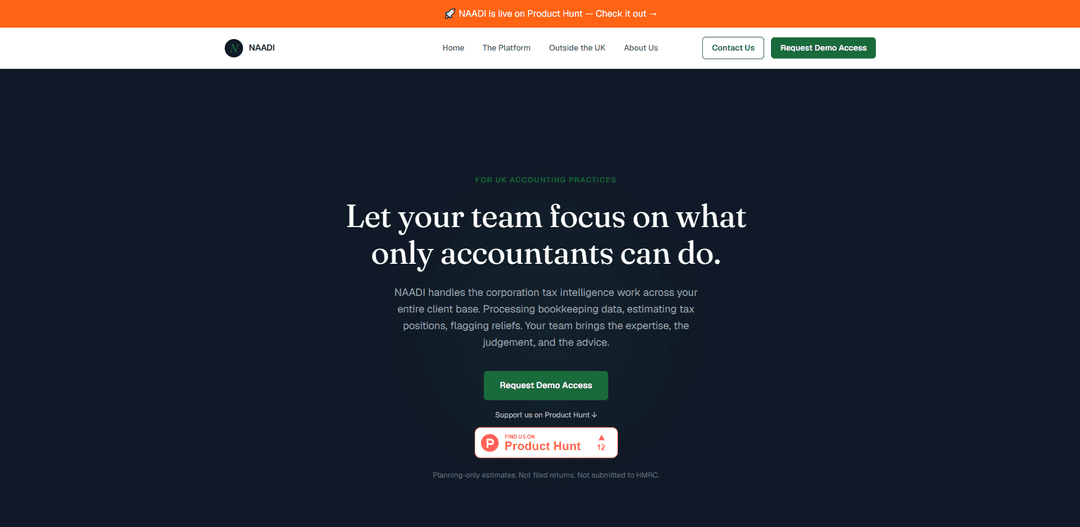
NAADI is a corporation tax intelligence tool for UK accounting practices that analyses clients’ bookkeeping data to estimate corporation tax early, classify transactions, and flag reliefs, risks, and savings opportunities with a full audit trail.
https://naadiai.com/?ref=producthunt
Product Information
Updated:Jun 8, 2026
What is NAADI
NAADI is a UK-focused product designed for accounting practices to automate the “groundwork” behind corporation tax planning. It reads bookkeeping exports from common platforms (e.g., Xero, QuickBooks, Sage, FreeAgent), applies UK corporation tax rules, and produces plain-English estimates and explanations months before a typical year-end view. NAADI is positioned as planning support rather than a filing solution—helping practices and their SME clients understand where they stand and what actions might be available earlier in the year.
Key Features of NAADI
NAADI is a corporation tax intelligence tool built for UK accounting practices that processes clients’ bookkeeping exports, applies UK corporation tax rules, estimates taxable profit and corporation tax months ahead of year-end, and flags reliefs, deductions, risks, and savings opportunities with a full audit trail of working. It’s designed for planning and advisory support (not filing or submitting to HMRC), helping practices automate rule-based groundwork so accountants can focus on review, judgement, and client advice.
Rapid CT estimation: Generates a planning-only UK corporation tax estimate in under a minute from uploaded bookkeeping data, helping teams and clients understand position far earlier than year-end.
Bookkeeping data ingestion (no new systems): Works from exports of common UK SME bookkeeping tools (e.g., Xero, QuickBooks, Sage, FreeAgent) so practices can analyze clients without changing their stack.
Transaction classification & deduction analysis: Automatically reads and classifies transactions to support taxable profit calculations and identifies potentially deductible items that need review.
Relief and savings opportunity identification: Flags applicable reliefs, deductions, and other savings opportunities across the client base, enabling earlier tax planning conversations.
Risk/anomaly flagging with audit trail: Detects risk flags and anomalies and shows 100% of the working/assumptions to support internal review and defensible client advice.
Client visibility in plain English: Provides clients with a clear, plain-English view of their corporation tax position as numbers change, reducing back-and-forth emails.
Use Cases of NAADI
Portfolio-wide CT planning for accounting practices: Run corporation tax estimates and opportunity scans across an entire client base to prioritize advisory work and standardize review workflows.
Proactive SME tax check-ins: Use mid-year or quarterly bookkeeping exports to give SMEs early visibility of likely CT liabilities and create time to act on savings opportunities.
Year-end readiness and triage: Pre-classify transactions, surface anomalies, and build an audit trail before year-end to reduce last-minute workloads and missed planning windows.
Client communications and inbox reduction: Share a plain-English CT position view with clients so routine “where do we stand?” queries are answered without repeated manual calculations.
Training and standardization for junior staff: Use NAADI’s shown working and classifications as a consistent baseline for junior team members, with seniors focusing on exceptions and judgement.
Pros
Automates rule-based groundwork (classification, estimates, flags) so accountants can focus on judgement and advisory.
Early, fast planning estimates with transparent working/audit trail improve reviewability and client confidence.
Compatible with common bookkeeping systems via exports, reducing implementation friction.
Cons
Planning-only: does not file returns or submit to HMRC, so final compliance work still requires accountant processes.
Accuracy depends on the quality/completeness of bookkeeping exports and may vary by client and transaction complexity.
Complex or ambiguous tax treatments still require professional judgement and review before acting.
How to Use NAADI
1) Confirm NAADI is the right fit (planning-only): Use NAADI for corporation tax planning and visibility across your UK accounting practice. It produces estimates and recommendations, but it does not file returns or submit anything to HMRC.
2) Gather the client bookkeeping export: From the client’s existing bookkeeping software (Xero, QuickBooks, Sage, or FreeAgent), export the bookkeeping data needed for analysis.
3) Upload the bookkeeping data to NAADI: Open NAADI and upload (drop in) the exported bookkeeping data for the client.
4) Run the NAADI analysis: Let NAADI process the uploaded data. It reads and classifies transactions, applies UK corporation tax rules, estimates taxable profit and the corporation tax position, and flags reliefs, deductions, savings opportunities, and anomalies.
5) Review the estimate and audit trail: Check NAADI’s plain-English output and the full breakdown of working/assumptions (audit trail) to understand how the estimate was produced.
6) Validate classifications and flags: Review transaction classifications, risk/anomaly flags, and suggested reliefs/deductions. Apply professional judgement where the situation is complex or ambiguous.
7) Turn findings into client advice: Use NAADI’s identified opportunities (reliefs, deductions, savings) and the estimated CT position to guide planning conversations with the client months earlier than typical year-end work.
8) Share client visibility (as needed): Provide the client with NAADI’s plain-English view of their corporation tax position so they can see where they stand as their numbers change, reducing back-and-forth emails.
9) Repeat across your client base: Use the same export → upload → analysis → review workflow for each client to standardise CT estimation, risk flagging, and savings identification across the practice.
10) Keep final sign-off and filing in your existing process: Use NAADI’s outputs for planning and preparation, but keep final review/sign-off and any actual return filing/submission to HMRC within your normal practice workflow.
NAADI FAQs
NAADI is a corporation tax intelligence tool built for UK accounting practices. It processes clients’ bookkeeping data, applies UK corporation tax rules, estimates tax positions, and flags reliefs, risks, and savings opportunities.
Popular Articles

Vosko AI: Localize and Dub Videos for Global Audiences
Oct 15, 2026

Atoms: A Multi-Agent AI Platform That Transforms Ideas into Launch-Ready Products
Oct 13, 2026

Nano Banana SBTI: What It Is, How It Works, and How to Use It in 2026
Apr 15, 2026

Atoms Review — The AI Product Builder Redefining Digital Creation in 2026
Apr 10, 2026
Latest AI Tools Similar to NAADI

TurboDoc
TurboDoc is an AI-powered invoice processing software that automatically extracts and transforms unstructured invoice data into organized, easy-to-read structured data through Gmail integration and intelligent document processing.
Smart Invoices
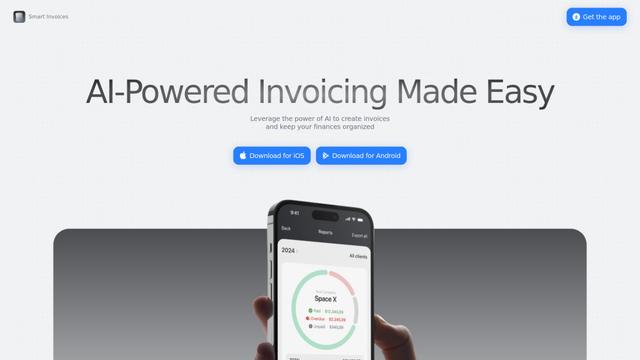
Smart Invoices is an AI-powered invoicing application that enables businesses to create, manage, and track professional invoices quickly while offering features like automated calculations, client integration, and cloud synchronization.

Spendtally
Spendtally is a smart expense tracking app that helps users manage their finances by scanning receipts, providing spending insights, and offering personalized recommendations for better deals and healthier shopping choices.

Simplify Money App
FreemiumAI Accounting Tools
Simplify Money is an AI-powered personal finance app that helps users track spending, set budgets, manage debt, and achieve financial goals through personalized insights and guidance.
Popular AI Tools Like NAADI
Trillion
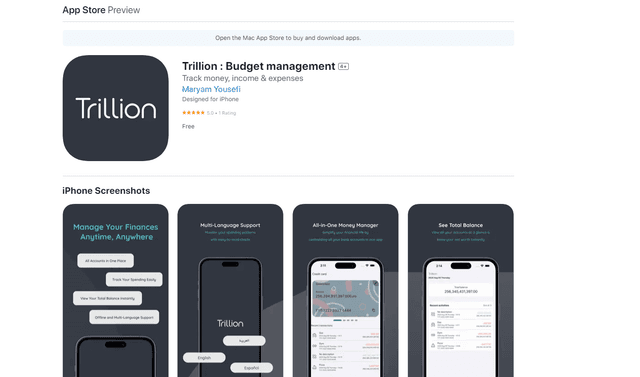
Trillion is an all-in-one personal finance app that helps users track expenses, set budgets, and manage finances across multiple currencies and accounts with an ad-free, multilingual interface.

Receipt Snapper And Scanner
Receipt Snapper And Scanner is a mobile app that allows users to instantly capture, categorize, and organize receipts through photo scanning with automatic data extraction and smart organization features.

Intuit
FreemiumAI Accounting Tools
Intuit is a global financial technology platform that provides financial management and compliance software and services for consumers, small businesses, and accounting professionals.
Datarails
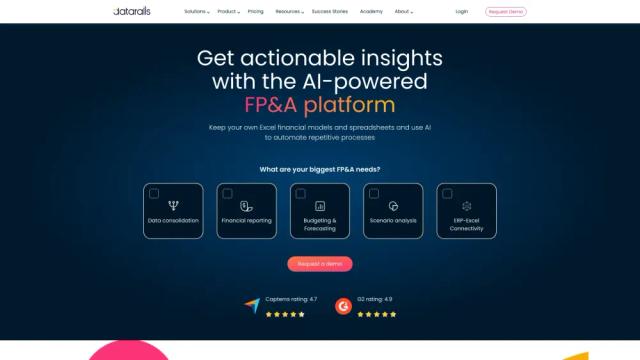
Datarails is an AI-powered financial planning and analysis (FP&A) platform that automates financial reporting and planning while allowing finance teams to continue using familiar Excel spreadsheets.