
MindReader v1
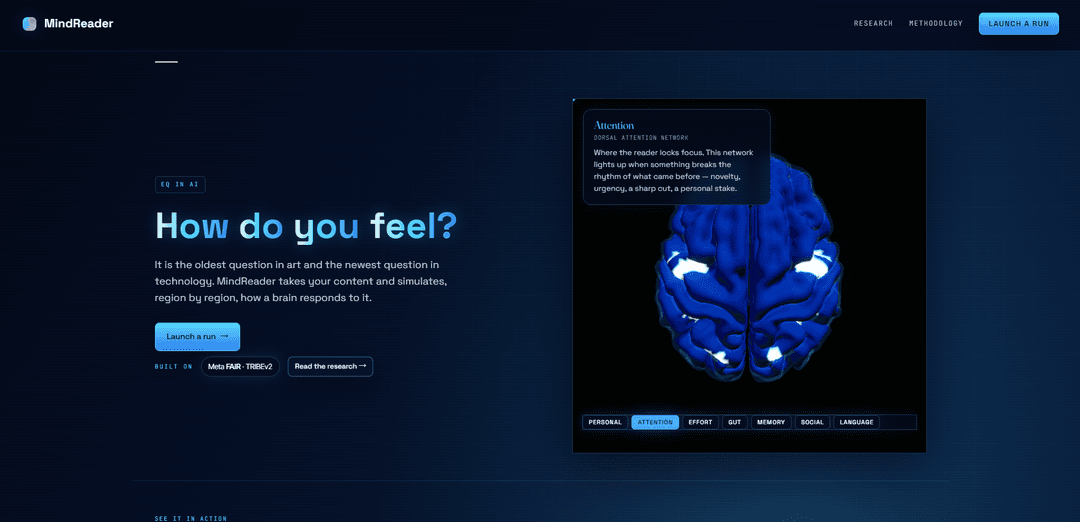
MindReader v1 is an EQ-in-AI tool that analyzes your text or call transcripts and simulates region-by-region brain responses across seven cortical systems, highlighting attention, personal resonance, and cognitive effort word-by-word.
https://mindreaderai.vercel.app/?ref=producthunt
Product Information
Updated:Jul 8, 2026
What is MindReader v1
MindReader v1 is a neuro-inspired content analysis product designed to show how a “reader” might react to language in real time. Positioned as “EQ in AI,” it takes written content (including sales call transcripts) and returns interpretable signals that map to brain-like systems—helping teams understand what parts of a message feel attention-grabbing, personally relevant, or mentally demanding. The experience is presented visually and interactively, letting users inspect results at a granular level while grounding the outputs in research-driven brain network concepts.
Key Features of MindReader v1
MindReader v1 is an AI-driven “EQ in AI” profiling and content-analysis tool that simulates how a reader’s brain responds to text, returning region-by-region predictions across multiple cortical systems. It highlights which words or lines capture attention, feel personally resonant, or require mental effort, enabling teams (notably sales and communication-heavy roles) to adapt messaging, coaching, and content based on predicted psychological and neuro-cognitive responses.
Seven-system brain-style readout: Generates seven separate “readings” mapped to cortical/brain systems (e.g., Attention via the dorsal attention network), letting users inspect different dimensions of response rather than a single score.
Word-by-word response playback: “Watches it read every word” by scoring lines/words in sequence, showing where attention spikes, where content feels personal, and where cognitive load increases.
Attention, resonance, and effort scoring: Provides interpretable metrics such as Attention, Personal Resonance, and Brain Effort to pinpoint what is novel/urgent, what feels self-relevant, and what is mentally taxing.
Region-by-region cortical mapping: Simulates responses across the brain surface and ties outputs to specific mapped regions, enabling more granular diagnostics than document-level sentiment.
Research-anchored model claims: Positions predictions as grounded in peer-reviewed neuroscience and trained/validated on large-scale fMRI datasets (e.g., hundreds of participants and thousands of modeled surface points).
Use Cases of MindReader v1
Sales call coaching and enablement: Analyze discovery-call transcripts to identify phrasing that spikes attention or personal resonance, helping reps adjust talk tracks and managers coach without listening to every call.
Marketing and ad creative testing: Pre-test ad copy, landing pages, or email campaigns to find moments of novelty/urgency that lock attention and reduce sections that create excessive cognitive effort.
Customer support and success messaging: Refine help-center articles, onboarding sequences, and renewal communications to increase clarity (lower effort) while maintaining user engagement (higher attention).
HR and internal communications: Improve employee announcements, policy updates, and change-management comms by detecting where readers may disengage or experience high cognitive load.
Training and education content design: Evaluate lessons and exercises for engagement and difficulty, balancing attention-grabbing moments with manageable cognitive effort for better learning flow.
Pros
Interpretable outputs (attention/resonance/effort) that can directly inform copy edits and coaching decisions.
Granular, sequence-level analysis (word/line playback) helps pinpoint exactly what triggers engagement or friction.
Differentiated multi-system approach (seven readings) provides richer diagnostics than single-score sentiment tools.
Cons
Neuro/brain-response framing may be perceived as over-precise for text-only inputs; real-world validity can vary by audience and context.
Potential ethical and privacy concerns if used for psychometric profiling in sales or hiring without clear consent and safeguards.
May require domain expertise to avoid misinterpreting scores as definitive measures of persuasion or truth.
How to Use MindReader v1
1. Open MindReader v1: Go to https://mindreaderai.vercel.app/?ref=producthunt in your browser.
2. Start a new reading: From the main page, choose the option to run a reading (e.g., “See it in action” / “Reading call”) to begin analyzing content.
3. Provide the content to analyze: Paste or load the text/content you want MindReader to evaluate (the demo shows it reading a discovery call line-by-line).
4. Run the model: Start the analysis so MindReader can simulate responses “region by region” across the brain surface.
5. Watch the word-by-word playback: Use the playback view (“Watch it read every word”) to see which specific words/lines drive different responses as the model reads through the content.
6. Review the three live signals: Monitor the live metrics shown during playback: Attention, Personal Resonance, and Brain Effort (example values shown in the demo: Attention 0.89, Personal Resonance 0.55, Brain Effort 0.38).
7. Inspect the seven-system cortical map: Open the “One cortex. Seven systems.” section to view the full set of seven readings (one per cortical system) returned for your run.
8. Click a system to see its location and meaning: Select a system (e.g., Attention) to see where it “lives” on the cortex map and read the system description (e.g., Attention = Dorsal attention network; rises on novelty, urgency, sharp cuts, personal stake).
9. Use the mapped highlights to revise content: Identify words/segments that spike Attention, increase Personal Resonance, or raise Brain Effort, then edit your content to amplify desired effects and reduce unnecessary effort.
10. Re-run to compare changes: Run MindReader again on the revised content and compare the updated signals and cortical-system readings to validate improvements.
MindReader v1 FAQs
MindReader v1 is an “EQ in AI” tool that takes your content and simulates—region by region—how a brain responds to it, returning predicted readings mapped to cortical systems.
Popular Articles

Vosko AI: Localize and Dub Videos for Global Audiences
Oct 15, 2026

Atoms: A Multi-Agent AI Platform That Transforms Ideas into Launch-Ready Products
Oct 13, 2026

Nano Banana SBTI: What It Is, How It Works, and How to Use It in 2026
Apr 15, 2026

Atoms Review — The AI Product Builder Redefining Digital Creation in 2026
Apr 10, 2026
Latest AI Tools Similar to MindReader v1
Itswrittenbyai
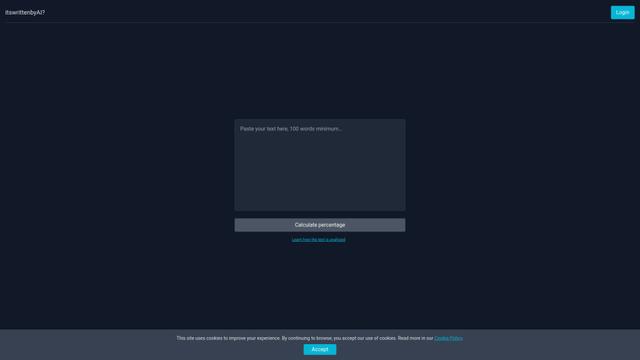
Itswrittenbyai is an AI detection tool that helps identify content generated by popular AI models like ChatGPT, Claude, and Gemini.

AI Website Tool
AI Website Tool is an AI-powered website builder that creates professional websites in minutes by automatically generating business-focused copy, custom visuals, and responsive designs with just a few clicks.

Progressa.ai
Progressa.ai is an AI-powered social media automation platform that streamlines content creation, scheduling, and engagement across multiple platforms with 24/7 functionality.
AI Tweet Generator
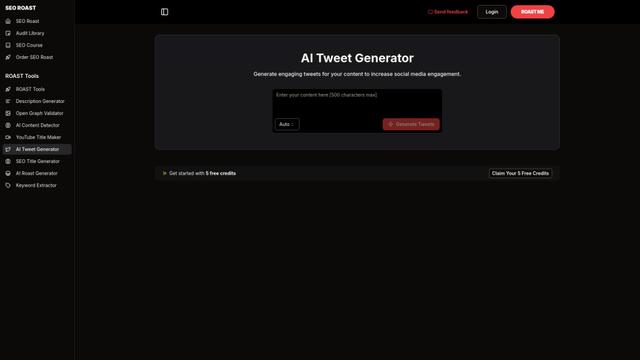
An AI-powered tool that automatically generates engaging, witty, and personalized tweets by leveraging natural language processing to help users create compelling social media content in seconds.
Popular AI Tools Like MindReader v1

undash
Undash is a lightweight Chrome extension that automatically removes long em dashes (—) from AI-generated text to make it feel more natural and human-like.

Pre-AI Search - Filter Google AI Content
Pre-AI Search is a Chrome extension that helps users filter out AI-generated content from Google search results by focusing on content published before the rise of AI content generation.
Pino - Fact Checker
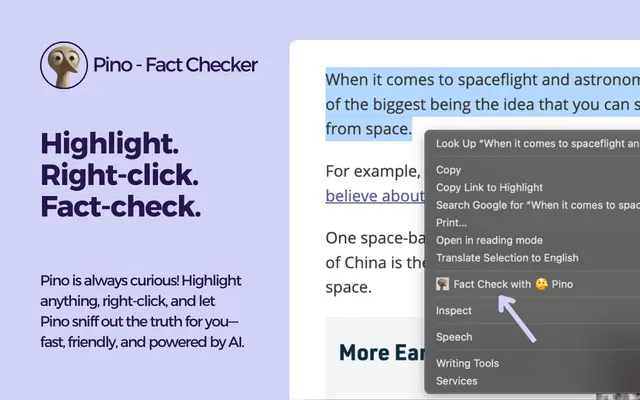
Pino is an AI-powered Chrome extension that enables instant fact-checking of any text with truth scores, detailed analysis, and reliable sources through a simple highlight-and-click interface.
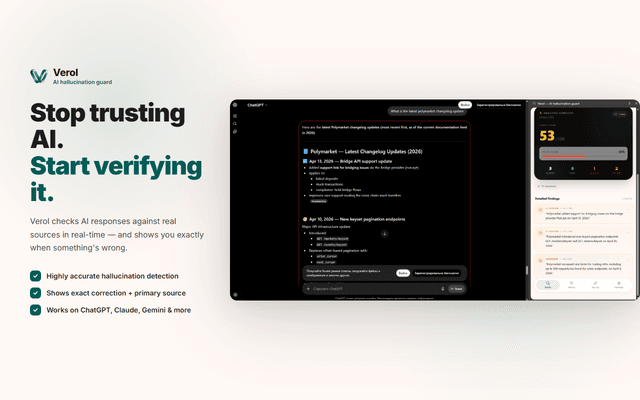
Verol
Verol is a Chrome extension that provides real-time AI fact-checking and hallucination detection for ChatGPT, Claude, Gemini, and Grok, using inline annotations, confidence scoring, and source traceability to verify model outputs as they’re generated.