LumiMusic
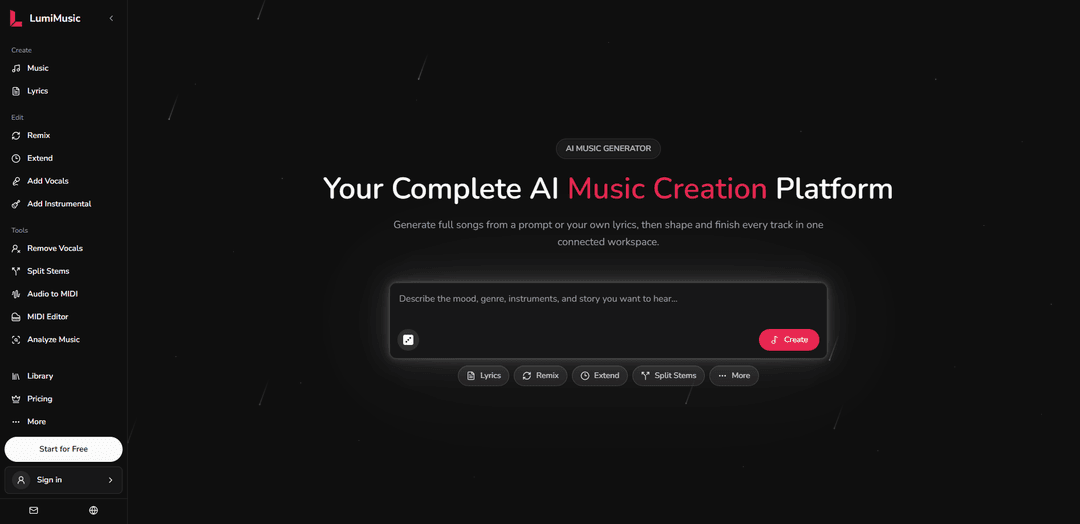
LumiMusic is an all-in-one AI music creation platform that transforms your ideas, text prompts, or lyrics into complete vocal and instrumental tracks—no production experience required.
https://lumimusic.ai/?utm_source=aipure
Product Information
Updated:Aug 10, 2026
What is LumiMusic
LumiMusic offers a full suite of editing tools to remix, extend, add or remove vocals, separate stems, analyze audio, and convert tracks into editable MIDI. You can organize your creations in a personal library, play them in a sleek web player, or share dedicated listening pages.Eligible plans include royalty-free commercial licenses with downloadable certificates, making it easy to use your songs in videos, podcasts, games, and social content. Whether you are a creator, songwriter, or beginner, LumiMusic makes making original music effortless.
Key Features of LumiMusic
LumiMusic is a browser-based, all-in-one AI music creation workspace that lets creators generate complete vocal or instrumental songs from text prompts or their own lyrics, then continue developing them using connected tools such as remixing, song extension, stem separation, vocal removal, music analysis, and audio-to-MIDI/MIDI editing—ending with an organized library, polished playback, and shareable listening pages. It emphasizes an iterative workflow (create → refine → finish/share) and offers royalty-free music with clear licensing, including commercial usage rights on eligible plans.
Text/lyrics-to-full song generation: Create complete tracks (instrumental or with vocals) from a prompt or your own lyrics using advanced AI models aimed at polished, expressive sound.
AI remixing for rapid variations: Generate alternate versions of an existing song by changing genre, mood, instrumentation, vocals, and arrangement to explore creative directions without starting over.
Advanced stem splitting (up to 12 stems): Separate a finished song into synchronized vocal and instrument stems (e.g., vocals, drums, bass, guitar, piano) with Solo/Mute preview controls for targeted edits and reuse.
Connected edit tools: extend, remove vocals, analyze: Go beyond generation with tools for extending songs, adding sections, removing vocals, and analyzing musical structure to guide revisions and production decisions.
Audio-to-MIDI and MIDI editing: Convert audio into MIDI and edit MIDI content for deeper compositional control, arrangement tweaks, and integration with other music workflows.
Library, playback, and share pages: Organize creations in a library, listen in a polished player, and share dedicated listening pages for easy review and collaboration.
Use Cases of LumiMusic
Content creation for social/video: Generate royalty-free background music, theme songs, or vocal tracks for YouTube/TikTok/short-form videos, then remix or stem-split to fit different cuts and moods.
Indie artist songwriting & demos: Turn lyric drafts into full demo songs, iterate via remixing and extensions, and export stems/MIDI to refine arrangements before studio recording.
Advertising and brand campaigns: Produce multiple on-brand music options quickly (different genres/energies), remove vocals for instrumental versions, and deliver polished tracks for ads and promos.
Game/interactive media prototyping: Create and extend loops or themes, analyze structure for transitions, and use stems to implement adaptive layers (drums/bass/melody) in game audio pipelines.
Podcasting and livestreaming: Create intros/outros and segment beds, then generate alternate mixes with remixes or vocal removal to maintain consistent sonic identity across episodes.
Music education and practice materials: Use stem separation and audio-to-MIDI to isolate parts for learning, transcription, and arrangement exercises, helping students study instrumentation and structure.
Pros
All-in-one, iterative workflow (generate → remix/edit → stem/MIDI) reduces tool-hopping and speeds up production.
Strong refinement capabilities (remix, extension, stem splitting, vocal removal, analysis) make it useful beyond one-click generation.
Browser-based with library/playback/sharing simplifies access, review, and collaboration.
Royalty-free music with clear licensing and commercial rights on eligible plans supports professional use.
Cons
Many features are credit/subscription-dependent, which can limit experimentation for free or low-credit users.
Stem separation quality and the exact stems available can vary depending on the source material.
AI-generated audio may still exhibit artifacts or mismatches in some outputs, requiring additional refinement.
How to Use LumiMusic
1) Open LumiMusic and start a new song: Go to https://lumimusic.ai/ and begin in the main creation workspace where you can move from an idea to a finished track.
2) Choose your input type (prompt or lyrics): Decide whether you want to generate a track from a text prompt (style + musical direction) or from your own lyrics (for a vocal song).
3) Write a detailed music prompt (if using text-to-music): Describe genre, mood, instrumentation, vocal type (or instrumental), and production notes. Example directions include things like “electronic pop”, “R&B groove”, “warm analog pads”, “close-miked female vocals”, and arrangement/FX notes.
4) Paste or write lyrics (if using lyrics-to-song): Provide your own lyrics (or use the built-in AI Lyrics Generator if available on your plan) to generate a complete vocal track.
5) Generate the song: Run the AI Music Generator to create a complete vocal or instrumental track from your prompt/lyrics.
6) Review playback in the built-in player: Listen to the generated result in LumiMusic’s polished playback experience before making edits or variations.
7) Remix to explore new versions: Use the AI music remixer to create alternate versions by changing elements such as genre, mood, instrumentation, vocals, and arrangement.
8) Split the track into stems for deeper control: Use the Advanced Stem Splitter to separate a finished song into up to 12 synchronized tracks (often including vocals, drums, bass, guitar, piano, and other parts). Preview stems using Solo and Mute controls.
9) Apply vocal-focused edits when needed: Use tools like vocal removal or adding vocals/instrumental sections to reshape the song structure and production direction.
10) Extend the song and refine the arrangement: Use extension tools to lengthen sections or add new parts, keeping the workflow connected so you can iterate without leaving the platform.
11) Analyze musical structure and timing: Use analysis tools to understand musical structure; where available, beat/rhythm detection and related analysis help guide editing decisions.
12) Convert audio to MIDI (optional): If you want editable note-level control, use audio-to-MIDI conversion to turn parts of the track into MIDI data.
13) Edit MIDI content (optional): Use MIDI editing tools to adjust notes, timing, and musical content after conversion.
14) Save and organize in your Library: Revisit completed songs from your Library so you can continue refining, remixing, or exporting later.
15) Download and share the finished track: Download your song (download limits depend on plan) and share it using LumiMusic’s dedicated listening/share page.
16) Confirm usage rights for your plan: Check the license terms and whether your plan includes commercial usage rights (commercial license is available on eligible plans with clear license terms).
LumiMusic FAQs
LumiMusic is a browser-based, all-in-one AI music creation platform that combines song generation with connected tools for remixing, stem separation, analysis, and editing in one workflow.
Popular Articles

Atoms: A Multi-Agent AI Platform That Transforms Ideas into Launch-Ready Products
May 22, 2026

Nano Banana SBTI: What It Is, How It Works, and How to Use It in 2026
Apr 15, 2026

Atoms Review — The AI Product Builder Redefining Digital Creation in 2026
Apr 10, 2026

Kilo Claw: How to Deploy and Use a True "Do‑It‑For‑You" AI Agent(2026 Update)
Apr 3, 2026
Latest AI Tools Similar to LumiMusic
MeloHunt
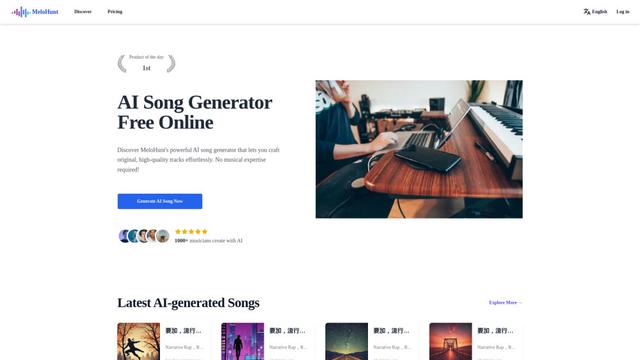
MeloHunt is a powerful AI-powered song generator that enables users to create original, high-quality music tracks without requiring any musical expertise.
ChopLab
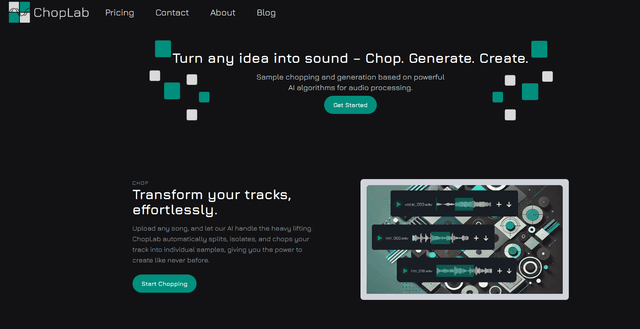
ChopLab is an AI-powered tool that enables music producers to transform audio tracks into unique samples and custom drum packs through automated splitting, isolation, and chopping processes.

MindBound Labs
MindBound Labs is an innovative platform focused on accelerating Artificial Super Intelligence (ASI) through community engagement, combining NFC cards, AI prompts, and personalization across multiple creative domains.

MusicAny
MusicAny is a cutting-edge free AI music generator that enables users to effortlessly create unique, royalty-free songs from text descriptions without any musical background.
Popular AI Tools Like LumiMusic
Jammy Chat
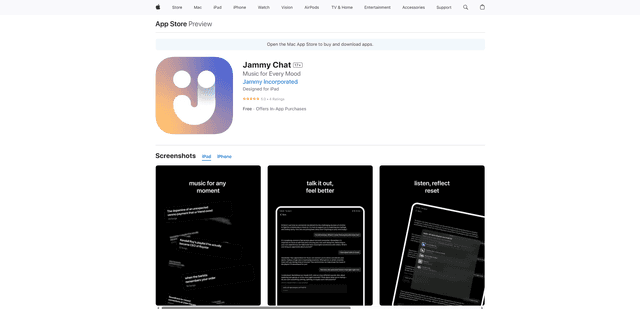
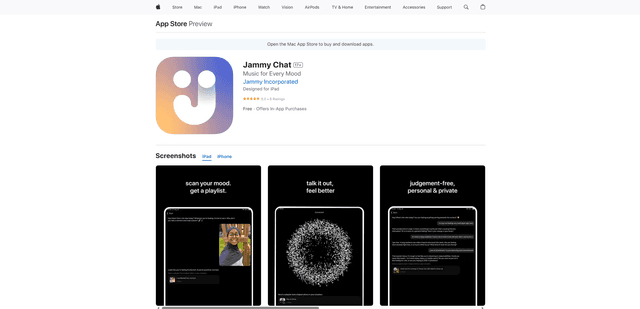
Jammy Chat is a music-infused mental health app that provides personalized playlists and emotional support by analyzing your mood through AI-powered conversations.
Jammy Chat
Jammy Chat is an AI-powered mental health app that scans users' facial expressions and provides personalized music playlists to help regulate emotions and improve mood.
Ritmo
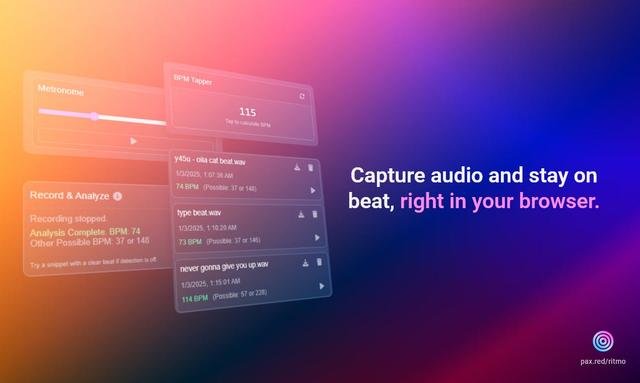
Ritmo is a smart audio toolkit Chrome extension that helps capture, analyze, and manage audio with features like BPM analysis, tap tempo, and metronome functionality.
Tempo-Pulse
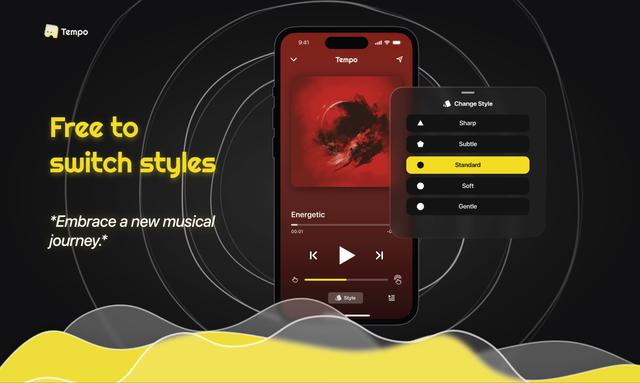
Tempo-Pulse is an AI-driven haptic music player that transforms any music into tactile sensations through innovative haptic technology, making music feelable for everyone including those who are hard of hearing.