
Freesolo Flash
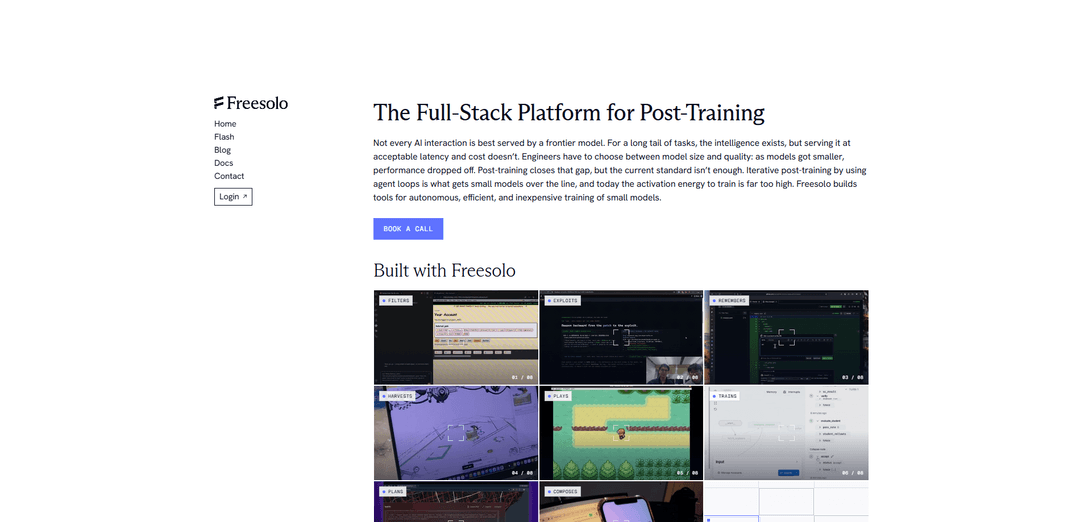
Freesolo Flash is an agent-driven post-training package that delivers a production-ready small model with exported weights, using fast custom-kernel training and a single fixed quote plus ETA upfront.
https://freesolo.co/?ref=producthunt
Product Information
Updated:Aug 8, 2026
What is Freesolo Flash
Freesolo Flash is a post-training solution built to be operated by coding agents like Claude Code, Cursor, and Codex, helping engineers turn an existing training loop into a deployable specialized model. It focuses on making common post-training workflows—such as supervised fine-tuning (SFT) and reinforcement learning methods like GRPO—end-to-end completable, so the output is not just experiment results but a model you can ship. Flash is positioned around small, sub-10B parameter models for low-latency, high-volume (“trillion-token”) production use cases, and emphasizes that your data, your model, and your weights remain yours, with weights exported back to your repository.
Key Features of Freesolo Flash
Freesolo Flash is a managed post-training service (SFT and RL/GRPO, plus on-policy distillation) designed to be driven by coding agents like Claude Code/Cursor/Codex: you write a short config and run one command to fine-tune a small model on managed infrastructure, get a fixed upfront quote and ETA, and receive a production-ready result that can be deployed behind an OpenAI-compatible endpoint with no hosting. Flash emphasizes high throughput via automated kernel optimization, cost predictability (no per-token metering), and ownership/portability of outputs (e.g., exporting adapter weights to your repo).
Agent-driven workflow: Built to be operated by coding agents; engineers provide a short config and trigger training with a single command to get a deployable model back.
Managed end-to-end training + serving: Runs fine-tuning on managed infrastructure and serves the resulting model behind an OpenAI-compatible endpoint—nothing to host locally.
Fixed quote and ETA upfront: Returns one pre-run price quote and an estimated completion time before execution, avoiding per-token metering and GPU-hour uncertainty.
Multiple post-training methods: Supports supervised fine-tuning (prompt/answer pairs), reinforcement learning via GRPO, and on-policy distillation where a managed teacher grades token-by-token to pull a smaller model toward a stronger one.
High-throughput training via kernel search: Treats kernel engineering as a search problem, continuously optimizing permutations with an autoresearch loop to maximize training throughput.
Deployable artifacts and weight export: Produces production-ready outputs (e.g., custom LoRA adapters) and can export weights/adapters back into your repository for versioning and reuse.
Use Cases of Freesolo Flash
Customer support automation: Fine-tune a small, fast model on historical support transcripts and policies to improve adherence, reduce latency, and lower per-request costs versus frontier models.
Enterprise document tagging and routing: Train sub-10B models to classify, tag, and route documents (legal, finance, HR) at high volume with millisecond latency and predictable spend.
E-commerce product normalization and attribute extraction: Specialize a lightweight model to extract attributes, normalize catalog data, and enforce formatting rules for millions of routine product ingestion calls.
Search and retrieval augmentation helpers: Tune a compact model for query rewriting, intent classification, or snippet generation to improve search quality while keeping inference cheap at scale.
Distilling a frontier workflow into a small model: Use on-policy distillation when a bigger model already performs well: the managed teacher grades the smaller model’s outputs, reducing the need to hand-write labels or design rewards.
Pros
End-to-end managed workflow (train + deploy + chat) with an OpenAI-compatible endpoint, minimizing ops overhead.
Predictable pricing with a fixed quote and ETA before running, avoiding per-token/GPU-hour surprises.
Supports multiple post-training strategies (SFT, RL/GRPO, on-policy distillation) for different data availability and optimization needs.
Emphasis on throughput via kernel optimization, aiming for faster and cheaper training runs for small models.
Cons
Requires using Freesolo’s managed platform and authentication (Freesolo API key), which may be a constraint for strict on-prem or air-gapped environments.
Best fit is small-model specialization; teams needing large-model full fine-tunes or highly custom infra control may find it less aligned.
On-policy distillation relies on a managed teacher model (e.g., GLM 5.2 by default), which may be a limitation for teams needing a specific teacher or fully offline grading.
How to Use Freesolo Flash
1) Get access + install the tooling: Create an account at https://freesolo.co and obtain a Freesolo API key. Install the Freesolo Flash training package/CLI for your platform (the CLI is described as a thin client for queuing Freesolo backend training jobs).
2) Prepare a training repo (or start from an existing code/data repo): Flash is designed to be driven by coding agents (Claude Code, Cursor, Codex, etc.). Point your agent at the Flash training package and your source repo (or a new repo) that will contain your dataset and environment code.
3) Define your task data (SFT prompt/answer pairs): For supervised fine-tuning (SFT), create a dataset of prompt/answer pairs (e.g., JSONL). Use the public SDK surface to load and validate it locally: `from freesolo.datasets import load_dataset` then `dataset = load_dataset("support.jsonl")` and inspect `len(dataset.examples)`.
4) (Optional but recommended) Define an evaluation/scoring environment: Create a Python environment module that exposes `load_environment()` and returns an `EnvironmentSingleTurn` or `EnvironmentMultiTurn`. Use the public SDK surface to load it locally: `from freesolo.environments import load_environment` then `environment = load_environment("freesolo/environment.py:load_environment")`. Single-turn environments build episodes via `start_episode()`; multi-turn environments own their `start_episode()` and should include any task-specific initial system message there.
5) Choose a training method: SFT vs RL vs on-policy distillation: Pick based on what you can provide: (a) SFT when you already have prompt/answer examples; (b) RL (e.g., GRPO) when you can score outputs with a reward/environment but can’t hand-write perfect answers; (c) on-policy distillation when a larger teacher model can grade your model’s completions token-by-token (GLM 5.2 is mentioned as the default managed teacher), so you don’t need answers or a reward function.
6) Write a short TOML config for Flash: Create a TOML configuration that selects (1) a supported base model, (2) the task/training mode (SFT, RL/GRPO, or distillation), and (3) pointers to your dataset and/or environment module. Flash trains a LoRA adapter (small add-on weights) on top of the base model.
7) Run the single Flash command to start training: Run the Flash CLI command that queues the managed training job using your TOML config. Before anything runs, Flash returns a fixed quote and an ETA; confirm to proceed (the docs describe this as: it prints a quote and ETA, then you say “go”).
8) (Optional) Use the agent-driven optimizer loop before final training: If using the Freesolo agent workflow, run the repo-based loop: `draft` to create an initial training contract from a source repo (returns a `targetRepoUrl`), then `optimize` to generate repo-level training files and run bounded strategy-discovery experiments (with concurrency and time caps), then `training` to run the optimizer-selected SFT/RL script/config combination.
9) Monitor job progress and completion: Use the CLI polling workflow to watch jobs: `poll` lists recent organization jobs and can watch a selected job until it finishes. When a job completes, it prints a short summary including job id, repo, commit, and changed files; full details are available in the Freesolo web platform at https://freesolo.co.
10) Retrieve your outputs (LoRA adapter + exported weights): When training finishes, you get a deployable result: the LoRA adapter is produced and weights are exported to your repo in standard formats so you can download and serve them anywhere.
11) Deploy with managed serving (optional): Run `flash deploy` to register the adapter with managed serving. After deployment, you can call the model via `flash chat` or any OpenAI-compatible client using your Freesolo key (Flash serves behind an OpenAI-compatible endpoint; nothing to host).
12) Iterate cheaply and retrain as your production data evolves: Flash is positioned for repeated post-training on production data (especially for sub-10B models). Iterate by updating your dataset/environment, adjusting the TOML config, re-running the job to get a new upfront quote/ETA, and redeploying the updated adapter.
Freesolo Flash FAQs
Freesolo Flash is an agent-native post-training package designed to be driven by coding agents (e.g., Claude Code, Cursor, Codex) to run post-training workflows like SFT and RL and return a finished, deployable model with weights exported back to your repo.
Freesolo Flash Video
Popular Articles

Vosko AI: Localize and Dub Videos for Global Audiences
Oct 15, 2026

Atoms: A Multi-Agent AI Platform That Transforms Ideas into Launch-Ready Products
Oct 13, 2026

Nano Banana SBTI: What It Is, How It Works, and How to Use It in 2026
Apr 15, 2026

Atoms Review — The AI Product Builder Redefining Digital Creation in 2026
Apr 10, 2026
Latest AI Tools Similar to Freesolo Flash
Gait
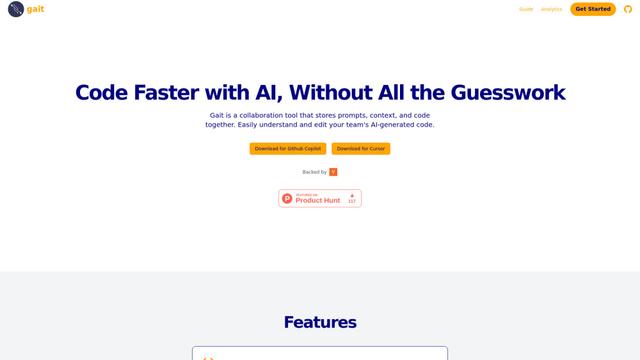
Gait is a collaboration tool that integrates AI-assisted code generation with version control, enabling teams to track, understand, and share AI-generated code context efficiently.
invoices.dev
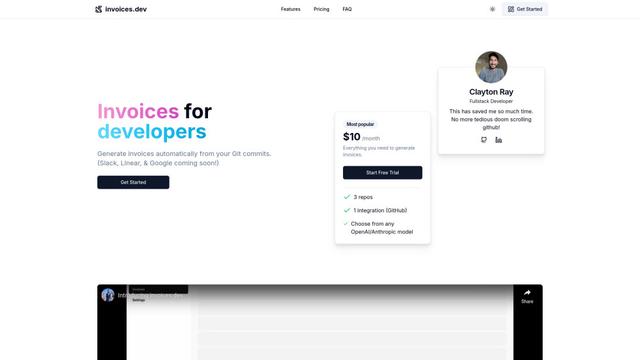
invoices.dev is an automated invoicing platform that generates invoices directly from developers' Git commits, with integration capabilities for GitHub, Slack, Linear, and Google services.
EasyRFP
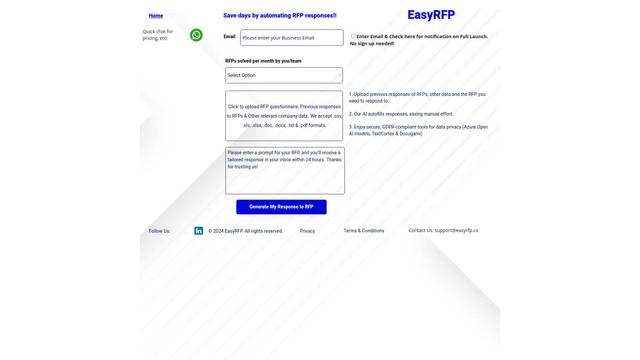
EasyRFP is an AI-powered edge computing toolkit that streamlines RFP (Request for Proposal) responses and enables real-time field phenotyping through deep learning technology.

Cart.ai
Cart.ai is an AI-powered service platform that provides comprehensive business automation solutions including coding, customer relations management, video editing, e-commerce setup, and custom AI development with 24/7 support.
Popular AI Tools Like Freesolo Flash

GitHub Copilot Chat
GitHub Copilot Chat is an AI-powered coding assistant that provides natural language interactions, real-time code suggestions, and contextual support directly within supported IDEs and GitHub.com.
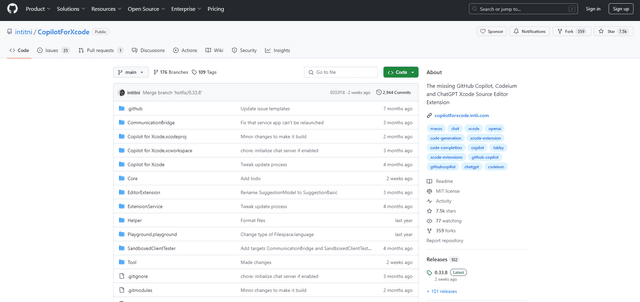
CopilotForXcode
CopilotForXcode is an Xcode Source Editor Extension that integrates GitHub Copilot, Codeium, and ChatGPT to provide AI-powered code suggestions, chat assistance, and prompt-to-code functionality within Xcode.
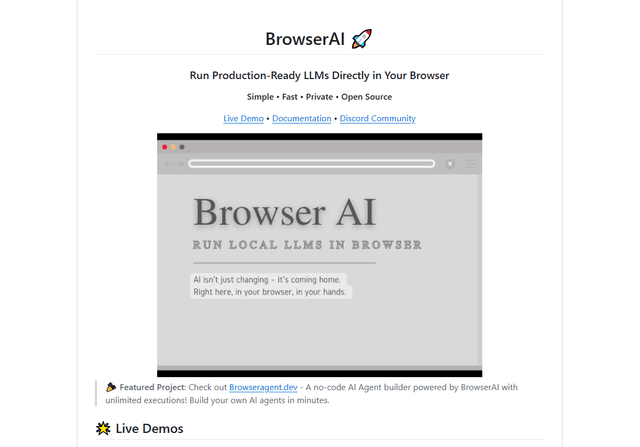
BrowserAI
BrowserAI is an open-source library that enables running local Large Language Models (LLMs) directly in web browsers with WebGPU acceleration, offering privacy-focused AI capabilities without requiring server infrastructure.
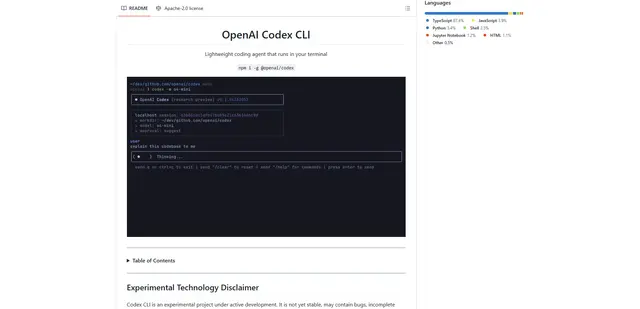
OpenAI Codex CLI
OpenAI Codex CLI is a lightweight, open-source coding agent that runs in your terminal, enabling developers to translate natural language into code execution while providing ChatGPT-level reasoning with the ability to run code, manipulate files, and iterate under version control.