
ByteAsk Embedded MCP - Open Source
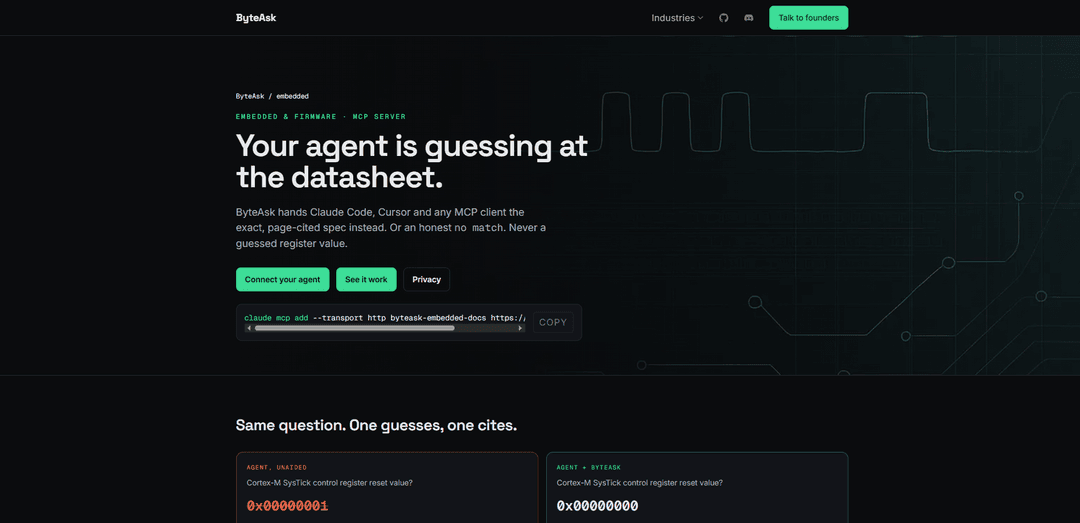
ByteAsk Embedded MCP is an embedded/firmware-focused MCP server that lets Claude Code, Cursor, and other MCP clients retrieve exact, page-cited datasheet/spec snippets (or an explicit “no match”) to prevent guessed register values and other hallucinations.
https://docs.byteask.ai/embedded?ref=producthunt
Product Information
Updated:Jul 8, 2026
What is ByteAsk Embedded MCP - Open Source
ByteAsk Embedded MCP is a Model Context Protocol (MCP) server designed for embedded and firmware engineers who need answers grounded in primary sources—not best-effort guesses. It acts like a “reference desk” for your coding agent, returning verbatim, page-cited evidence from standards, datasheets, and register maps (e.g., Arm Cortex-M, Modbus, SCPI, and other embedded protocols). It integrates with common MCP clients such as Claude (web/desktop), Claude Code, Cursor, VS Code, Windsurf, and more via an HTTP (Streamable HTTP) MCP endpoint, with no key, token, or signup required for the public service.
Key Features of ByteAsk Embedded MCP - Open Source
ByteAsk Embedded is an MCP server for embedded and firmware teams that lets AI coding agents (Claude Code, Cursor, VS Code/Windsurf, and other MCP clients) retrieve exact, page-cited answers from primary-source technical documents—datasheets, register maps, and protocol specifications—instead of guessing. It is designed to be source-grounded by returning verbatim, page-referenced evidence (or an explicit “no match”), and it can also be configured with organization-scoped private document libraries so internal/NDA parts and public references can be searched together safely.
Page-cited, source-grounded answers: Returns exact, page-referenced specs from primary documents (e.g., register reset values, protocol limits) rather than plausible but unsourced guesses, and can respond with “no match” when evidence isn’t found.
MCP server compatible with common coding agents: Connects via MCP (HTTP / Streamable HTTP) and works with Claude Code, Cursor, and “any MCP client,” enabling agents to call a dedicated doc-search tool during development workflows.
Embedded/firmware-focused document coverage: Optimized for embedded references like Arm Cortex-M docs, Modbus specs, SCPI references, and datasheets/register maps—useful for questions involving bitfields, hex values, timing thresholds, and part numbers.
Private, org-scoped libraries for internal/NDA docs: Supports uploading proprietary datasheets and in-house design docs into an organization-scoped corpus so only team tokens can access them, while still searching public and private sources in one query.
Team-wide approved parts knowledge base: Centralizes vetted component documentation (plus optional custom metadata like internal MPNs/AVLs/design notes) so every engineer queries the same approved sources instead of relying on shared drives.
Simple connector setup with no key for public access: Can be added as a custom connector by pointing clients to the hosted MCP endpoint, with guidance to make it the default tool to consult before memory/web search for spec-critical questions.
Use Cases of ByteAsk Embedded MCP - Open Source
Firmware register-level implementation: Engineers can ask agents for register reset values, bit meanings, and configuration sequences with page citations to reduce bring-up errors and prevent “guessed” hex constants.
Industrial protocol integration (Modbus/SCPI/etc.): Teams implementing device communications can quickly confirm function codes, limits (e.g., max registers), and exception codes from the official spec with traceable citations.
Hardware bring-up and validation: During board bring-up, agents can answer timing/threshold questions from datasheets with cited evidence, improving confidence in power, clocking, and peripheral configuration decisions.
Safety/compliance documentation traceability: In regulated environments, page-cited outputs help teams keep an audit trail of why a parameter or behavior was implemented a certain way, grounded in the authoritative document.
Enterprise internal parts and custom silicon support: Organizations can upload NDA-protected component docs and internal design notes so agents can search them alongside public references without exposing queries or documents outside the org.
Pros
Reduces hallucinations for spec-critical embedded work by returning page-cited evidence or an explicit “no match.”
Fits existing agent workflows via MCP and supports popular tools (Claude Code, Cursor, and other MCP clients).
Supports org-scoped private libraries for proprietary/NDA documentation with team-only visibility.
Cons
Effectiveness depends on document availability/coverage; if a spec isn’t in the corpus, it will return “no match.”
Primarily optimized for embedded/firmware documentation workflows, so it may be less useful for non-spec-driven software tasks.
How to Use ByteAsk Embedded MCP - Open Source
1) Connect ByteAsk Embedded MCP in Claude Code (CLI): Run: `claude mcp add --transport http byteask-embedded-docs https://mcp.byteask.ai/mcp`
2) Verify the MCP server is available: In your MCP-enabled client, start a new session and confirm the ByteAsk server appears as an available tool/server (commonly exposed as a docs search tool such as `search_docs`).
3) Ask a datasheet/spec question and allow tool use: Ask a question that requires a primary-source citation (e.g., register reset values, Modbus function codes). When prompted to use the docs tool (e.g., “Search docs”), approve it—ideally set permission to “Always allow” so the agent can use ByteAsk automatically.
4) Connect ByteAsk in the Claude app (claude.ai or desktop) via Custom Connector: In a new chat, click `+` → `Add connector` → `Add custom connector`.
5) Add the MCP address (no auth required): Give the connector a name (e.g., “Docs”), paste `https://mcp.byteask.ai/mcp` into the address field, leave OAuth fields blank, then click `Add`.
6) Use ByteAsk as your source of truth for embedded/firmware specs: When you need exact, page-cited evidence (register/bitfields, hex values, Modbus exception/function codes, SCPI references, MCU part numbers, timing/thresholds), invoke the ByteAsk docs search tool first and treat page-cited results as authoritative. If it returns “no match,” report that instead of guessing.
7) Make ByteAsk the default behavior in your agent rules: Add a rule to your agent instructions file (e.g., `AGENTS.md` or `CLAUDE.md`) telling the agent: when a question involves registers/bitfields, hex values (0x..), Modbus codes, SCPI commands, MCU part numbers, or datasheet timing/thresholds, call `byteask-embedded-docs` (the docs search tool) FIRST, before memory or web search, and don’t guess if there’s no confident match.
8) Connect from any other MCP client: Point your MCP client at `https://mcp.byteask.ai/mcp` using HTTP transport (Streamable HTTP). No key/token/signup is required per the provided setup instructions.
ByteAsk Embedded MCP - Open Source FAQs
ByteAsk Embedded is an MCP server for embedded/firmware and datasheet lookups that gives MCP clients (e.g., Claude Code, Cursor, VS Code, Windsurf, Cline, Kiro) exact, page-cited answers from primary sources—or an explicit “no match”—instead of guessing register values or protocol details.
Popular Articles

Atoms: A Multi-Agent AI Platform That Transforms Ideas into Launch-Ready Products
May 22, 2026

Nano Banana SBTI: What It Is, How It Works, and How to Use It in 2026
Apr 15, 2026

Atoms Review — The AI Product Builder Redefining Digital Creation in 2026
Apr 10, 2026

Kilo Claw: How to Deploy and Use a True "Do‑It‑For‑You" AI Agent(2026 Update)
Apr 3, 2026
Latest AI Tools Similar to ByteAsk Embedded MCP - Open Source
invoices.dev
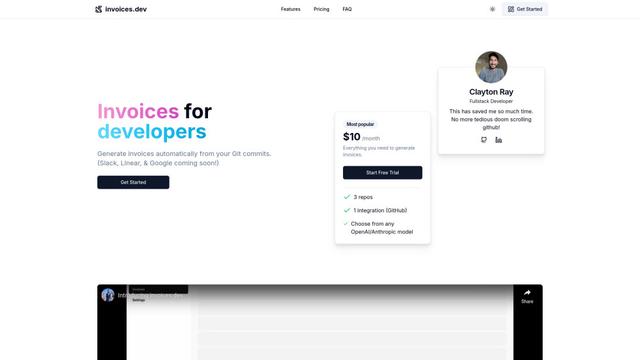
invoices.dev is an automated invoicing platform that generates invoices directly from developers' Git commits, with integration capabilities for GitHub, Slack, Linear, and Google services.
Monyble
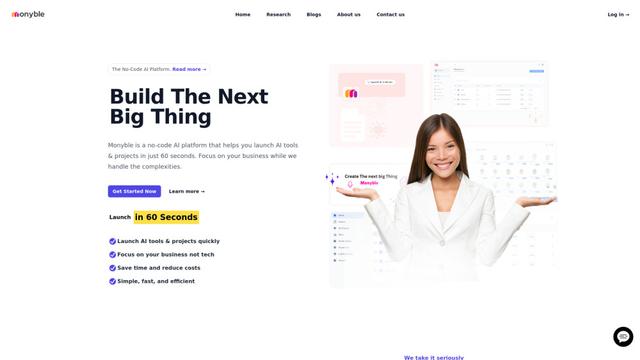
Monyble is a no-code AI platform that enables users to launch AI tools and projects within 60 seconds without requiring technical expertise.
Devozy.ai
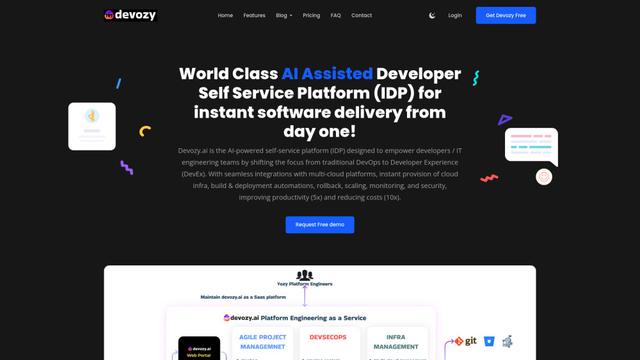
Devozy.ai is an AI-powered developer self-service platform that combines Agile project management, DevSecOps, multi-cloud infrastructure management, and IT service management into a unified solution for accelerating software delivery.
Mediatr
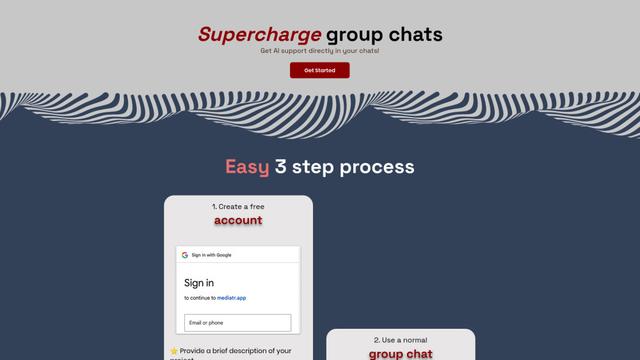
MediatR is a popular open-source .NET library that implements the Mediator pattern to provide simple and flexible request/response handling, command processing, and event notifications while promoting loose coupling between application components.
Popular AI Tools Like ByteAsk Embedded MCP - Open Source

Launch
Launch is an AI-powered platform that enables users to build full-stack applications instantly while providing comprehensive tools for product launches, entrepreneurship programs, and customer acquisition.

GitHub Copilot Chat
GitHub Copilot Chat is an AI-powered coding assistant that provides natural language interactions, real-time code suggestions, and contextual support directly within supported IDEs and GitHub.com.
Rememberall
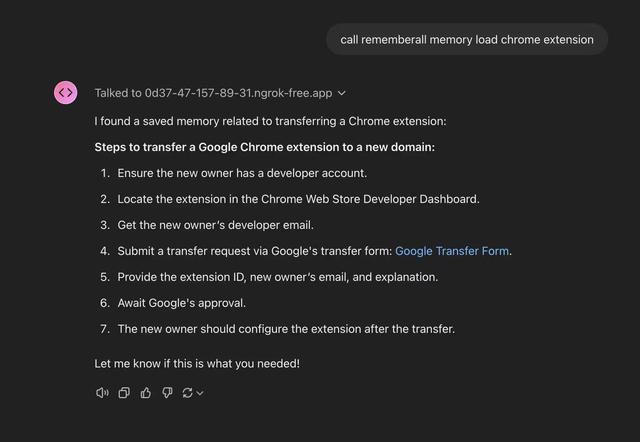
Rememberall is a secure, open-source long-term memory solution that enables AI applications and GPT models to maintain persistent memory across conversations through semantic search and vector storage capabilities.
Upsonic
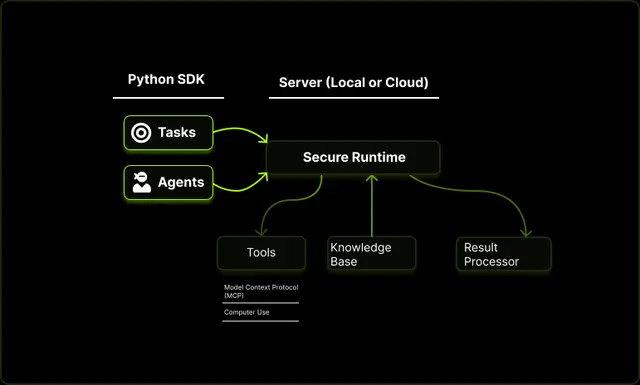
Upsonic is a reliability-focused AI agent framework with dockerized server-client architecture that enables trusted agent workflows through advanced features like verification layers, triangular architecture, and Model Context Protocol (MCP) integration.