
Claude Code Desktop App Redesigned
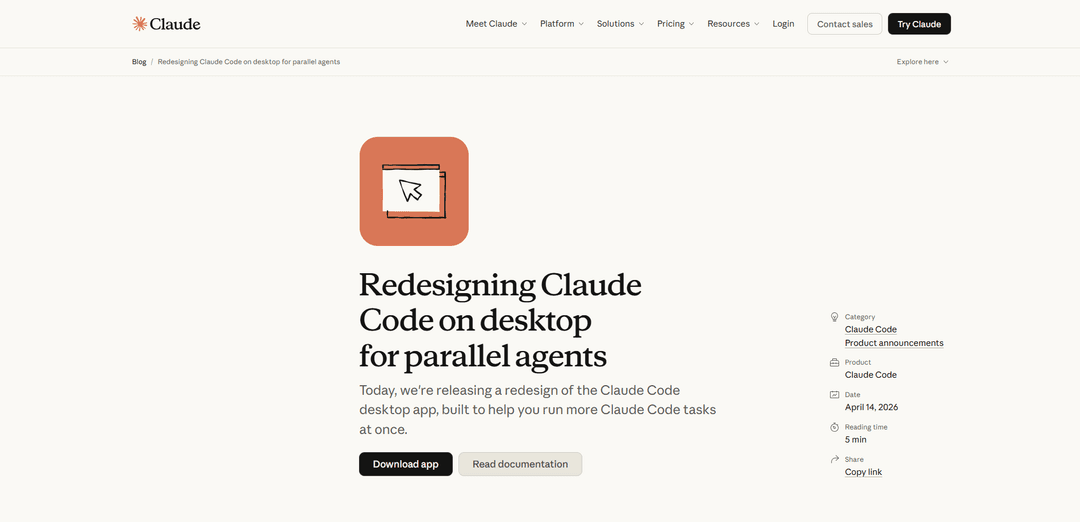
The redesigned Claude Code desktop app, released April 14, 2026, introduces parallel session management, integrated terminal and file editor, drag-and-drop workspace layouts, and enhanced performance for running multiple AI coding agents simultaneously.
https://claude.com/blog/claude-code-desktop-redesign?ref=producthunt
Produktinformationen
Aktualisiert:May 8, 2026
Was ist Claude Code Desktop App Redesigned
Claude Code Desktop App Redesigned represents a fundamental shift in how developers interact with AI coding assistants. Released by Anthropic on April 14, 2026, this complete redesign transforms the desktop experience from a simple conversational interface into a comprehensive workspace designed for agentic coding workflows. Available for macOS and Windows users on Pro, Max, Team, and Enterprise plans, the redesigned app enables developers to orchestrate multiple AI coding sessions in parallel, manage complex development tasks across different repositories, and review code changes without switching between applications. The redesign reflects how modern agentic coding actually works—with multiple tasks running simultaneously while developers act as orchestrators, steering and reviewing work as results arrive.
Hauptfunktionen von Claude Code Desktop App Redesigned
The redesigned Claude Code desktop app, released on April 14, 2026, transforms AI coding from a single-conversation interface into a parallel orchestration platform. It introduces a multi-session sidebar that allows developers to run multiple Claude Code tasks simultaneously across different repositories, with automatic Git worktree isolation. The app features a drag-and-drop layout system for arranging workspace panes (chat, terminal, diff viewer, file editor, preview, plan, tasks), an integrated terminal and file editor to reduce context-switching, and improved performance with streaming responses. It maintains full parity with CLI plugins, supports SSH connections on Mac and Linux, and offers three view modes (Verbose, Normal, Summary) to customize detail levels. Available for Pro, Max, Team, and Enterprise users on macOS and Windows, the redesign shifts the focus from being an IDE replacement to becoming an agent dashboard where developers direct and review AI-generated work.
Multi-Session Sidebar with Parallel Execution: Run multiple Claude Code sessions simultaneously in one window with a new sidebar that manages active and recent sessions. Filter by status, project, or environment, with automatic archiving when PRs merge or close, enabling developers to orchestrate work across multiple repositories concurrently.
Drag-and-Drop Workspace Layout: Customize your workspace by arranging any combination of panes (chat, terminal, diff viewer, file editor, preview, plan, tasks, subagent) in a flexible grid layout. Rearrange panels to match your workflow, such as focusing on diffs while putting chat aside during code review.
Integrated Terminal and File Editor: Review, edit, and ship code without leaving the app through built-in terminal for running tests/builds and an in-app file editor for making spot edits directly. Eliminates the need to bounce between the Claude interface and external editors.
Side Chats for Contextual Questions: Open side chats (⌘+; or Ctrl+;) that branch off from the main conversation thread to ask questions mid-task. Side chats pull context from the main thread but don't add responses back, preventing task misdirection while maintaining conversation flow.
Enhanced Diff Viewer and Preview: Rebuilt diff viewer optimized for performance on large changesets, plus expanded preview capabilities for HTML files, PDFs, and local app servers. Right-click on generated HTML or images to get live previews directly in the app.
CLI Plugin Parity and SSH Support: Full compatibility with CLI plugins—whether centrally managed by your organization or locally installed—working identically in the desktop app. SSH support now extends to Mac alongside Linux for accessing remote machines, with options to run sessions locally or in the cloud.
Anwendungsfälle von Claude Code Desktop App Redesigned
Parallel Feature Development Across Microservices: Development teams working on microservices architectures can simultaneously run refactoring tasks in one repository, bug fixes in another, and test generation in a third, checking on each as results arrive and steering when needed without waiting for sequential completion.
Code Review and Quality Assurance Workflow: Developers can focus on the diff viewer to examine AI-generated changes, use the integrated terminal to run tests immediately, make spot edits in the file editor, and ask clarifying questions via side chats—all without switching between multiple applications.
Remote Development on Cloud Infrastructure: Teams using remote development environments can SSH into their VMs or cloud machines from the desktop app (Mac/Linux), run Claude Code sessions on remote infrastructure, and manage multiple cloud-based projects simultaneously through the unified interface.
Enterprise Plugin Management: Organizations with centrally managed Claude Code plugins can deploy custom tools across their development teams, knowing these plugins will work identically in both the desktop app and CLI, enabling standardized workflows while supporting both interface preferences.
Interactive Prototyping and Preview: Frontend developers and designers can generate HTML/CSS code, immediately preview the output in-app with live rendering, make iterative adjustments through side chats, and test server responses—all within a single window without external browser switching.
Automated Routine Tasks with Desktop Orchestration: Combine the desktop redesign with Routines (launched same day) where Routines handle unattended recurring work in the cloud, while the desktop app orchestrates interactive work, covering the majority of manual development tasks through parallel agent management.
Vorteile
Multi-session support fundamentally changes workflow by enabling parallel task execution, allowing developers to direct multiple AI agents simultaneously rather than waiting for sequential completion
Integrated tools (terminal, file editor, diff viewer, preview) eliminate context-switching friction and keep developers focused within a single interface for reviewing and shipping code
Flexible drag-and-drop layout adapts to different workflows and tasks, unlike competitors like OpenAI's Codex where pane positions are fixed
CLI plugin parity ensures consistency across interfaces and supports enterprise plugin management, making it suitable for organizations with standardized tooling requirements
Nachteile
No Linux desktop support at launch (only macOS and Windows), limiting accessibility for developers on Linux workstations despite CLI availability
Lacks native IDE features like LSP, go-to-definition, and multi-cursor editing—it's an agent dashboard rather than a full code editor replacement, requiring developers to maintain separate IDEs for certain tasks
Token usage concerns with multiple parallel sessions potentially burning through usage limits faster, as reported by users experiencing rapid limit exhaustion
Some users report third-party plugins not showing up properly in the terminal or main view during testing, indicating potential compatibility issues despite claimed CLI parity
Wie verwendet man Claude Code Desktop App Redesigned
1: Download or update the Claude desktop app from claude.com/download. If you already have the app installed, restart it to get the redesigned version.
2: Ensure you have a paid subscription (Pro, Max, Team, or Enterprise plan). Claude Code requires one of these plans to access.
3: Click the 'Code' tab at the top center of the app. If prompted to upgrade, subscribe to a paid plan first. If prompted to sign in online, complete the sign-in and restart the app.
4: Use the new sidebar to manage multiple sessions. You can kick off work across multiple repositories and move between them as results arrive. Filter sessions by status, project, or environment, or group them by project.
5: Arrange your workspace using drag-and-drop. Customize the layout by moving panes for the terminal, preview, diff viewer, and chat to match your workflow preferences.
6: Use the integrated terminal to run tests or builds alongside your session without leaving the app.
7: Make spot edits directly in the in-app file editor. Open files, edit them, and save changes without switching to an external editor.
8: Review code changes using the rebuilt, faster diff viewer designed for performance on large changesets.
9: Preview HTML files, PDFs, or run local app servers in the expanded preview pane. Right-click on Claude's output to get a live preview when it generates HTML, images, or certain server responses.
10: Open a side chat (⌘ + ; on Mac or Ctrl + ; on Windows) to ask questions mid-task. Side chats pull context from the main thread without adding anything back, avoiding misdirection of your tasks.
11: Customize your view mode by choosing between Verbose, Normal, and Summary modes to control how much detail you see about Claude's tool calls.
12: Use keyboard shortcuts for navigation. Press ⌘ + / (Mac) or Ctrl + / (Windows) to see the full list of available shortcuts for session switching, spawning, and navigation.
13: Monitor your usage by clicking the new usage button to see both your context window and session usage at a glance.
14: Configure CLI plugins if your organization manages them centrally. They will work in the desktop app exactly as they do in your terminal.
15: For Mac users, use SSH support to point sessions at remote machines. You can run sessions locally or in the cloud.
16: Interrupt Claude at any point if needed. Click the stop button or type your correction and press Enter to steer the work in a different direction.
17: Explore the documentation at docs.claude.com/claude-code for more detailed information and advanced features.
Claude Code Desktop App Redesigned FAQs
Released on April 14, 2026, the Claude Code desktop redesign is a complete rebuild of the desktop app that enables running multiple Claude Code sessions in parallel. It features a new sidebar for session management, drag-and-drop pane layouts, an integrated terminal, in-app file editor, faster diff viewer, and expanded preview capabilities for HTML and PDF files. The redesign is available for Pro, Max, Team, and Enterprise users on Mac and Windows.
Claude Code Desktop App Redesigned Video
Beliebte Artikel

Vosko AI: Videos für ein globales Publikum lokalisieren und synchronisieren
Oct 15, 2026

Atoms: Eine Multi-Agenten-KI-Plattform, die Ideen in startbereite Produkte verwandelt
May 22, 2026

Nano Banana SBTI: Was es ist, wie es funktioniert und wie man es im Jahr 2026 einsetzt
Apr 15, 2026

Atoms Review – Der KI-Produkt-Builder, der die digitale Erstellung im Jahr 2026 neu definiert
Apr 10, 2026
Neueste KI-Tools ähnlich wie Claude Code Desktop App Redesigned
Gait
Gait ist ein Collaboration-Tool, das KI-unterstützte Codegenerierung mit Versionskontrolle integriert und es Teams ermöglicht, KI-generierten Codekontext effizient zu verfolgen, zu verstehen und zu teilen.
invoices.dev
invoices.dev ist eine automatisierte Rechnungsplattform, die Rechnungen direkt aus den Git-Commits der Entwickler generiert und Integrationsmöglichkeiten für GitHub, Slack, Linear und Google-Dienste bietet.
EasyRFP
EasyRFP ist ein KI-gestütztes Edge-Computing-Toolkit, das RFP (Request for Proposal)-Antworten optimiert und eine Echtzeit-Feldphänotypisierung durch Deep-Learning-Technologie ermöglicht.

Cart.ai
Cart.ai ist eine KI-gestützte Dienstleistungsplattform, die umfassende Lösungen zur Automatisierung von Geschäftsprozessen bietet, einschließlich Programmierung, Kundenbeziehungsmanagement, Videobearbeitung, E-Commerce-Setup und benutzerdefinierter KI-Entwicklung mit 24/7 Unterstützung.
Beliebte KI-Tools wie Claude Code Desktop App Redesigned

GitHub Copilot Chat
GitHub Copilot Chat ist ein KI-gestützter Codierungsassistent, der Interaktionen in natürlicher Sprache, Echtzeit-Codevorschläge und kontextuelle Unterstützung direkt innerhalb unterstützter IDEs und GitHub.com bietet.
CopilotForXcode
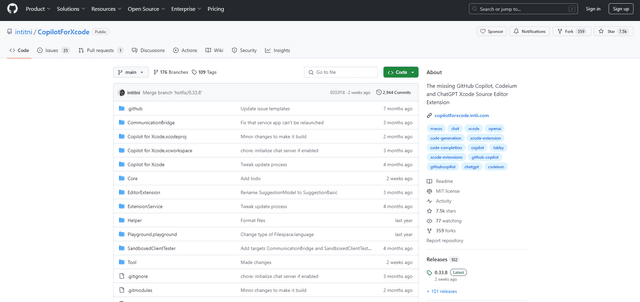
CopilotForXcode ist eine Xcode-Quell-Editor-Erweiterung, die GitHub Copilot, Codeium und ChatGPT integriert, um KI-gestützte Codevorschläge, Chat-Unterstützung und Prompt-to-Code-Funktionalität innerhalb von Xcode bereitzustellen.

BrowserAI
BrowserAI ist eine Open-Source-Bibliothek, die die Ausführung lokaler Large Language Models (LLMs) direkt in Webbrowsern mit WebGPU-Beschleunigung ermöglicht und datenschutzorientierte KI-Funktionen bietet, ohne dass eine Serverinfrastruktur erforderlich ist.
OpenAI Codex CLI
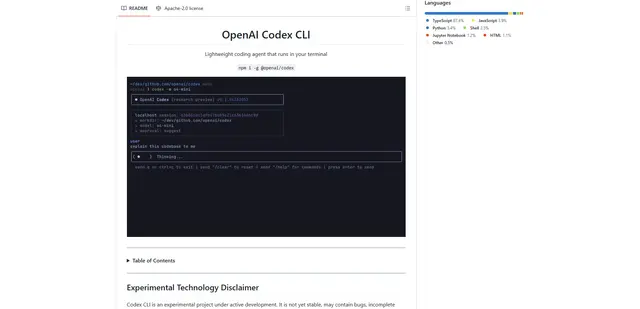
OpenAI Codex CLI ist ein schlanker Open-Source-Coding-Agent, der in Ihrem Terminal ausgeführt wird und es Entwicklern ermöglicht, natürliche Sprache in Codeausführung zu übersetzen und gleichzeitig ChatGPT-ähnliche Argumentation mit der Möglichkeit, Code auszuführen, Dateien zu bearbeiten und unter Versionskontrolle zu iterieren, bereitzustellen.