
Via 1.0
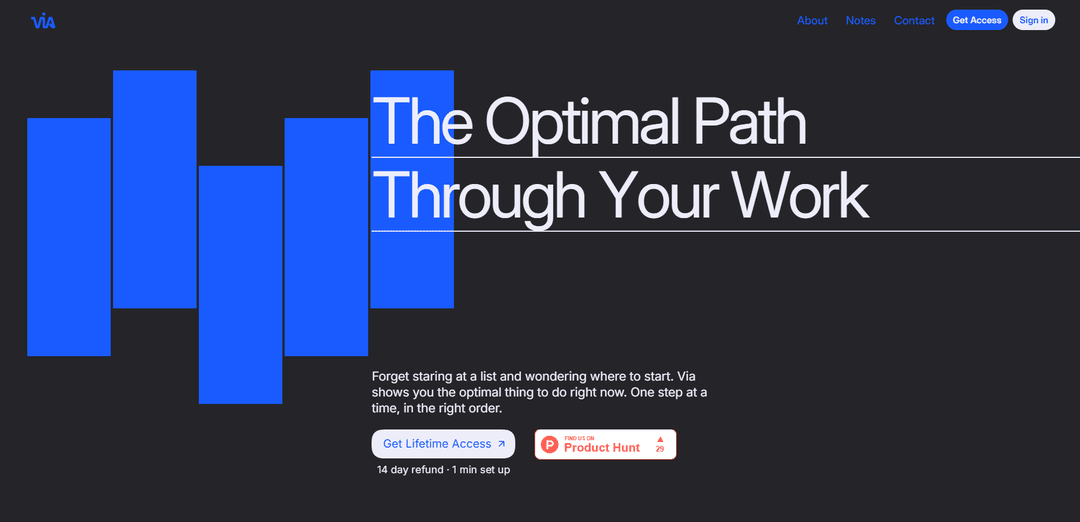
Via 1.0 is an AI-powered productivity planner that turns voice/text/photo “brain dumps” into structured work and automatically builds an energy-aware, continuously updating schedule that always shows your optimal next step.
https://www.usevia.io/?ref=producthunt
Product Information
Updated:Aug 8, 2026
What is Via 1.0
Via 1.0 is a planning and execution tool designed to help you move from scattered thoughts to completed work without manually reshuffling to-do lists. It combines capture, prioritisation, and auto-scheduling in a single workspace that can hold tasks, events, notes, and routines, then guides you step-by-step through what to do next. Built for individuals (and available in tiers that add advanced capabilities like dependencies and integrations), Via focuses on reducing decision fatigue by making your plan adaptive as your day changes.
Key Features of Via 1.0
Via 1.0 is a productivity and planning tool that captures messy inputs (typed notes, voice, photos, files) and turns them into structured work items—tasks, events, notes, and routines—then automatically prioritizes and builds an optimized schedule around your availability, energy, goals, deadlines, and dependencies. It continuously adapts as your day changes (e.g., meetings shift, priorities move), and focuses execution by showing the single optimal “next thing” to do right now. It also includes multiple ways to visualize plans (calendar, list, kanban), tracking/insights via a focus timer, multilingual support, offline-capable mobile/desktop use, and integrations such as Google Calendar, with advanced options like BYOK, API access, and MCP integration in higher tiers.
Multi-modal capture → structured work: Capture work by speaking, typing, photographing notes, or uploading files; Via converts inputs into organized tasks, events, notes, and routines so ideas don’t stay as unstructured “brain dumps.”
Logistics-grade auto-planning & rescheduling: An auto-scheduling algorithm builds an optimized plan around what matters and updates instantly as your day changes—reducing manual reshuffling when meetings run late or deadlines move.
Multi-factor prioritization (next-best action): Prioritizes using factors like effort, importance, duration, deadlines, and dependencies, then surfaces the optimal thing to work on right now to reduce decision fatigue.
Energy-aware scheduling profiles: Plans can be shaped by your energy and goals using profiles, helping match task selection and timing to how you want your day/week to be constructed.
Unified workspace + relationships/dependencies: Keeps notes, tasks, events, and routines in one place and links related items; higher tiers add task dependencies and multiple workspaces for more complex organization.
Execution support: focus timer, tracking & insights: Includes focus mode and time tracking to analyze workload trends and estimation accuracy; a predictive model can adjust task duration estimates to make plans more realistic.
Use Cases of Via 1.0
Solo founder / operator workload management: Capture scattered ideas and commitments, then let Via prioritize and auto-schedule across product, sales, and admin—adapting when urgent customer issues or meetings disrupt the day.
Client services & consulting delivery: Turn client emails/notes into tasks and events, schedule work around availability, and use dependencies to ensure deliverables happen in the right order while calendars shift.
Creative production (content, design, writing): Brain-dump concepts via voice or photos, convert them into actionable steps, and rely on next-best-action guidance to keep momentum without constantly re-planning.
Project execution for small teams: Use the team tier to distribute workload and coordinate collaboration, while the planner optimizes schedules and helps teams react to changing priorities.
Personal life admin + routines: Combine errands, appointments, and routines with work tasks in one system, timeblock by categories, and let Via rebuild the plan when real life interrupts.
AI-integrated workflows (MCP / API / BYOK): For technical users, connect Via to external tools or preferred AI models using MCP integration, API access, or BYOK to automate capture, enrichment, or cross-app planning workflows.
Pros
Reduces decision fatigue by continuously presenting the optimal next task rather than a static list.
Auto-scheduling adapts to real-world changes (meetings/deadlines) without manual reshuffling.
Flexible capture methods (voice/photo/file/text) help turn messy inputs into structured work quickly.
Supports multiple planning styles (calendar/list/kanban) plus tracking/insights for improving estimates.
Cons
Full capability is tier-dependent (e.g., dependencies, MCP, BYOK, API, and team features require higher tiers).
Heavily relies on the quality of captured inputs and estimates (duration/importance) to produce optimal schedules.
Users who prefer fully manual planning may find algorithm-driven prioritization less controllable without tuning.
How to Use Via 1.0
1) Open Via 1.0: In a Chromium-based browser (Chrome, Edge, Brave, Opera), go to the official VIA configurator web app: https://usevia.app/ (no download needed).
2) Connect your keyboard (wired recommended): Plug your VIA-compatible keyboard into your computer with a USB cable and set the keyboard to wired mode if it has a mode switch. Confirm the keyboard works by typing in any text editor.
3) Allow device access so VIA can detect the keyboard: When the browser prompts for HID/device access, grant permission and select your keyboard. If the Configure page stays on “Searching for devices,” retry using the web app at https://usevia.app/ and ensure you are not using Firefox (which typically blocks HID access).
4) (If needed) Load your keyboard’s JSON definition: If VIA doesn’t recognize your board automatically, import the correct keyboard JSON file (each keyboard has its own JSON). Use the JSON provided by your keyboard brand/model documentation, then retry detection.
5) Open the Configure tab and understand layers: Go to the Configure screen to see your keymap. Layers are numbered starting at Layer 0 (your default/base typing layer). The currently selected layer is shown/highlighted near the layer indicator.
6) Remap a key on Layer 0 (basic remap): Select Layer 0, click the key you want to change on the on-screen layout, then click the new keycode/function you want to assign. The change applies immediately.
7) Add an “Fn” style key using MO(n) (momentary layer): To create an Fn-like key, assign a key to MO(1) from the Layers keycodes. Holding that key temporarily activates Layer 1; releasing it returns to Layer 0.
8) Put alternate functions on Layer 1: Switch to Layer 1 in the layer selector, then assign secondary functions (e.g., media controls). Example behavior: F8 on Layer 0 can remain F8, while on Layer 1 you can set that same position to Play/Pause—then use Fn (MO(1)) + F8 to trigger it.
9) Use other common layer behaviors (optional): Use LT(layer, kc) for a dual-role key (tap sends kc, hold switches to the layer). Use OSL(n) for one-shot layer access (tap to activate Layer n for one keypress, then it returns to Layer 0). Use TG(n) to toggle a layer on/off (a more “permanent” switch until toggled back).
10) Record a macro: Go to MACROS in the Configure area. A macro must be recorded/created first before binding it to a key. Enter the macro content and save it.
11) Build macros using QMK keycode aliases (optional advanced): Look up the keycode aliases you need (e.g., from QMK keycodes documentation) and enter them in VIA’s macro format. Example shown in sources: {KC_LWIN,KC_LSFT,KC_S} then press Save.
12) Bind a macro to a key: Return to KEYMAP, select the target layer, click the key you want to assign, then choose the macro slot (e.g., M0) you created so pressing that key triggers the macro.
13) Verify and iterate: Test the remaps, layers, and macros in a text editor or the target app/game. Adjust Layer 0/1/2 layouts as needed (e.g., keep Layer 1 for frequently used shortcuts and move less-used controls to another layer).
Via 1.0 FAQs
Via 1.0 is a productivity and planning tool that captures your work (notes, tasks, events, and routines) and builds an optimized schedule around your priorities, energy, and availability. It then shows you the optimal next thing to do and adapts your plan when your day changes.
Via 1.0 Video
Popular Articles

Vosko AI: Localize and Dub Videos for Global Audiences
Oct 15, 2026

Atoms: A Multi-Agent AI Platform That Transforms Ideas into Launch-Ready Products
Oct 13, 2026

Nano Banana SBTI: What It Is, How It Works, and How to Use It in 2026
Apr 15, 2026

Atoms Review — The AI Product Builder Redefining Digital Creation in 2026
Apr 10, 2026
Latest AI Tools Similar to Via 1.0
Inbox AI
Inbox AI is a privacy-focused MacOS productivity app that combines voice-driven AI automation with email management capabilities, allowing users to create custom workflows and commands while offering both cloud-based and on-device AI options.

Cart.ai
Cart.ai is an AI-powered service platform that provides comprehensive business automation solutions including coding, customer relations management, video editing, e-commerce setup, and custom AI development with 24/7 support.
Hiyllo Work
Hiyllo Work is an all-in-one team workspace platform that combines chat, project management, calendar, email, file storage and video meetings in a single integrated environment.

MailSense
MailSense is an AI-powered email assistant that filters, summarizes, and generates replies to emails through a Telegram bot interface to help users manage their inbox more efficiently.
Popular AI Tools Like Via 1.0
Magentic-UI
Magentic-UI is an open-source, human-centered web agent prototype by Microsoft Research that enables collaborative planning and execution of complex web-based tasks through transparent interaction between humans and AI agents.
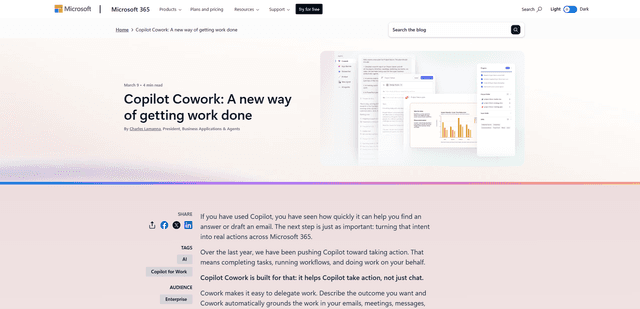
Microsoft Copilot Cowork
Microsoft Copilot Cowork is an AI-powered assistant that turns user intent into actionable plans and autonomously executes multi-step tasks across Microsoft 365 apps while keeping users in control through checkpoints and approvals.
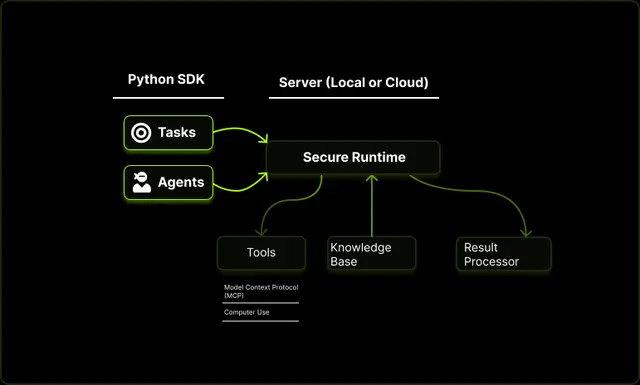
Upsonic
Upsonic is a reliability-focused AI agent framework with dockerized server-client architecture that enables trusted agent workflows through advanced features like verification layers, triangular architecture, and Model Context Protocol (MCP) integration.
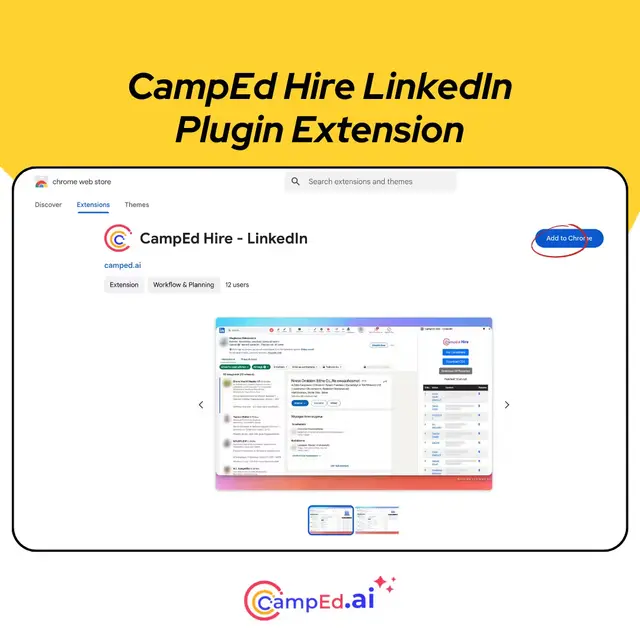
CampEd Hire
CampEd Hire is a powerful Chrome extension that streamlines recruitment by automatically collecting and organizing job applicant data from LinkedIn job posts, with features like automated data collection, CSV export, and batch resume downloads.