
Solarch
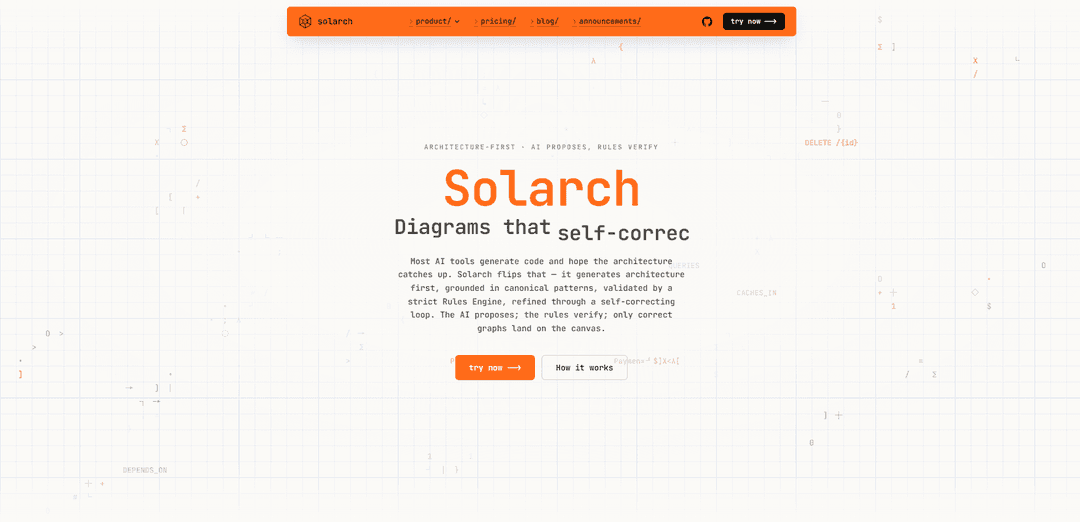
Solarch is an architecture-first backend tool that validates your system diagrams with a strict rules engine and then compiles the verified graph into type-safe code using a hybrid deterministic + AI generation pipeline.
https://solarch.dev/?ref=producthunt
Product Information
Updated:Jun 15, 2026
What is Solarch
Solarch is a backend-architecture product that turns system design into shippable code by making the diagram the source of truth. Instead of generating code first and hoping the architecture stays consistent, Solarch lets you model your backend as a node/edge graph (e.g., controllers, services, repositories, tables, DTOs, queues) on a single canvas while a default-deny Rules Engine enforces canonical patterns and blocks invalid connections. From that validated architecture, Solarch can export code, diagrams, and AI-readable artifacts to keep implementation aligned with design.
Key Features of Solarch
Solarch is an architecture-first backend design and code-generation tool where you model systems as a validated node/edge graph (controllers, services, repositories, tables, DTOs, queues). A strict default-deny Rules Engine prevents illegal connections to enforce canonical patterns and avoid architectural drift. From the verified diagram, Solarch generates a type-safe code skeleton deterministically (zero tokens) and then uses “surgical” AI to fill only empty function bodies, with exports to code, Mermaid diagrams, and AI-readable memory for use in tools like Cursor/Claude.
Architecture-first diagramming: Design the entire backend on a single canvas as a graph of components (e.g., controllers, services, repositories, DB tables, DTOs, queues) to keep structure explicit and reviewable.
Default-deny Rules Engine validation: Enforces architectural constraints in real time by rejecting non-whitelisted edges (e.g., preventing controllers from directly accessing tables), reducing anti-patterns and drift.
Hybrid code generation (deterministic + AI): Stage 1 compiles the verified graph into boilerplate skeleton code (DTOs, entities, constructor injection) deterministically; Stage 2 uses AI to complete function bodies without regenerating everything.
Self-correcting propose/verify loop: The AI proposes an architecture, rules verify it, and only valid graphs land on the canvas—helping teams converge on correct designs faster.
Multi-format exports for collaboration: Export generated outputs as code, Mermaid diagrams, API contracts, or AI-readable memory to share designs across engineering and documentation workflows.
Team collaboration model: Supports shared projects with organizational reuse patterns (e.g., single-home nodes and ghost references) to coordinate architecture across teams.
Use Cases of Solarch
Rapid scaffolding for SaaS backends: Generate consistent service/repository/controller layers and DTOs for multi-tenant apps, leaving only business logic to implement.
Standardizing architecture in engineering teams: Use rules-validated diagrams to enforce agreed patterns, reduce review overhead, and keep code aligned with intended architecture over time.
API-first platform development: Model controllers/DTOs and export API contracts and diagrams to align backend implementation with product and integration requirements.
Modernizing legacy systems: Re-map a legacy backend into a clean target architecture, validate boundaries (e.g., controller → service → repository), then scaffold a refactorable codebase.
Regulated or audit-heavy environments: Maintain an explicit, validated architecture artifact (diagram + generated skeleton) that supports traceability and reduces undocumented architectural changes.
Pros
Real-time architectural enforcement reduces common anti-patterns and drift between diagrams and code.
Hybrid generation accelerates boilerplate creation while keeping core business logic under developer control.
Exports (code/Mermaid/AI memory) improve collaboration and documentation across tools and stakeholders.
Cons
Rules-driven modeling can feel restrictive for unconventional architectures or rapid experimentation.
Best fit is backend systems that map cleanly to canonical patterns; niche stacks may require adaptation.
AI-filled function bodies may still require review and iteration to match domain-specific requirements.
How to Use Solarch
1) Start Solarch and create a project: Go to https://app.solarch.dev (or the main site https://solarch.dev and click into the app). Create a new project/workspace so you have an empty canvas to design your backend.
2) Understand the canvas model (nodes + edges): Solarch represents your backend as a graph. Add nodes for backend building blocks (e.g., Controllers, Services, Repositories, Tables/DB entities, DTOs, Queues). Connect them with edges to represent allowed dependencies and data flow.
3) Draw your architecture on the canvas: Place the core components you need (e.g., Controller → Service → Repository → Table, plus DTOs for request/response). Keep building the graph until it matches the system you want to implement.
4) Let the Rules Engine validate every connection: As you draw edges, Solarch’s default-deny Rules Engine validates them immediately. If an edge is not explicitly allowed, it is rejected. Example from the FAQ: a Controller cannot connect directly to a Table; it must go through a Service or Repository.
5) Iterate until the graph is fully valid: Refine the architecture by adjusting nodes and edges until the Rules Engine accepts the whole design. This is the “architecture-first” loop: the AI can propose, but the rules verify, and only correct graphs remain on the canvas.
6) (Optional) Use AI diagram generation to accelerate the first draft: If your plan includes AI diagram generation (e.g., Build), describe what you want to build and let Solarch propose an initial architecture. Then review and edit it while the Rules Engine enforces correctness.
7) Generate code using the hybrid code engine (Stage 1 + Stage 2): Trigger code generation from the validated graph. Stage 1 is deterministic (0 tokens) and produces a skeleton that matches the diagram exactly (e.g., DTOs, entities, constructor injection derived from edges). Stage 2 uses “surgical AI” to fill only the empty function bodies.
8) Review the generated output for alignment with your intent: Confirm the generated skeleton and AI-filled function bodies match your desired behavior. Solarch’s goal is zero architectural drift: the code should reflect the validated diagram.
9) Export artifacts for development and collaboration: Export the result in the format you need: generated code, a Mermaid diagram, or AI-readable memory. The site also mentions exports “to Cursor & Claude Ready,” enabling you to continue work in those tools with the architecture context preserved.
10) Collaborate with a team (if applicable): If you’re on the Team plan, work in shared projects. The source mentions shared projects with “single-home nodes” and “ghost references across the org,” enabling reuse and consistency across teams.
11) Keep evolving the system by updating the diagram first: When requirements change, update the architecture graph on the canvas first. Let the Rules Engine prevent invalid dependencies, then regenerate/export so the codebase stays aligned with the diagram.
12) Choose a plan based on how much automation you want: Per the pricing info: start with Draw for rules-validated diagramming; use Build for AI scaffolding; and consider higher tiers (e.g., Team/Enterprise) if you need collaboration or org features like SSO/audit logs/custom rules.
Solarch FAQs
Solarch is a backend-architecture tool where you model your system as a node/edge graph (e.g., controllers, services, repositories, tables, DTOs, queues). A strict Rules Engine validates connections as you draw, and Solarch generates code from the validated graph to prevent architecture drifting from the codebase.
Solarch Video
Popular Articles

Atoms: A Multi-Agent AI Platform That Transforms Ideas into Launch-Ready Products
May 22, 2026

Nano Banana SBTI: What It Is, How It Works, and How to Use It in 2026
Apr 15, 2026

Atoms Review — The AI Product Builder Redefining Digital Creation in 2026
Apr 10, 2026

Kilo Claw: How to Deploy and Use a True "Do‑It‑For‑You" AI Agent(2026 Update)
Apr 3, 2026
Latest AI Tools Similar to Solarch
Foundry
Foundry is a versatile platform that exists in multiple forms - as a smart contract development toolchain, a virtual tabletop gaming software, and a traditional metal casting facility - each offering specialized features for their respective domains.
PythonConvert.com
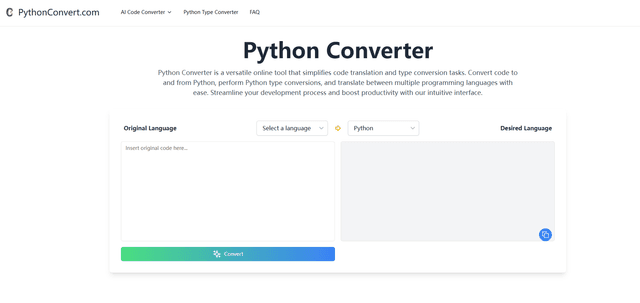
PythonConvert.com is a free web-based tool that provides AI-powered code translation between Python and other programming languages as well as Python type conversion capabilities.

Softgen
Softgen.ai is an AI-powered full-stack project generator platform that enables users to transform their ideas into functional web applications without coding requirements.
Micro SaaS Ideas
Micro SaaS Ideas are small-scale, niche-focused software solutions that target specific problems or markets, offering entrepreneurs a way to build profitable businesses with minimal resources and complexity.
Popular AI Tools Like Solarch

GitHub Copilot Chat
GitHub Copilot Chat is an AI-powered coding assistant that provides natural language interactions, real-time code suggestions, and contextual support directly within supported IDEs and GitHub.com.
CopilotForXcode
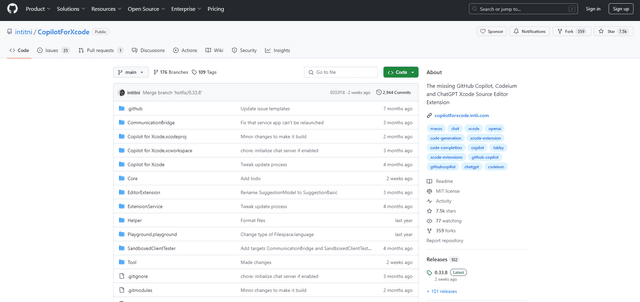
CopilotForXcode is an Xcode Source Editor Extension that integrates GitHub Copilot, Codeium, and ChatGPT to provide AI-powered code suggestions, chat assistance, and prompt-to-code functionality within Xcode.
OpenAI Codex CLI
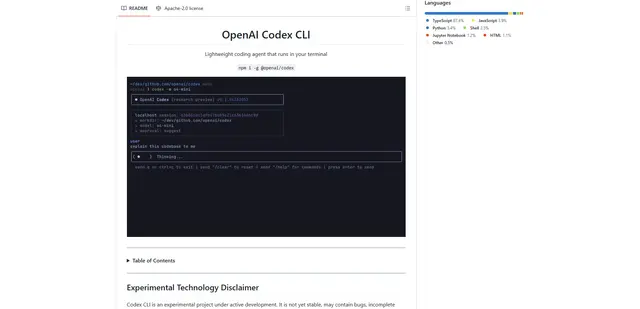
OpenAI Codex CLI is a lightweight, open-source coding agent that runs in your terminal, enabling developers to translate natural language into code execution while providing ChatGPT-level reasoning with the ability to run code, manipulate files, and iterate under version control.
GoCodeo SaaS Builder
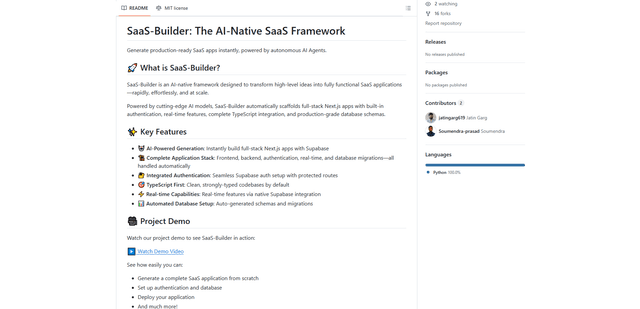
GoCodeo SaaS Builder is an AI-native framework that automatically generates production-ready full-stack SaaS applications using autonomous AI agents, complete with authentication, real-time features, and TypeScript integration.