Sequence

Sequence

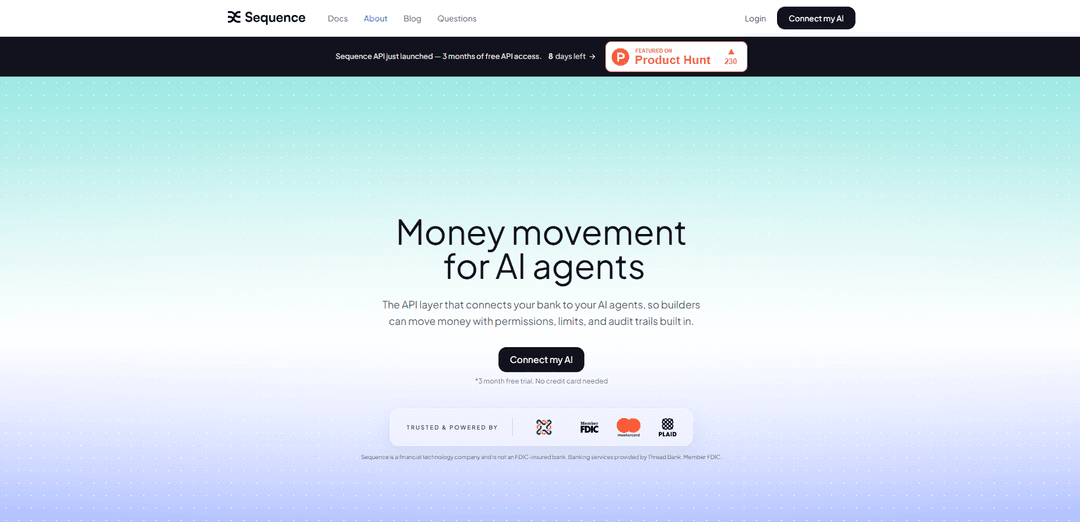
Sequence is a financial router and API layer for automating and executing real money movement across connected bank accounts, with permissions, limits, simulation mode, and audit trails built in.
https://home.getsequence.io/?ref=producthunt
Sequence

Product Information

Updated:Jul 2, 2026

What is Sequence

Sequence is a fintech platform designed to make money movement actionable and automated across the financial accounts you already use. It connects to a broad set of U.S. institutions (via Plaid and other providers) so you can unify checking, savings, credit cards, loans, investments, and more in one place, then route funds according to rules or workflows. For builders and AI teams, Sequence Agentic provides an execution layer that lets AI agents trigger real transfers securely—so systems that can already read invoices, flag exceptions, or route approvals can also “close the loop” by actually paying vendors, reimbursing expenses, or transferring funds. Sequence is a financial technology company and not an FDIC-insured bank; banking services are provided by Thread Bank, Member FDIC.

Key Features of Sequence

Sequence is a financial automation and “money movement” platform (and API layer via Sequence Agentic) that connects to your existing financial accounts—typically through Plaid—and lets you visualize cash flow, set smart routing rules, and actually execute transfers across real bank rails (e.g., ACH). It’s designed to be the execution layer for workflows and AI agents: when your system decides money should move (pay a vendor, reimburse an employee, fund tax savings), Sequence can perform the transfer with safeguards like scoped access, enforced limits, and audit trails, plus a simulation mode for end-to-end testing before going live.
Multi-account connectivity (95%+ US institutions via Plaid): Connect checking, savings, credit cards, loans, brokerages, and more—including major institutions like Chase, Bank of America, Schwab, Fidelity, and Stripe—so balances and transfers can be orchestrated from one place.
Smart routing rules & “Pods” for goal-based budgeting: Create custom rules that automatically route money into buckets (Pods) for goals like taxes, bills, savings, or investing, turning incoming cash into a structured, repeatable flow.
Agentic/API money movement (Sequence Agentic): An API layer that lets AI agents and automations trigger real transfers programmatically—dropping Sequence in wherever you’d otherwise write “TODO: move money.”
Security controls: scoped keys, spend limits, and audit trails: Agents authenticate with scoped API keys you can revoke, with server-side enforced limits per key/rule and detailed logs (session ID, timestamps, and action records) for traceability.
Simulation mode for safe end-to-end testing: Test workflows using simulated accounts and instant test transfers so you can validate automations before enabling real money movement.
Operational transfer execution over banking rails: Transfers between Sequence-held accounts can be instant; external transfers typically run over ACH and settle same or next business day, with Sequence selecting the rail while you/your agent selects timing.

Use Cases of Sequence

AP automation: autopay approved vendor invoices: After an invoice is read, validated, and approved in a workflow tool (e.g., n8n/Zapier), Sequence executes the vendor payment and logs the action for reconciliation.
Personal/household “CFO”: split paychecks automatically: Route each paycheck into bills, emergency fund, debt payoff, and savings Pods immediately upon deposit—reducing manual budgeting and missed payments.
SMB cash management: allocate revenue to taxes, payroll, and margin: When client payments land, automatically distribute funds into tax reserves, operating cash, and other targets based on predefined rules.
Expense operations: reimbursements and internal transfers: Once expenses are flagged and approved, trigger reimbursements or move funds between accounts/Pods to keep budgets and cash positions aligned.
AI-agent financial execution inside no-code/LLM tools: Integrate with tools like ChatGPT/Claude/Cursor/LangChain via tool definitions so an agent can decide and then execute transfers with guardrails.
Goal-driven financial automation for founders/operators: Non-engineers can build “money maps” and routing strategies in a visual system, then rely on automations to keep the plan running behind the scenes.

Pros

Closes the loop from finance workflows to real execution (moves money, not just tracks it).
Strong safety model for automation/agents: scoped keys, enforced limits, and audit trails.
Broad account connectivity via Plaid and compatibility with popular automation/AI builder ecosystems.
Simulation mode reduces risk when developing/testing automations.

Cons

External API is a premium/advanced feature and may be disabled by default depending on the plan.
External transfers rely on ACH timing (same/next business day), so not all movements are instant.
Not all connected accounts may support full routing/money movement (some may be visibility-only depending on institution/account type).

How to Use Sequence

1) Create a Sequence account: Go to getsequence.io and sign up. Sequence is a fintech platform (not a bank); banking services are provided by Thread Bank (Member FDIC) for Sequence-held accounts.
2) Decide your setup: personal, business, or both: If you plan to use business features (e.g., business-only capabilities), ensure your business beneficiary can be verified so Sequence accounts can be tied to the correct business entity.
3) Connect your existing financial institutions: In Sequence, link the bank/investment/liability accounts you already use (Sequence supports connectivity to ~95% of U.S. institutions via Plaid and other providers).
4) (Optional) Create Pods to organize money by goal: Create Pods (mini accounts) for goals like taxes, savings, payroll, and expenses so funds don’t get mixed and can be routed intentionally.
5) (Optional) Issue a card per Pod: If available in your account, issue a virtual or physical debit card for a Pod so spending maps cleanly to the right budget/goal.
6) Build your Money Map: Use Sequence’s visualization to see balances and how money is distributed across connected accounts and Pods, then plan where money should flow.
7) Create routing Rules (automations): Define how money should move: percentages, fixed amounts, dates, priorities, or triggers. Add IF logic to adapt (e.g., pause savings when balance is low, send more to debt when income is high).
8) Test safely with Simulation Mode: Use the built-in simulation mode with simulated accounts and instant test transfers to validate your end-to-end flow before moving real money.
9) Go live and monitor transfers: Enable your rules for real accounts. Transfers between Sequence-held accounts are instant; external transfers run over ACH and typically settle same or next business day. Use notifications/audit history to stay in the loop.
10) Enable External/Remote API access (advanced): If you want to integrate Sequence into your own software/agent/no-code tool, enable the External API feature in Sequence account settings (it may be disabled by default). Remote API is described as beta and may require contacting support to enable.
11) Authenticate API calls correctly: For user-context endpoints (e.g., retrieving accounts/balances), send your user access token in the header: x-sequence-access-token: Bearer YOUR_ACCESS_TOKEN. Keep tokens/secrets out of client-side code.
12) Retrieve your accounts via API: Call the accounts endpoint to list account data (id, balance, name). Example pattern shown in docs: POST https://api.getsequence.io/accounts with headers x-sequence-access-token: Bearer {YOUR_ACCESS_TOKEN} and Content-Type: application/json, body {}.
13) Trigger a Rule via API (agentic execution): Create a Rule in Sequence configured to be triggered externally, then call the trigger endpoint with the rule’s API secret in x-sequence-signature: Bearer YOUR_API_SECRET. Example pattern: POST https://api.getsequence.io/rules/{ruleId}/trigger (or Remote API path shown in docs) with JSON body {}.
14) Use idempotency for safe retries: When triggering sensitive operations (like payments/transfers), include an idempotency-key header (any string up to 255 chars; UUID v4 recommended). If a network error occurs, retry with the same idempotency-key to ensure the operation happens no more than once.
15) Apply permissions, limits, and revocation for agent safety: When using Sequence Agentic with AI agents, use scoped API keys/permissions and enforce spend limits per key and per rule. Sequence enforces limits server-side and logs actions to an audit trail so agents can’t bypass controls.

Sequence FAQs

Sequence Agentic is an API layer that lets AI agents move money with permissions, limits, and audit trails built in—so when an agent decides money should move, it can call Sequence and Sequence executes the transfer on real banking rails.

Latest AI Tools Similar to Sequence

Foundry
Foundry
Contact for PricingAI Code GeneratorGame Tools
Foundry is a versatile platform that exists in multiple forms - as a smart contract development toolchain, a virtual tabletop gaming software, and a traditional metal casting facility - each offering specialized features for their respective domains.
PythonConvert.com
PythonConvert.com
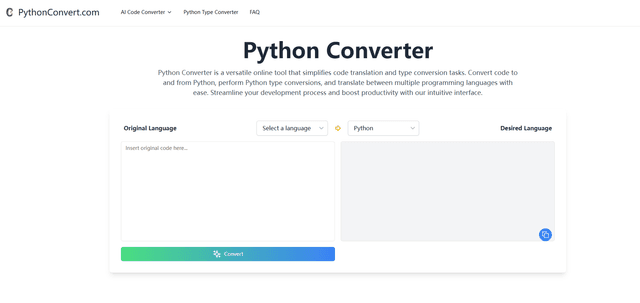
PythonConvert.com is a free web-based tool that provides AI-powered code translation between Python and other programming languages as well as Python type conversion capabilities.
Softgen
Softgen
Softgen.ai is an AI-powered full-stack project generator platform that enables users to transform their ideas into functional web applications without coding requirements.
Micro SaaS Ideas
Micro SaaS Ideas
Micro SaaS Ideas are small-scale, niche-focused software solutions that target specific problems or markets, offering entrepreneurs a way to build profitable businesses with minimal resources and complexity.