
OptimizeGEO.ai
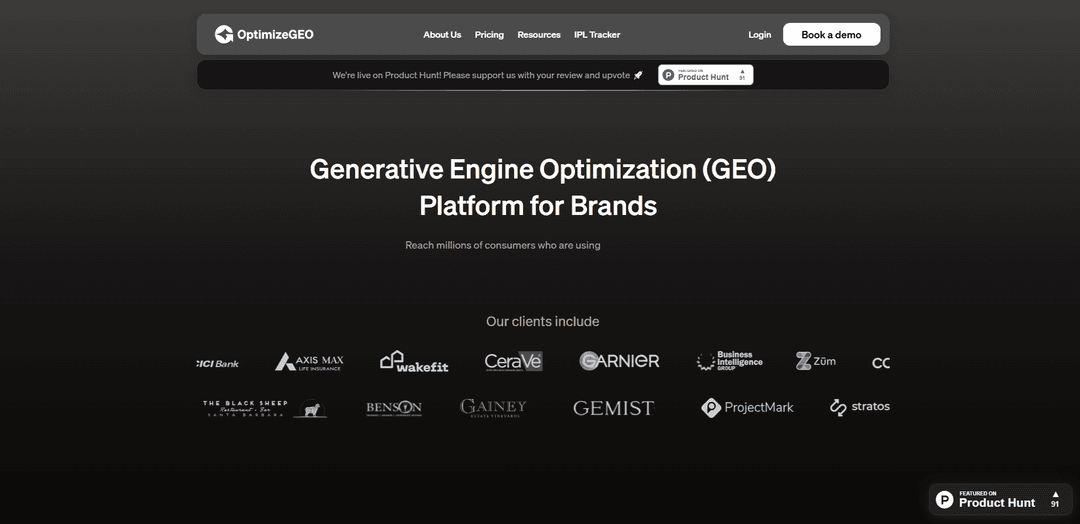
OptimizeGEO.ai is a Generative Engine Optimization (GEO) platform that tracks brand visibility, citations, share of voice, and sentiment across AI answer engines (ChatGPT, Perplexity, Gemini, Google AI Overview, Claude, Copilot) and turns those insights into prioritized, executable actions—up to autonomous content publishing.
https://www.optimizegeo.ai/?ref=producthunt
Product Information
Updated:May 18, 2026
What is OptimizeGEO.ai
OptimizeGEO.ai is an AI search visibility and monitoring platform built for brands that want to be cited and recommended inside AI-generated answers. As discovery shifts from traditional search clicks to synthesized responses, OptimizeGEO helps teams understand how their brand appears across leading LLM and AI search platforms, which prompts and personas drive exposure, and where competitors are winning. It positions GEO as distinct from SEO: instead of optimizing only for rankings in search results, it focuses on LLM retrieval, entity understanding, and knowledge grounding so AI systems represent your brand accurately and consistently.
Key Features of OptimizeGEO.ai
OptimizeGEO.ai is a Generative Engine Optimization (GEO) platform that helps brands measure, monitor, and improve how they show up in AI-generated answers across engines like ChatGPT, Gemini, Perplexity, Claude, Copilot, and Google AI Overviews. It provides end-to-end workflows—Diagnostics (AI-readiness and technical health), Insights (visibility score, share of voice, citations, sentiment, competitive positioning, and prompt intelligence), and Recommendations (a prioritized, cross-channel roadmap plus content generation/publishing via agents)—so teams can find where they are (and aren’t) being cited, understand accuracy and sentiment of AI mentions, and execute fixes that drive measurable AI-referred traffic and revenue outcomes.
Multi-engine AI visibility tracking: Tracks where your brand appears in AI answers across major LLMs/AI search surfaces, including the prompts/queries that trigger mentions, citations, and competitive comparisons.
Visibility Score + Share of Voice analytics: Quantifies performance with metrics like Visibility Score and Share of Voice, helping teams benchmark against competitors and monitor changes over time by region, persona, and platform.
Citations, sources, and sentiment monitoring: Shows when and where AI systems cite your brand, which sources they rely on, and how sentiment/representation shifts—supporting reputation and narrative correction when AI outputs are inaccurate.
Diagnostics for AI-readiness: Evaluates site structure, content, and technical health to identify barriers that prevent AI systems from retrieving, grounding, and accurately representing your brand.
Persona-driven prompt intelligence: Builds targeted prompts around buyer personas to reveal high-intent opportunities, gaps where competitors win, and what topics/framings drive AI recommendations.
Actionable recommendations + Content Agents: Generates a prioritized, real-time cross-channel roadmap (content, technical, partnerships, paid, product, PR) and can create AI-optimized content (blogs/FAQs/site updates) with optional autonomous CMS publishing.
Use Cases of OptimizeGEO.ai
CPG brand visibility gap recovery: Identify prompts where competitors are recommended but your brand is missing (e.g., “zero visibility” segments), then publish targeted FAQs/product pages and track improvements in citations and sentiment.
Retail & eCommerce AI discovery optimization: Monitor how products/brands are positioned in AI answers and shopping-like experiences, close prompt/topic gaps, and measure downstream AI-referred traffic and revenue impact.
Financial services & advisory lead generation: Track global prompts that drive high-intent discovery (e.g., “best advisory firm for…”) and optimize thought leadership and service pages to increase accurate AI mentions and qualified AI traffic.
Travel & hospitality recommendation wins: Use citation/source intelligence plus targeted outreach and content updates to secure top placement in AI-generated “best hotels/things to do” recommendations in key destinations.
Global brand expansion with local insights: Compare visibility and competitors by country, city, or region, then tailor localized content and PR/partnership actions to improve AI visibility in specific markets.
Brand reputation and misinformation correction: Detect negative or inaccurate AI narratives (e.g., ingredient claims), identify the sources influencing the model, fix the underlying content/coverage, and monitor sentiment recovery.
Pros
End-to-end GEO loop: combines diagnostics, insights, and execution-oriented recommendations rather than stopping at monitoring.
Broad AI-platform coverage with competitive, citation, and sentiment signals to manage both discovery and brand accuracy.
Persona- and region-based analysis supports full-funnel and local-market strategies for global brands.
Cons
Autonomous content publishing via agents may require strong governance/human review to avoid brand, legal, or compliance issues.
Effectiveness can depend on access to and quality of underlying web sources and site content that AI systems can retrieve and cite.
How to Use OptimizeGEO.ai
1) Create access and log in: Go to https://www.optimizegeo.ai/ and use Login (or Book a demo if you need provisioning). Once your workspace is created, sign in to access the platform.
2) Define what you want to measure (brands, markets, languages): Set up your scope so reporting matches your business: add the brand(s) you manage, the domain(s) you want represented, and the markets/regions and languages you care about (OptimizeGEO supports multi-market and multi-language deployments).
3) Configure personas (who the buyer is): Create or select buyer personas you want to win in AI answers. OptimizeGEO’s analysis is persona-driven, so prompts and insights reflect real intent and purchase influence for each persona.
4) Generate and review targeted prompts: Use OptimizeGEO’s Targeted Prompts to build a prompt set aligned to your personas and themes. This becomes the baseline set of questions you’ll track across ChatGPT, Gemini, Perplexity, Claude, Copilot, and other AI platforms.
5) Run visibility tracking across AI platforms: Execute the prompt set to see where your brand appears in AI answers and which prompts surface you. Review core outputs such as Visibility Score, Share of Voice, Citations, Sentiment, and prompt performance across models and regions.
6) Check representation quality with Accuracy Score: Open the Accuracy Score view to verify whether AI platforms are representing your brand correctly (not just mentioning it). Use this to spot misrepresentation issues that can harm conversion or trust.
7) Analyze citations and competitive positioning: Inspect which sources/mentions are driving AI citations for you and where competitors are being cited instead. Compare performance by persona, platform, and geography (including granular local insights beyond country-level).
8) Identify visibility gaps (where you should be cited but aren’t): Use gap identification to find prompts/topics where your brand has low or zero visibility while competitors win. Prioritize gaps that map to high-intent prompts and key funnel stages (awareness, consideration, conversion).
9) Use the Cross-Channel Roadmap to decide what to do next: Open the Cross-Channel Roadmap to get a prioritized action plan spanning content, technical, partnerships, paid media, product, and more—updated as the competitive landscape shifts.
10) Produce GEO-ready content with Content Agents (optional): Use Content Agents to translate recommendations into AI-optimized blogs, FAQs, and site content. Choose autonomous publishing to your CMS on a schedule, or enable human-in-the-loop review to keep editorial control.
11) Publish and align content to brand voice: Publish the recommended content updates (or edits) so they close the identified gaps, match your brand voice, and support measurable outcomes. This is the execution layer that turns tracking into improved AI visibility.
12) Monitor sentiment shifts and fix narrative issues: Track sentiment by persona and platform. If negative or incorrect narratives appear (e.g., ingredient misinformation), use the platform’s diagnostics to identify what to address, then monitor recovery over time.
13) Scale globally and manage multiple brands/domains: If you operate across regions, expand coverage by adding more markets, languages, brands, and domains. Use the single-platform view to keep visibility and positioning consistent while adapting to local differences.
14) Repeat the closed loop (track → find gaps → execute): Run the cycle continuously: re-run prompt tracking, watch for citation/visibility changes, re-prioritize gaps, and publish new improvements. OptimizeGEO is designed to complete all three layers in a structured, repeatable workflow.
OptimizeGEO.ai FAQs
OptimizeGEO.ai is a Generative Engine Optimization (GEO) platform that helps brands measure and improve their visibility in AI-driven discovery and search experiences.
OptimizeGEO.ai Video
Popular Articles

Atoms: A Multi-Agent AI Platform That Transforms Ideas into Launch-Ready Products
May 22, 2026

Nano Banana SBTI: What It Is, How It Works, and How to Use It in 2026
Apr 15, 2026

Atoms Review — The AI Product Builder Redefining Digital Creation in 2026
Apr 10, 2026

Kilo Claw: How to Deploy and Use a True "Do‑It‑For‑You" AI Agent(2026 Update)
Apr 3, 2026
Latest AI Tools Similar to OptimizeGEO.ai
Frizerly
Frizerly is an AI-powered platform that automatically creates and publishes SEO-optimized blog content by learning about your business and industry to help improve your website's search rankings.
GPT Easy Web
GPT Easy Web is a user-friendly AI-powered platform that enables users to easily build, customize and manage websites through natural language interactions and automated tools without requiring coding knowledge.

altcheckerai
AltCheckerAI is an AI-powered tool that automatically optimizes image alt text to improve website SEO and accessibility through intelligent recommendations.

Scribly AI
Scribly AI is an AI-powered content creation platform that helps users generate high-quality articles, blogs, emails, and various types of content in minutes while maintaining SEO optimization and brand voice consistency.
Popular AI Tools Like OptimizeGEO.ai
GrowMatic SEO Chrome Browser Extension
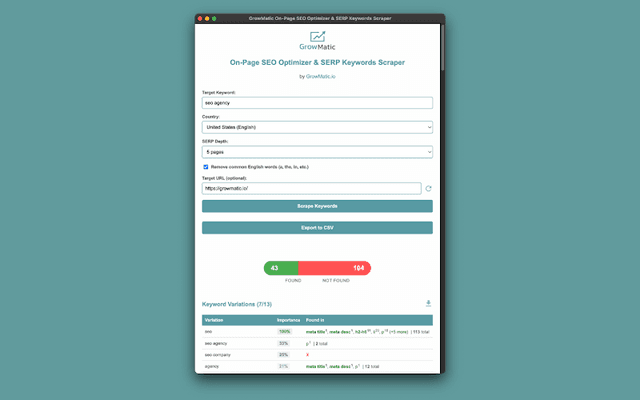
GrowMatic is a powerful Chrome browser extension that helps SEO professionals and content creators analyze Google Search Results Pages (SERPs) across 20 countries to optimize content for better search engine rankings.
Radar
App Radar is a comprehensive app store optimization (ASO) tool that leverages AI-powered keyword research, competitor analysis, and automated tools to help improve app visibility and rankings across the Apple App Store and Google Play Store.

AISEO
AISEO is an AI-powered writing assistant that helps create SEO-optimized content quickly, with features like article generation, paraphrasing, readability improvement, and AI detection bypassing.

Surfer
Surfer is a comprehensive SEO content optimization platform that helps content creators, marketers and agencies create, optimize and rank content through data-driven analysis, AI-powered writing, and automated optimization tools.