
Nimble
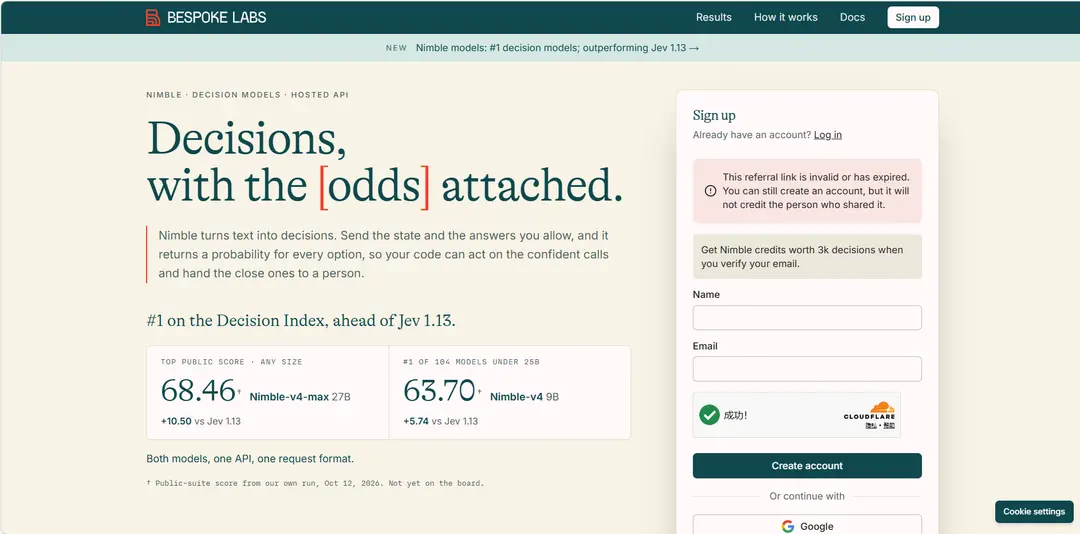
Nimble is Bespoke Labs’ hosted decision-model API that converts text into fast, structured choices, boolean judgments, and scores with calibrated probabilities for every allowed answer.
https://console.bespokelabs.ai/?ref=producthunt
Product Information
Updated:Nov 23, 2026
What is Nimble
Nimble is a specialized AI decision system from Bespoke Labs designed for applications that need reliable, machine-actionable judgments rather than open-ended generated text. Developers send it a piece of context, called a state, along with structured questions and permitted answers; Nimble returns a selected answer and confidence probabilities. It is available through a hosted API, with Nimble-v4 (9B parameters) and Nimble-v4-max (27B parameters) using the same request format. The product supports common decision workflows such as ticket routing, policy checks, classification, response grading, and priority assessment.
Key Features of Nimble
Nimble is a hosted typed-decision model API from Bespoke Labs that converts unstructured text into constrained, actionable outputs such as yes/no probabilities, selected categories, and ordinal scores. Developers send a text “state” plus a defined set of allowed answers, and Nimble returns a decision with confidence probabilities for each option, enabling automation of high-confidence cases and human review of uncertain ones. It is available in 9B and 27B model variants through a shared API format.
Probability-aware decisions: Returns confidence probabilities for answers, not just a final label, so applications can set thresholds for automatic action, escalation, or review.
Typed question formats: Supports noul for true/false judgments, choice for selecting among named options, and score for assigning an ordered level.
Constrained outputs: Decisions are limited to the answer options supplied by the developer, helping make downstream workflows more predictable than open-ended text generation.
Multi-question request handling: Accepts one source state and multiple questions in a single request, allowing related routing, eligibility, and prioritization decisions to be evaluated together.
Hosted API with model options: Provides a common API interface for Nimble-v4 and the larger Nimble-v4-max model, enabling teams to choose a size-performance tradeoff without changing integration patterns.
Use Cases of Nimble
Customer-support routing: Classify incoming tickets by department—such as billing, technical support, account access, or sales—and automatically route high-confidence cases.
Refund and policy triage: Determine whether a customer is requesting a refund, whether a case meets a policy condition, and whether it should be escalated to a human agent.
Content moderation review: Score or categorize user-generated content for policy risk, then automatically handle clear cases while sending close or low-confidence decisions to moderators.
Document and operations classification: Extract operational decisions from emails, forms, claims, or reports, such as assigning document types, urgency levels, queues, and review priorities.
Lead and sales qualification: Classify inquiries by purchase intent, customer segment, product fit, or follow-up priority so sales teams can focus on the most qualified leads.
Quality assurance scoring: Apply consistent ordinal scores to support conversations, agent replies, or workflow outcomes for monitoring, auditing, and coaching.
Pros
Confidence values support practical automation thresholds and human-in-the-loop escalation.
Typed, constrained answer formats simplify reliable integration with business workflows.
One request can evaluate multiple decisions against the same text state.
Offers both compact and larger model variants through a consistent API.
Cons
Designed for predefined choices and scoring rather than open-ended generation or complex nested structured extraction.
Decision quality depends on the clarity of the supplied criteria and how well a task matches the model's training domains.
Reported benchmark leadership is based on the provider's own public-suite run and may not represent every production domain.
Applications still need to define confidence thresholds, exception handling, and human review processes for ambiguous decisions.
How to Use Nimble
1. Create a Bespoke Labs account and API key: Sign in at the Bespoke Labs console, verify your email if required, and create an API key. Store it securely as an environment variable named BESPOKE_API_KEY.
2. Choose a Nimble model: Use the hosted API model name "nimble-latest" for the current default model. Nimble-v4 (9B) and Nimble-v4-max (27B) use the same request format; select the model appropriate for your latency, cost, and accuracy needs if specific names are available in your account.
3. Define the state to evaluate: Put the text, record, ticket, document, or other context Nimble should judge into the "state" field. Keep it concise: the full state and all questions must fit within Nimble's 8,192-token context window, and request bodies can be up to 64 KiB.
4. Define typed decision questions: Add one or more entries to the "questions" object. Use type "noul" for a true/false-style judgment that returns a probability from 0 to 1; use "choice" to select among named options and receive probabilities for each; use "score" to classify an item on ordered levels.
5. Add instructions and criteria: For each question, write clear "instructions" describing the decision. For choice questions, provide a "criteria" object that defines every allowed option. Precise, mutually distinguishable criteria improve consistency.
6. Send a POST request to the System One endpoint: Call POST https://api.bespokelabs.ai/v1/systemone with Authorization: Bearer $BESPOKE_API_KEY and Content-Type: application/json. Example: curl https://api.bespokelabs.ai/v1/systemone -H "Authorization: Bearer $BESPOKE_API_KEY" -H "Content-Type: application/json" -d '{"model":"nimble-latest","state":"The customer was charged twice and asks for a refund. The service still works.","questions":{"refund":{"type":"noul","instructions":"Does the customer request a refund?"},"department":{"type":"choice","instructions":"Which department should handle this request?","criteria":{"billing":"Charges, payments and refunds","technical":"Software bugs and outages"}}}}'.
7. Read the returned probabilities: The response contains an "answers" object keyed by your question names. A noul answer includes a "noul" probability, such as 0.998 for a likely true statement. A choice answer includes the selected "choice" plus probabilities for the available options. Inspect the response usage information if provided to track token consumption.
8. Apply confidence thresholds in your application: Automate decisions with sufficiently high probability, and route uncertain or close decisions to human review. For example, automatically send a ticket to billing when billing has a high probability, but defer when billing and technical probabilities are similar.
9. Optionally use the Python SDK: Install and configure the Bespoke Labs SDK, then create a client that reads BESPOKE_API_KEY. Call client.nimble.system_one(state="...", questions={...}) and process response.answers in the same way as the HTTP response.
10. Test on your own data before production use: Nimble's performance depends on the task domain and the quality of the state, instructions, and criteria. Evaluate it with representative examples, tune your automation thresholds, and retain human escalation for ambiguous or high-impact decisions.
Nimble FAQs
Nimble is a family of decision models from Bespoke Labs. It takes a text state plus a defined set of allowed answers and returns a decision with probabilities, enabling applications to automate high-confidence cases and escalate uncertain ones.
Popular Articles

Proferex: A Cloud-Based Ad Tracking and Campaign Optimization Platform
Nov 4, 2026

How to Create Viral Talking Baby Podcast Videos with AI: Step-by-Step Guide
Nov 2, 2026

Vosko AI: Localize and Dub Videos for Global Audiences
Oct 15, 2026

Atoms: A Multi-Agent AI Platform That Transforms Ideas into Launch-Ready Products
Oct 13, 2026
Latest AI Tools Similar to Nimble
invoices.dev
invoices.dev is an automated invoicing platform that generates invoices directly from developers' Git commits, with integration capabilities for GitHub, Slack, Linear, and Google services.

Monyble
Monyble is a no-code AI platform that enables users to launch AI tools and projects within 60 seconds without requiring technical expertise.
Devozy.ai
Devozy.ai is an AI-powered developer self-service platform that combines Agile project management, DevSecOps, multi-cloud infrastructure management, and IT service management into a unified solution for accelerating software delivery.
Mediatr
MediatR is a popular open-source .NET library that implements the Mediator pattern to provide simple and flexible request/response handling, command processing, and event notifications while promoting loose coupling between application components.
Popular AI Tools Like Nimble

Launch
Launch is an AI-powered platform that enables users to build full-stack applications instantly while providing comprehensive tools for product launches, entrepreneurship programs, and customer acquisition.

GitHub Copilot Chat
GitHub Copilot Chat is an AI-powered coding assistant that provides natural language interactions, real-time code suggestions, and contextual support directly within supported IDEs and GitHub.com.
Rememberall
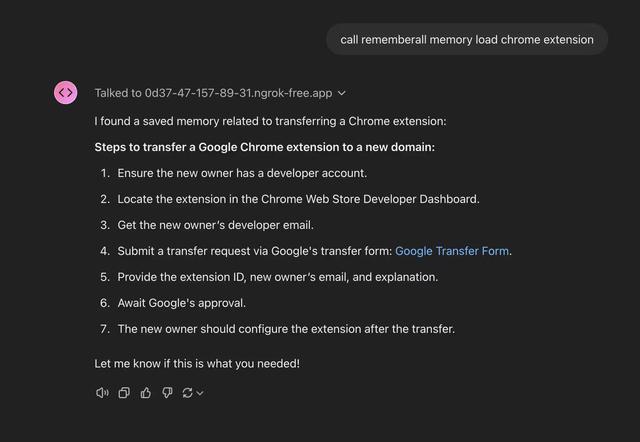
Rememberall is a secure, open-source long-term memory solution that enables AI applications and GPT models to maintain persistent memory across conversations through semantic search and vector storage capabilities.
Upsonic
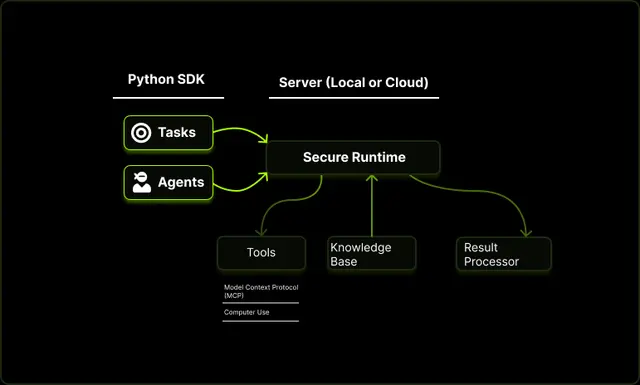
Upsonic is a reliability-focused AI agent framework with dockerized server-client architecture that enables trusted agent workflows through advanced features like verification layers, triangular architecture, and Model Context Protocol (MCP) integration.