
Intervool
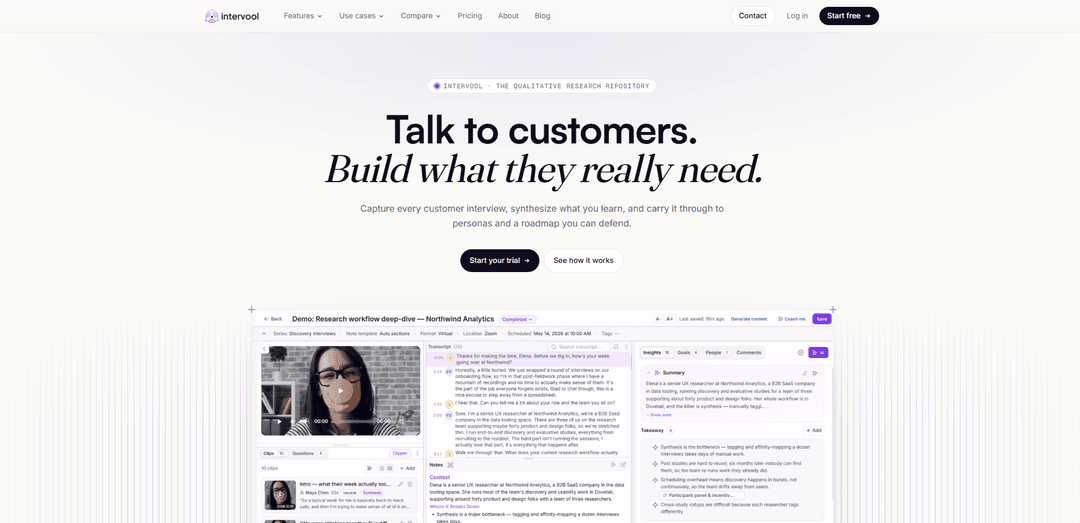
Intervool is an AI-powered customer discovery and qualitative research workspace that captures interviews (recordings, transcripts, and notes), extracts evidence-linked insights, and turns themes into dynamic personas, segments, and a defensible product roadmap.
https://intervool.com/?ref=producthunt
Product Information
Updated:Jul 9, 2026
What is Intervool
Intervool is a qualitative research repository and customer discovery workspace built for early-stage startup teams, founders, product managers, and UX researchers who need interviews to translate into clear product and go-to-market decisions. Instead of leaving research as scattered notes or a tagged archive, Intervool centralizes your customer calls and organizes what you learn into structured outputs—pain points, feature requests, opportunities, and quotes—so teams can align on what to build and why, with every decision traceable back to customer evidence.
Key Features of Intervool
Intervool is a qualitative research and discovery workspace that helps teams capture customer interviews (video/audio/notes), automatically transcribe and extract structured insights (pain points, quotes, feature requests, opportunities), and connect that evidence to themes, personas/segments, and a prioritized roadmap. It adds an AI “Copilot” to query your research with source-backed answers, and supports collaboration so teams can track who requested what and keep discovery tightly linked to product and early GTM decisions.
Interview capture + transcript repository: Upload customer calls (video/audio) or notes; Intervool stores recordings and generates full transcripts so research isn’t scattered across docs and tools.
AI extraction of key learnings (with evidence links): Automatically pulls out pain points, feature requests, opportunities, workflows, and quotes, each linked back to the exact moment in the call for defensible decision-making.
Copilot Q&A over your research: Ask questions like “top pain points,” “most common themes,” or “what do we know about a persona,” and get answers grounded in your own interviews with clickable sources.
Themes → feature ideas → roadmap workflow: Cluster insights into evidence-linked themes, turn themes into feature ideas, prioritize (e.g., impact vs. effort), and maintain a roadmap that stays one click from supporting customer quotes.
Dynamic personas and segments: Group interviewees into personas and account segments built from real signals; analyze how needs, objections, and opportunities differ by persona/segment.
Collaboration and request tracking: Connect insights and feature ideas to specific people/customers so you can track who asked for what and coordinate follow-ups across the team.
Use Cases of Intervool
Seed-to-Series A product discovery: Founders/PMs run continuous discovery, synthesize interviews into themes, and justify roadmap priorities with direct evidence from calls.
B2B SaaS persona and segmentation research: Teams building for multiple buyer/user types can create dynamic personas (e.g., engineering leaders, ops admins) and compare pain points across segments like company size or industry.
UX research consolidation for design teams: Designers/researchers centralize interview recordings and notes, extract recurring usability issues and workflows, and generate shareable, source-backed insights.
Customer feedback to feature prioritization: Product teams convert qualitative feedback into a structured backlog where each feature idea is tied to quotes, frequency, and the customers who need it.
Discovery-to-GTM handoff: Early GTM teams use interview learnings to refine ICP hypotheses, messaging, objections handling, and follow-up outreach drafts based on real conversations.
Pros
End-to-end workflow from interviews to themes, personas/segments, and roadmap—beyond simple storage/tagging.
Evidence-linked insights and Copilot Q&A make decisions easier to defend and share internally.
Supports multiple input formats (video/audio/notes) and can import past interviews so prior research isn’t lost.
Designed for early teams without dedicated researchers, with AI-assisted structuring and synthesis.
Cons
AI-driven extraction/summaries may still require human review and refinement for accuracy and nuance.
Video retention is limited (noted as 90 days by default), which may be a constraint for some compliance or long-term archival needs.
Some GTM/outbound capabilities are described as “building next,” implying parts of the discovery-to-GTM vision may still be evolving.
How to Use Intervool
1) Create a workspace and start a free trial: Go to the Intervool signup page and create your account/workspace. Intervool offers a 30-day free trial (no credit card required).
2) Define your learning goals: Set what you want to learn from customer conversations (e.g., validate a problem, understand onboarding friction, test positioning). These goals guide what you capture and how you synthesize insights over time.
3) Choose the attributes you want to track: Decide which fields matter for your research and segmentation (e.g., role, seniority, company stage, company size, industry, tools). Use these attributes to keep interviews organized and comparable.
4) Plan interviews and prepare questions (or templates): For each interview, add prep details and questions directly in Intervool, or reuse a template so your team runs consistent conversations across a series.
5) Add an interview record with context: Create an interview entry and fill in basics like title, date, the series it belongs to, and who you spoke to. Add the person/company details using the attributes you defined so later analysis can slice by persona/segment.
6) Upload your call (or notes): Upload video, audio, or written notes. Intervool stores the recording and generates a full transcript for the interview.
7) Generate structured outputs from the interview: Have Intervool extract key outputs such as takeaways, pain points, opportunities, quotes, feature requests, and workflows. These are linked back to the exact moments they came from in the transcript/recording.
8) Review and refine the extracted insights: Scan the AI-generated outputs and adjust wording, merge duplicates, or correct context so the repository reflects what was actually said and what matters to your product decisions.
9) Create and tailor “Series” for repeatable analysis: Use a series as a lens that every interview gets read through (e.g., “Onboarding friction”). Choose which outputs to pull (pain points, feature requests, opportunities, etc.) and write a short plain-English prompt to tailor extraction to your product.
10) Chat with your research using Copilot: Ask Copilot questions across interviews, themes, and people you’ve captured (e.g., “What are the top pain points across my calls?” “Summarize what I know about a persona/segment.” “Where are the biggest gaps in my research?”). Copilot answers from your own research with clickable sources.
11) Cluster insights into evidence-linked themes: Group related insights into themes so patterns emerge across interviews. Keep each theme connected to the underlying quotes/moments so you can defend conclusions with evidence.
12) Build dynamic personas from real signals: Group the people you talk to into personas (who the user is) based on the attributes and signals you’ve collected. Personas roll up pain points, opportunities, and objections from matching interviews and update as you add more calls.
13) Create segments to understand account-level differences: Define segments (the account context the persona sits in) such as industry, stage, or size. Use segments to compare how needs differ across groups (e.g., Seed-stage SaaS vs. larger teams).
14) Turn themes into feature ideas: Convert themes into feature ideas while keeping each idea one click away from the customer evidence behind it (quotes, clips, transcript moments).
15) Prioritize ideas and map them to a roadmap: Use prioritization views (e.g., impact vs. effort) to decide what to build next. Roll prioritized ideas into a roadmap that stays tied to themes and interview evidence.
16) Import past research so nothing is stranded: Upload existing recordings, audio files, or written notes from previous interviews. Intervool will transcribe and extract insights the same way as new calls.
17) Manage retention and capacity as you scale: Be aware of plan limits (e.g., calls per month) and top up if needed. Transcripts and insights are kept forever; video is retained for 90 days by default (extended retention available on request).
18) Control access and keep research secure: Use role-based access to control who can see what in your workspace. Intervool states data is encrypted in transit and at rest and isolated to your workspace.
Intervool FAQs
Intervool is a qualitative research repository and customer discovery workspace that captures interviews (recordings, transcripts, notes), extracts insights (pain points, opportunities, feature requests, workflows) linked back to evidence, and carries those insights through to themes, personas/segments, and a roadmap you can defend.
Popular Articles

Vosko AI: Localize and Dub Videos for Global Audiences
Oct 15, 2026

Atoms: A Multi-Agent AI Platform That Transforms Ideas into Launch-Ready Products
Oct 13, 2026

Nano Banana SBTI: What It Is, How It Works, and How to Use It in 2026
Apr 15, 2026

Atoms Review — The AI Product Builder Redefining Digital Creation in 2026
Apr 10, 2026
Latest AI Tools Similar to Intervool

MarketYap!
MarketYap! is an AI-powered investment news aggregation platform that simplifies stock research by gathering and summarizing articles from multiple reputable sources.

ArXiv Pulse
ArXiv Pulse is a platform that helps researchers stay updated with the latest research papers by providing personalized, easy-to-read summaries of arXiv preprints delivered directly to their inbox.
Zeli.app
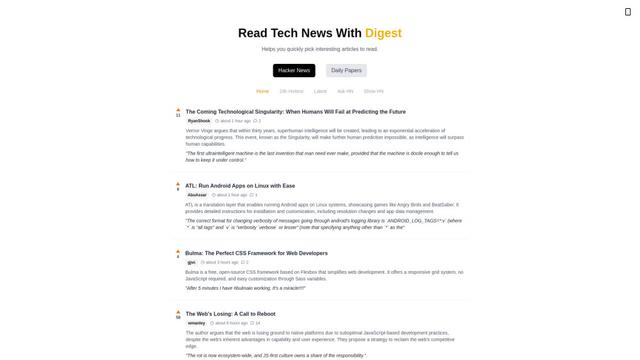
Zeli is an English-language platform that aggregates and provides digests of Hacker News articles and latest AI research papers to help tech enthusiasts stay updated with cutting-edge technology.

Gene
Gene is an AI-powered research and web assistant tool that helps users analyze, summarize and extract key information from articles and documents.
Popular AI Tools Like Intervool
Hierarchical Reasoning Model
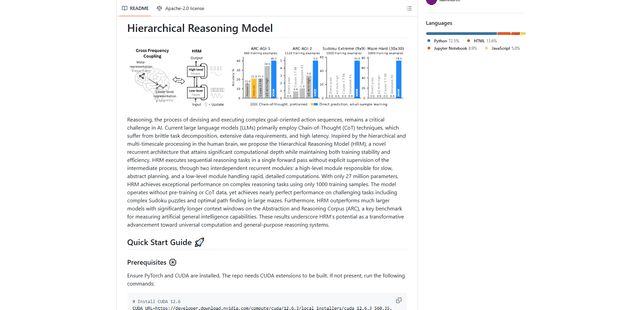
The Hierarchical Reasoning Model (HRM) is a brain-inspired AI architecture that achieves exceptional reasoning capabilities with only 27 million parameters, using two interdependent recurrent modules for abstract planning and detailed computations.
Web Researcher MCP
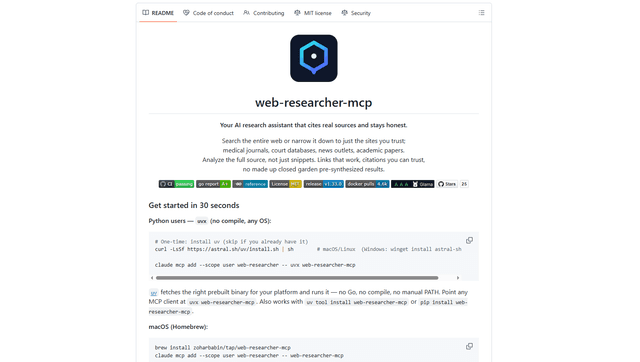
Web Researcher MCP is a local, production-grade MCP server that lets AI assistants search the web (optionally restricted to trusted “search lenses”), read full sources (including JS-rendered pages, PDFs, and YouTube transcripts), and return verifiable citations with multi-provider failover. [Source: https://github.com/zoharbabin/web-researcher-mcp?ref=producthunt]
Open AI o3
OpenAI o3 is a next-generation AI reasoning model with enhanced capabilities in coding, mathematics, and problem-solving that achieves breakthrough performance on advanced benchmarks while prioritizing safety through deliberative alignment.

NextGenAI by OpenAI
NextGenAI is a first-of-its-kind consortium launched by OpenAI that unites 15 leading research institutions with $50M in funding and tools to advance AI research and education.