
iArt.ai
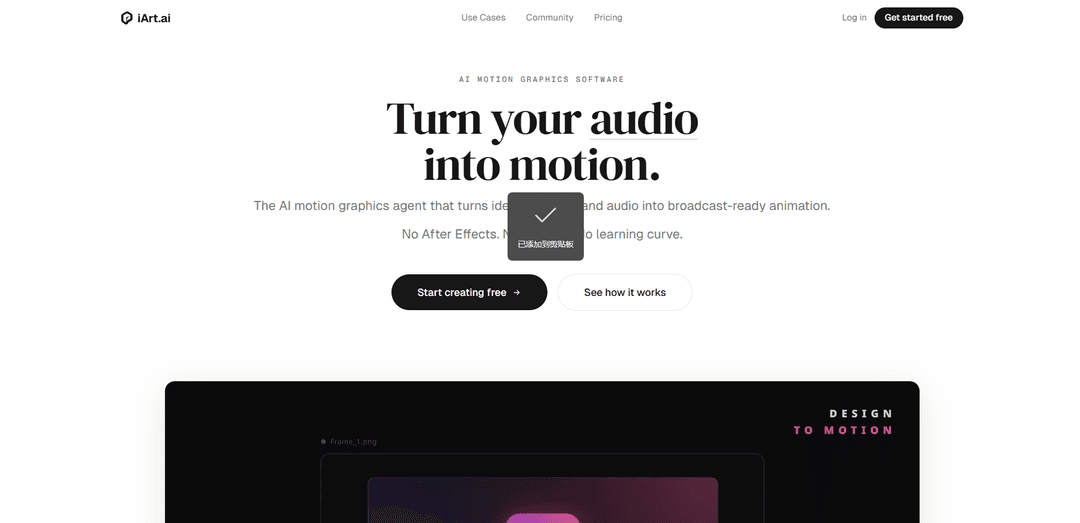
iArt.ai is an AI motion-graphics platform that turns text, designs, and audio into editable, broadcast-ready animations in seconds—no After Effects, timeline, or keyframing required.
https://www.iart.ai/?utm_source=aipure&utm_medium=referral&ref=producthunt
Product Information
Updated:Jun 15, 2026
What is iArt.ai
iArt.ai is an AI-powered motion graphics engine designed for people who need professional animated content without learning complex tools like After Effects. It generates vector-precise motion graphics—such as kinetic typography, explainer-style sequences, and presentation-grade visuals—from simple prompts or uploaded assets. Users can start from a concept, import existing materials (e.g., Figma designs, Notion docs, images, audio, or even YouTube links), and export production-ready videos in formats like MP4 (up to 4K/60fps), GIF, or Lottie JSON.
Key Features of iArt.ai
iArt.ai is an AI motion-graphics engine that turns text prompts, designs (e.g., Figma), documents (e.g., Notion), and audio/voice into broadcast-ready animated videos—without After Effects, timelines, or manual keyframing. It generates scene-by-scene layouts, typography, transitions, and timing in seconds, supports voice cloning/TTS and music, keeps styles consistent across assets, and lets users edit outputs (timing, colors, text, easing) before exporting production formats like 4K MP4, GIF, or Lottie JSON.
Prompt/design/audio → motion graphics: Create keynote-style vector animations from plain-language prompts or by uploading assets like images, Figma designs, documents, audio files, or YouTube links.
Scene-by-scene auto composition: The agent builds animations with intentional layout, typography, transitions, and timing—assembling a full motion sequence automatically rather than generating “footage.”
Audio-synced kinetic typography: Sync motion to narration and beats—supporting voice cloning or built-in TTS plus optional background music for punchy, rhythm-aligned graphics.
Editable outputs (real control): Adjust timing, colors, text, and easing curves after generation, enabling iterative refinement beyond simple “accept or regenerate.”
Multi-format, production-ready export: Export MP4 (H.264) up to 4K/60fps, GIF, or Lottie JSON, or share via a playable link—no render-queue workflow.
Tool connectivity via MCP integrations: Connect to existing workflows and sources (e.g., Notion/Figma) with native-style ingestion to reduce import/export friction.
Use Cases of iArt.ai
Product marketing & launches: Turn product briefs, landing-page copy, or Figma mockups into polished launch teasers, feature highlights, and social-ready motion assets.
Explainer videos for complex topics: Animate algorithms, processes, strategies, or technical concepts into clear scene-based explainers for SaaS, fintech, or developer tools.
Social media shorts from long-form audio: Convert podcasts, lectures, or interviews into highlight clips with kinetic type and branded motion for Reels/Shorts/TikTok.
Sales enablement & presentations: Create animated openers, lower thirds, and end cards that match brand style for decks, demos, webinars, and customer pitches.
Internal comms & training: Transform Notion docs or written SOPs into quick animated training modules and announcements without needing an animation team.
Pros
Very low learning curve compared with After Effects (no timeline/keyframing required).
Accepts many input types (text, Figma, Notion, audio, links) and generates fast, scene-structured motion graphics.
Editable results (timing/colors/text/easing) provide more control than many one-shot AI video tools.
Exports to common production formats including 4K MP4 and Lottie for web/app animation.
Cons
Primarily focused on motion graphics (typography/layout/vector animation), not cinematic, live-action-style video generation.
Credit-based pricing tied to AI compute may make costs less predictable at higher iteration volumes.
Best results may depend on having clear source content/brand assets; fully bespoke art direction may still require iteration.
How to Use iArt.ai
1) Create an account and start with free credit: Go to https://www.iart.ai/ and sign up. New accounts include a $5 signup credit (no credit card required), which you can use to generate your first motion graphics.
2) Choose your starting point (Prompt, Design, or Voice): Decide what you want to feed iArt: (a) a text description, (b) an existing design file (e.g., Figma mockup/brand poster), or (c) voice/script + audio for synced motion.
3) Provide input by typing or uploading: Either type what you want to create or upload/drop in assets such as images, Figma designs, documents (e.g., Notion docs), audio files, or even a YouTube link. iArt supports multimodal inputs and can connect to existing tools via MCP integrations.
4) Set narration voice (optional): If your video needs narration, choose a built-in TTS voice or clone your own voice (if available in your workflow). You can do this in your preferred language.
5) Add background music (optional): Add BGM if desired so iArt can align pacing and transitions to the audio feel.
6) Describe the motion and style in plain language: Write a clear description of what you want. Include key details like: the on-screen text, mood, pacing, visual style, and any timing constraints. Example (kinetic type): "The phrase THINK BIGGER appears word by word, each word scaling up, white on black, 3 seconds total."
7) Generate the motion graphic: Click generate. iArt builds the animation scene by scene—handling layout, typography, timing, and transitions automatically. You can watch it come together in seconds.
8) Iterate by re-prompting if needed: If the first result isn’t right, describe what to change (e.g., faster pacing, different mood, different typography emphasis) and regenerate. This is intended to be a quick revision loop.
9) Edit the output (timing, colors, text, easing): Open the generated result and make manual adjustments. iArt outputs are editable—change timing, colors, text, and easing curves rather than being forced to accept-or-regenerate only.
10) Export or share: Export in the format you need: MP4 (H.264), GIF, or Lottie JSON. Exports support up to 4K resolution at up to 60fps. Alternatively, generate a share link that others can play instantly.
11) Use the right aspect ratio and destination workflow: When creating, tailor your prompt and content to the destination (e.g., explainer video, title sequence, logo animation, kinetic typography, social clips). If you’re turning audio into kinetic type, provide the audio and ask iArt to highlight key moments for Shorts/Reels/TikTok-style outputs.
12) Work in your preferred language: Prompt, chat with the agent, generate narration, and render on-screen text in supported languages (e.g., English, Chinese, Japanese, Spanish, French, German, Portuguese, Arabic, Korean). No English is required.
iArt.ai FAQs
iArt.ai is an AI motion graphics platform (an “AI motion graphics agent”) that turns ideas, text prompts, designs, and audio into broadcast-ready motion graphics—without needing After Effects, a timeline workflow, or a learning curve.
iArt.ai Video
Popular Articles

Atoms: A Multi-Agent AI Platform That Transforms Ideas into Launch-Ready Products
May 22, 2026

Nano Banana SBTI: What It Is, How It Works, and How to Use It in 2026
Apr 15, 2026

Atoms Review — The AI Product Builder Redefining Digital Creation in 2026
Apr 10, 2026

Kilo Claw: How to Deploy and Use a True "Do‑It‑For‑You" AI Agent(2026 Update)
Apr 3, 2026
Latest AI Tools Similar to iArt.ai
Loud Fame
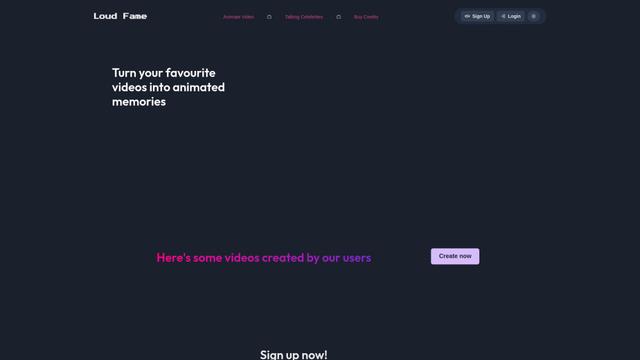
Loud Fame is an AI-powered video transformation tool that allows users to convert regular videos into anime-style animations and create AI-generated celebrity talking videos.
BizBoom.ai
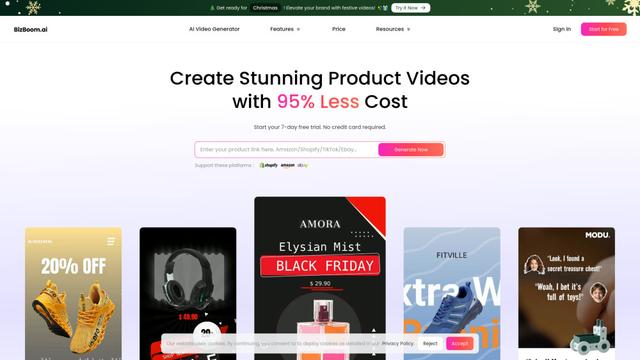
BizBoom.ai is an AI-powered platform that automatically generates professional product videos from product links and images with 95% less cost.
EzVideos
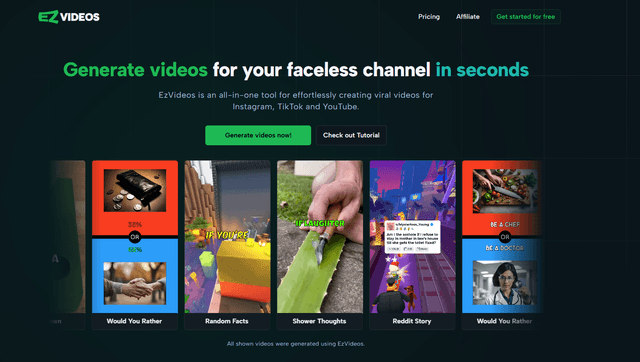
EzVideos is an all-in-one video creation tool that helps users generate viral videos for social media platforms like Instagram, TikTok, and YouTube with automated editing features and built-in resources.
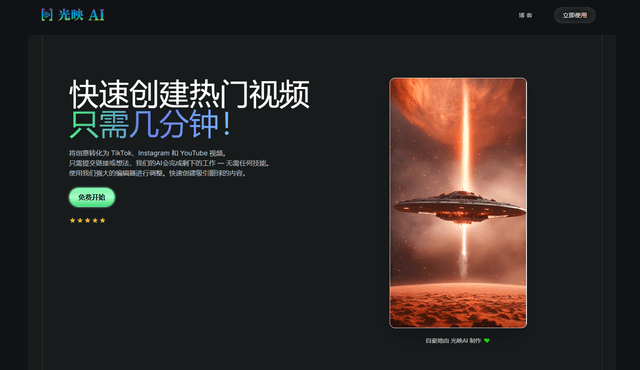
Illuminix
Illuminix is an AI-powered platform that empowers businesses with autonomous hyper-experts and specialized tools for automated business processes, data management, and video content creation.
Popular AI Tools Like iArt.ai
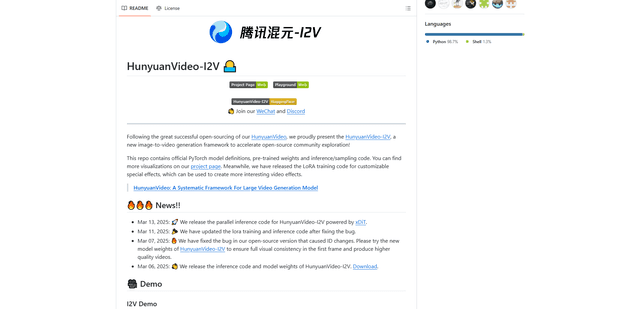
HunyuanVideo-I2V
HunyuanVideo-I2V is an open-source AI framework developed by Tencent that transforms static images into high-quality, dynamic videos with customizable motion effects and exceptional visual consistency.
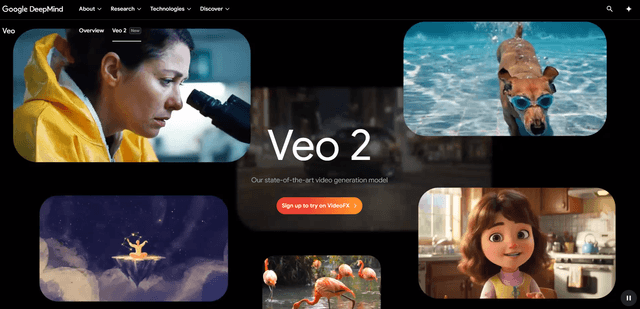
Google Veo 2
Veo 2 is Google DeepMind's state-of-the-art AI video generation model that can create high-quality videos up to 4K resolution with realistic motion, extensive camera controls, and improved physics simulation from text prompts.
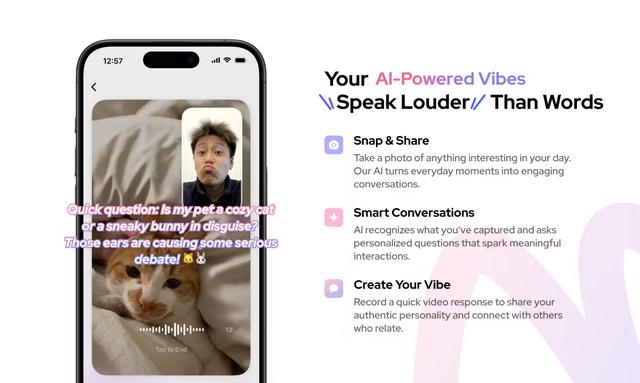
Vibing
Vibing is an AI-powered dating app that helps users share authentic moments through video stories and make genuine connections based on personality matching and interactive features.
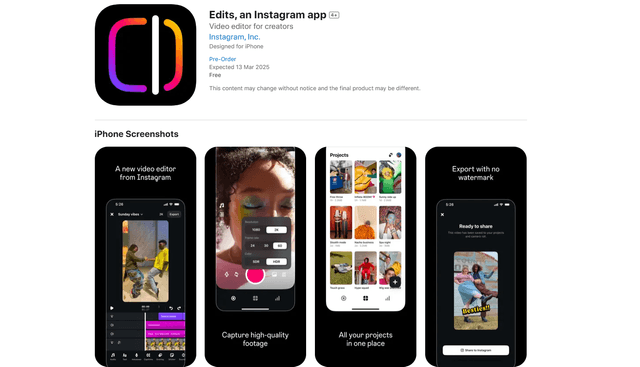
Edits, an Instagram app
Edits is Instagram's free video creation app that provides creators with professional editing tools, AI features, and analytics capabilities to create high-quality videos directly from their phones.