
FactGuard
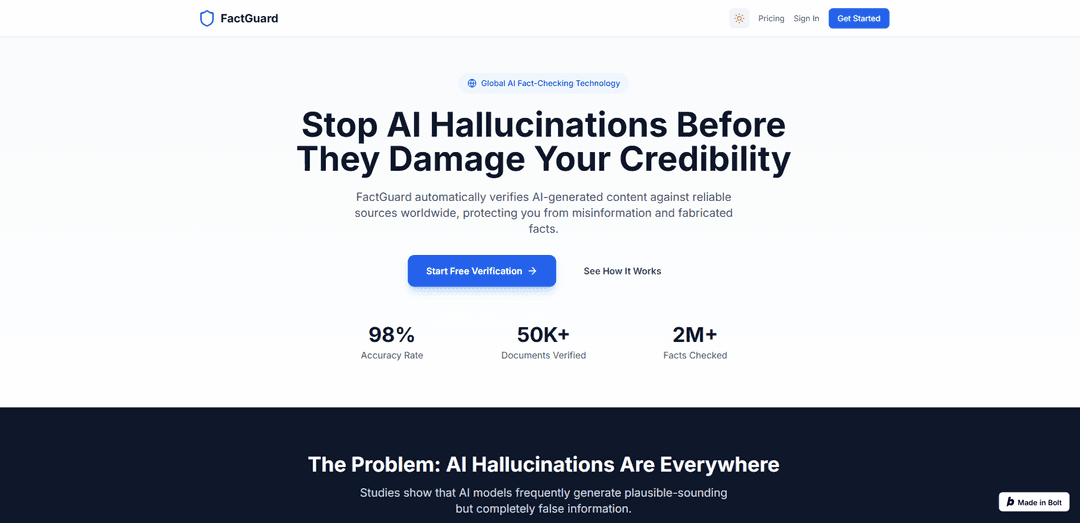
FactGuard is a professional AI audit and fact-checking tool that automatically verifies AI-generated content against reliable global sources, flags questionable claims, and provides transparent source-backed results with confidence scoring.
https://factguard-id.bolt.host/?ref=producthunt
Product Information
Updated:Jun 8, 2026
What is FactGuard
FactGuard is a global AI fact-checking technology designed to help individuals and teams prevent AI hallucinations from turning into credible-looking misinformation. Built for verifying AI-generated text and documents, it breaks content into checkable claims and validates them against trusted sources, then reports which statements are verified, incorrect, or need further review. With an emphasis on credibility and source transparency, FactGuard aims to protect publishers, professionals, and organizations from fabricated facts and citations before content is shared publicly.
Key Features of FactGuard
FactGuard is an AI fact-checking and audit tool designed to reduce hallucinations in AI-generated content by breaking text into individual claims, cross-referencing those claims against reliable global sources, and returning clear verification results with confidence indicators and source links. It emphasizes source transparency and a simple workflow (paste/upload content → automated verification → results), and offers pay-per-check credit packs (plus an optional no-ads premium tier) so teams can verify content without a subscription.
Claim-level verification workflow: Takes pasted or uploaded AI-generated content, decomposes it into discrete claims, and checks each claim rather than evaluating the text as a whole.
Automated cross-referencing against trusted sources: Verifies claims by searching and matching them against reputable information sources worldwide (examples mentioned include Reuters, BBC, CNN, Snopes, and PolitiFact).
Transparent citations and source links: Provides source links for findings so users can directly inspect evidence behind “verified” or “flagged” outcomes.
Clear result labeling and confidence signaling: Returns easy-to-scan outcomes such as verified/incorrect/needs verification and includes confidence-style scoring to help prioritize review.
Pay-per-verification credit model: Uses a top-up system where 1 credit equals 1 verification check, with multiple pack sizes and an optional premium option that removes ads.
Use Cases of FactGuard
Newsroom and media pre-publication checks: Helps editors validate AI-assisted drafts, headlines, and summaries to prevent publishing misinformation and to attach evidence-backed references.
Legal content review and citation validation: Supports legal teams in screening AI-generated memos or research summaries to reduce the risk of fabricated cases or unsupported assertions.
Healthcare and medical content safety screening: Assists healthcare communicators in checking AI-generated health advice and medical claims before distributing patient-facing materials.
Academic and research writing verification: Helps students and researchers identify questionable claims or citations in AI-assisted writing and improve credibility with traceable sources.
Marketing and corporate communications QA: Enables brand and comms teams to validate statistics, product claims, and competitive statements in AI-generated campaigns to avoid reputational damage.
Pros
Source transparency via cited links makes verification auditable and easier to trust.
Simple, structured workflow (paste/upload → verify → results) lowers adoption friction.
Pay-per-check credits avoid mandatory subscriptions and can fit intermittent usage.
Cons
Accuracy claims (e.g., “98%”) are difficult to assess without published methodology or benchmarks.
Results quality depends on available sources and coverage; some niche or emerging topics may remain “needs verification.”
Credit-based pricing can become costly for high-volume, continuous verification workloads.
How to Use FactGuard
1) Open FactGuard: Go to https://factguard-id.bolt.host/ in your browser to access the FactGuard homepage.
2) Start the app (sign in / create an account): Click “Get Started Free” or open https://factguard-id.bolt.host/auth and follow the on-screen prompts to access the dashboard.
3) Add the content you want to verify: In the dashboard, paste your AI-generated text into the input area, or upload a document if that option is available.
4) Run automated verification: Start the verification process. FactGuard will break your text into individual claims and cross-reference them against reliable sources worldwide.
5) Review the results claim-by-claim: Read the verification output for each claim (e.g., Verified Fact, Incorrect Claim, Needs Verification) and check the provided source links for transparency.
6) Fix or remove flagged claims: Edit your original content based on the results—correct incorrect claims, add missing context, or remove statements that can’t be verified.
7) Re-check after edits (recommended): Re-run FactGuard on the updated text to confirm that corrections are accurate and previously unverified claims are resolved.
8) Top up credits when you need more checks: If you run out of verifications, purchase Top-Up Credits (1 credit = 1 verification). Choose a package (e.g., 50/150/500 credits or Premium) and pay via Midtrans-supported methods such as QRIS, GoPay, OVO, Dana, ShopeePay, or Virtual Account.
FactGuard FAQs
FactGuard is a professional AI audit and fact-checking tool designed to verify AI-generated content against reliable sources to help prevent misinformation and fabricated facts.
Popular Articles

Vosko AI: Localize and Dub Videos for Global Audiences
Oct 15, 2026

Atoms: A Multi-Agent AI Platform That Transforms Ideas into Launch-Ready Products
Oct 13, 2026

Nano Banana SBTI: What It Is, How It Works, and How to Use It in 2026
Apr 15, 2026

Atoms Review — The AI Product Builder Redefining Digital Creation in 2026
Apr 10, 2026
Latest AI Tools Similar to FactGuard
TimelyGrader
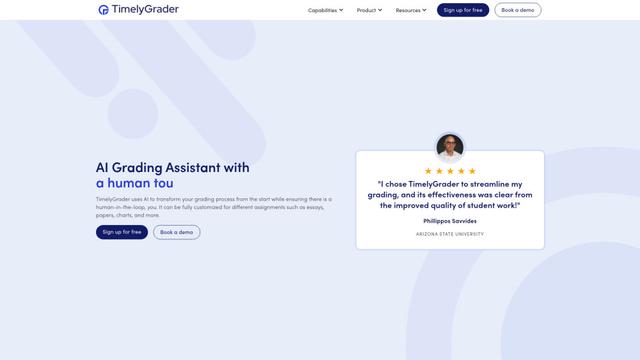
TimelyGrader is an AI-powered grading and feedback assistant that helps educators streamline their grading process while maintaining human oversight and providing personalized feedback to students.

CopyFind AI
CopyFind AI is a comprehensive online plagiarism checker that combines AI content detection, text comparison, and paraphrasing detection capabilities with support for multiple file formats.

Zealos.ai
Zealos.ai is an AI-powered fact-checking platform that helps users verify content accuracy instantly by leveraging custom knowledge bases and advanced AI models.
Uncheck AI
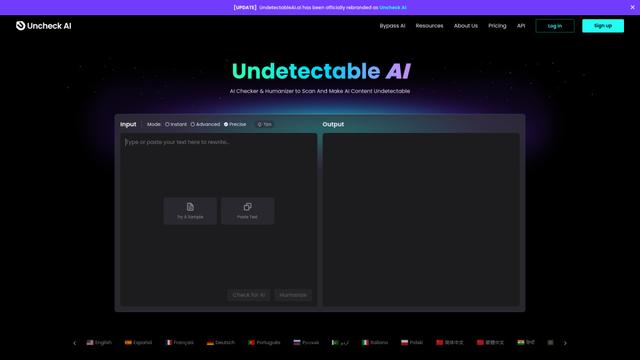
Uncheck AI is an advanced AI detection and humanization tool that can accurately identify AI-generated content and rewrite it to be undetectable by popular AI detectors.
Popular AI Tools Like FactGuard
Verol
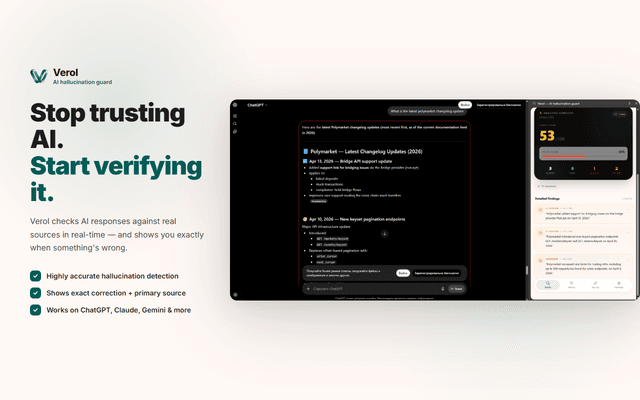
Verol is a Chrome extension that provides real-time AI fact-checking and hallucination detection for ChatGPT, Claude, Gemini, and Grok, using inline annotations, confidence scoring, and source traceability to verify model outputs as they’re generated.
Turnitin
Turnitin is a comprehensive academic integrity and assessment solution that detects plagiarism, provides feedback, and facilitates grading for educational institutions.
ContentDetector.AI
ContentDetector.AI is a free, advanced AI content detector that can identify text generated by ChatGPT, GPT-3, GPT-4, and other AI models with high accuracy.
Uncheck AI
Uncheck AI is an advanced AI detection and humanization tool that can accurately identify AI-generated content and rewrite it to be undetectable by popular AI detectors.