
Crawlly AI
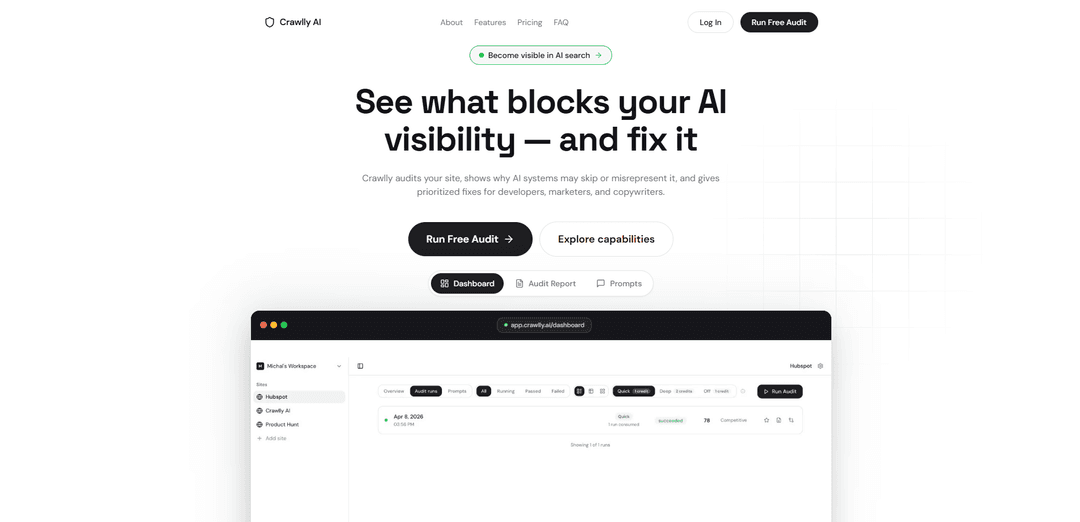
Crawlly AI is a SaaS auditing platform that combines technical SEO, AEO/GEO, structured data/entity checks, and prompt-level LLM visibility testing to produce prioritized P1/P2/P3 issues and role-based action plans with measurable progress tracking.
https://www.crawlly.ai/?ref=producthunt
Product Information
Updated:May 18, 2026
What is Crawlly AI
Crawlly AI helps teams stay visible as search shifts from “blue links” to AI-generated answers by auditing the technical and content signals that influence AI discovery, summarization, and citation. It runs end-to-end audits across technical SEO foundations, schema/entity clarity, answer formatting and extractability (AEO), generative search readiness (GEO), and LLM prompt-based visibility, then turns the findings into an execution-ready roadmap that developers, SEO, and content teams can act on together.
Key Features of Crawlly AI
Crawlly AI is a SaaS auditing platform focused on improving visibility in AI-era search (SEO, AEO, GEO, and LLM citation). It runs end-to-end audits that combine technical crawlability/indexability checks with structured data/entity clarity, “answer engine” retrieval readiness, and prompt-level LLM visibility testing. Outputs are designed for operational execution: an executive score and risk band, prioritized P1/P2/P3 issues with AI and revenue impact, and role-based action lists for engineering, SEO, and content teams, plus run-to-run comparisons to measure progress over time.
Executive score + risk band: Provides a top-level AI-readiness score and risk profile so stakeholders can quickly understand current visibility risk and overall performance.
Prioritized issue roadmap (P1/P2/P3): Generates an execution-ready backlog with severity, complexity, AI impact, and revenue impact to clarify what to fix first.
Role-based action lists: Maps fixes to owners (developers, SEO, and copywriters/marketers) so teams can work from one coordinated plan with clear accountability.
Technical SEO foundation audit: Audits crawlability, indexability, canonicals, site architecture, and other infrastructure signals that determine discoverability.
Structured data + entity graph validation: Checks schema coverage and entity consistency to help AI systems correctly understand the brand, services, and relationships.
LLM visibility testing + trend tracking: Runs prompt suites to track mention rate, citation rate, and citation rank with evidence, and compares audit runs to see deltas and regressions after releases.
Use Cases of Crawlly AI
SaaS & tech marketing visibility in AI answers: Identify why AI systems skip or misrepresent product pages, then prioritize fixes (schema, content extractability, technical issues) to improve citations and summaries.
E-commerce category and product discoverability: Audit indexability, canonicals, and structured data to reduce misclassification and increase the chance products are surfaced and cited in generative shopping queries.
Publishers and media improving citation outcomes: Measure retrieval readiness (chunk quality, evidence density, answer formatting) and track prompt-level citation performance to increase attribution in AI-generated responses.
Agencies managing multiple client sites: Use standardized scoring, prioritized roadmaps, and compare-runs reporting to demonstrate progress, manage deliverables, and coordinate engineering/SEO/content work across accounts.
Post-release monitoring for SEO/AEO regressions: Re-run audits after deployments to spot score deltas, category movers, and changes in LLM visibility, helping teams validate whether fixes worked.
Pros
Unified audit across technical SEO, AEO/GEO, and LLM prompt-based visibility rather than isolated checks
Actionable prioritization with ownership (role-based tasks) plus AI and revenue impact indicators
Run comparison and trend tracking to measure improvements and catch regressions over time
No on-site script required; audits can start from the public site and configuration context
Cons
LLM visibility results can vary depending on prompt suites and evolving model behavior, which may introduce variability in measurements
Some fixes implied by audits (e.g., architecture/schema/content rewrites) may require cross-team effort and engineering time to implement
API access and unlimited usage appear limited to the custom Agency plan
How to Use Crawlly AI
1) Create an account: Go to Crawlly AI and sign up (Free plan available; no card needed).
2) Start a new workspace audit: From your workspace/dashboard, begin a new audit run so you can track runs, scores, and risk bands in one place.
3) Connect your domain: Add your website domain to Crawlly AI. No script installation is required—Crawlly audits from your public site plus the context you provide.
4) Define your brand context: Provide configuration/brand context so the audit can evaluate entity clarity, brand understanding, and prompt-level visibility more accurately.
5) Choose audit depth: Select Quick or Deep audit mode depending on how comprehensive you want the crawl and analysis to be.
6) Run the audit: Launch an audit run to generate a single report covering technical SEO foundation, structured data/entity graph checks, AEO/retrieval readiness, GEO considerations, and prompt-based LLM visibility testing.
7) Review the executive score and risk band: Open the report and start with the top-level score and risk band to understand overall AI readiness and the highest-level risk profile.
8) Work through the prioritized issue roadmap (P1/P2/P3): Use the roadmap to see what to fix first. Issues are grouped by priority and include severity, complexity, AI impact, and revenue impact to help you sequence work.
9) Assign role-based actions to the right teams: Use the role-focused next steps so engineering, SEO, and content/copy teams each have clear, accountable tasks aligned to the same plan.
10) Validate schema and entity consistency: In the structured data + entity graph section, confirm schema coverage and entity consistency so AI systems can correctly understand your brand, services, and relationships.
11) Improve AEO / retrieval readiness: Use the AEO + retrieval readiness findings to improve answer formatting, extractability, evidence density, and chunk quality so answer engines can more reliably pull and summarize your content.
12) Check prompt-level LLM visibility evidence: Review where your brand is mentioned, cited, and ranked across the tested prompt suites, including mention rate, citation rate, and citation rank with domain-level evidence.
13) Implement fixes and ship changes: Execute the highest-impact items first (typically P1), using the roadmap to guide release order and reduce AI visibility blockers quickly.
14) Re-run audits to measure impact: After changes go live, run another audit to validate improvements in scores, visibility, and citation outcomes.
15) Compare audit runs over time: Use the Compare feature to view score deltas, category movers, issue changes, and LLM visibility changes to confirm what improved, what regressed, and what to fix next.
16) Manage audit run capacity (optional): If you need more runs than your plan includes, purchase one-time audit run top-up packs inside the app. Monthly included runs reset each billing cycle; purchased/promotional bonus runs remain available while the account stays active.
Crawlly AI FAQs
Crawlly AI is a SaaS platform that runs SEO, AEO, GEO, and LLM visibility audits to help teams improve how AI systems discover, summarize, and cite their websites.
Crawlly AI Video
Popular Articles

Atoms: A Multi-Agent AI Platform That Transforms Ideas into Launch-Ready Products
May 22, 2026

Nano Banana SBTI: What It Is, How It Works, and How to Use It in 2026
Apr 15, 2026

Atoms Review — The AI Product Builder Redefining Digital Creation in 2026
Apr 10, 2026
Kilo Claw: How to Deploy and Use a True "Do‑It‑For‑You" AI Agent(2026 Update)
Apr 3, 2026
Latest AI Tools Similar to Crawlly AI
Frizerly
Frizerly is an AI-powered platform that automatically creates and publishes SEO-optimized blog content by learning about your business and industry to help improve your website's search rankings.
GPT Easy Web
GPT Easy Web is a user-friendly AI-powered platform that enables users to easily build, customize and manage websites through natural language interactions and automated tools without requiring coding knowledge.
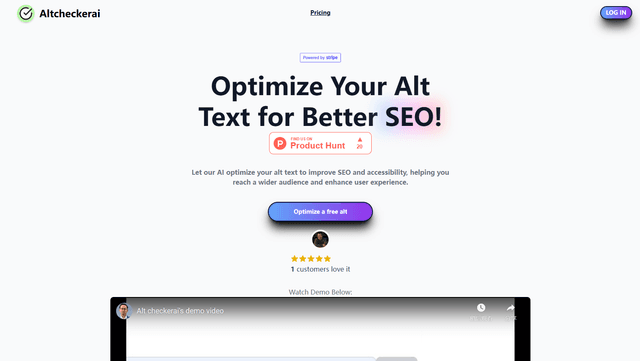
altcheckerai
AltCheckerAI is an AI-powered tool that automatically optimizes image alt text to improve website SEO and accessibility through intelligent recommendations.

Scribly AI
Scribly AI is an AI-powered content creation platform that helps users generate high-quality articles, blogs, emails, and various types of content in minutes while maintaining SEO optimization and brand voice consistency.
Popular AI Tools Like Crawlly AI
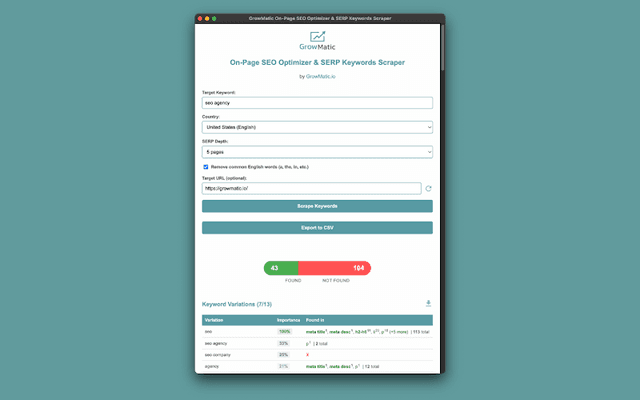
GrowMatic SEO Chrome Browser Extension
GrowMatic is a powerful Chrome browser extension that helps SEO professionals and content creators analyze Google Search Results Pages (SERPs) across 20 countries to optimize content for better search engine rankings.
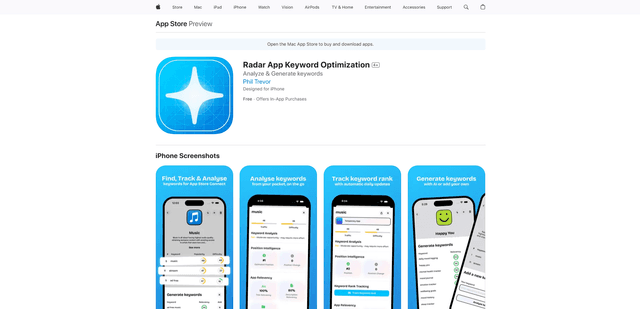
Radar
App Radar is a comprehensive app store optimization (ASO) tool that leverages AI-powered keyword research, competitor analysis, and automated tools to help improve app visibility and rankings across the Apple App Store and Google Play Store.

AISEO
AISEO is an AI-powered writing assistant that helps create SEO-optimized content quickly, with features like article generation, paraphrasing, readability improvement, and AI detection bypassing.
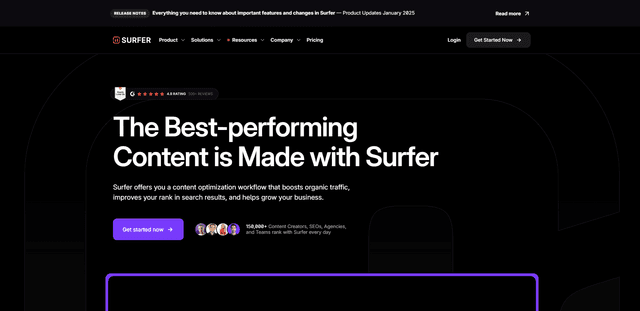
Surfer
Surfer is a comprehensive SEO content optimization platform that helps content creators, marketers and agencies create, optimize and rank content through data-driven analysis, AI-powered writing, and automated optimization tools.