
Rex
WebsiteAI Accounting Tools
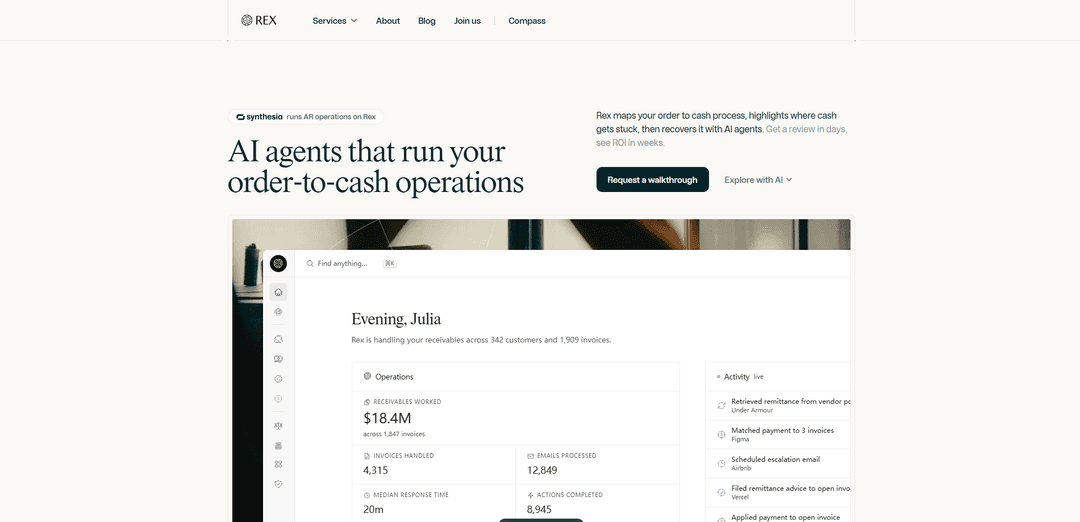
Rex is an AI operations partner for order-to-cash that maps where cash gets stuck and uses always-on AI agents to run AR workflows, resolve exceptions, and accelerate collections with measurable ROI.
https://rex.inc/?ref=producthunt
Product Information
Updated:Aug 8, 2026
What is Rex
Rex (rex.inc) is an enterprise-focused AI platform designed to operate and improve the order-to-cash (O2C) process—from AR inbox triage and customer portal work to collections and cash application. Instead of relying on manual spreadsheets, fragmented context across systems, or headcount-heavy outsourcing, Rex provides continuous, auditable execution through AI agents that work every invoice, account, and customer touchpoint. The product is positioned around fast time-to-value (start in days, ROI in weeks) and enterprise readiness, including SOC 2 Type II monitoring, encryption, role-based access controls, and full action audit logs.
Key Features of Rex
Rex is an AI operations partner for the order-to-cash (O2C) process that maps how cash flows through your receivables workflow, identifies where cash gets stuck (exceptions, inbox backlogs, portal issues), and uses AI agents to continuously execute day-to-day AR work across invoices, accounts, and customer touchpoints. It connects to existing systems to build context from historical data, provides real-time visibility into actions and blockers, proactively monitors payment risk, and is positioned as an outcome/SLA-based alternative to outsourcing or consulting, with enterprise security features such as SOC 2 Type II monitoring, encryption, audit logs, and SSO.
End-to-end O2C AI agents: Agents continuously work invoices, accounts, and customer touchpoints to keep cash moving—covering tasks like inbox triage, collections follow-ups, and cash application without adding headcount.
Process mapping + cash-stuck detection: Rex maps your order-to-cash process, highlights bottlenecks and exceptions where cash gets delayed, and focuses execution on unblocking those points.
Inbox and portal automation: Automates AR inbox handling and supports work across many customer portals (e.g., triaging messages, responding, and progressing cases), aiming for high auto-triage rates and faster response times.
Real-time AR visibility and tracking: Provides a live view of every customer and receivable, including actions taken, blockers, and SLA status—reducing reliance on spreadsheets and static monthly reporting.
Proactive risk monitoring and escalation: Detects signals like payment cadence drift, inactivity on invoices, and risk of slipping past terms, then monitors and follows up to resolve issues before they escalate.
Enterprise security and compliance: Built for enterprise deployments with SOC 2 Type II (monitoring), AES-256 encryption, GDPR compliance with EU data residency, role-based access, full audit logs, and SSO/SCIM support; customer data is not used to train models.
Use Cases of Rex
SaaS subscription billing collections: Manage high-volume AR inboxes and recurring invoice follow-ups, monitor payment cadence changes, and reduce DSO by automating routine collections and exception handling.
Manufacturing and industrial B2B invoicing: Track and resolve invoice disputes, missing documentation, and approval delays that commonly block payment; maintain continuous follow-up across many accounts.
Enterprises with many customer payment portals: Operate across dozens of customer portals to check statuses, respond to requests, and progress invoices—reducing manual portal work and improving response SLAs.
Shared services AR teams needing continuous coverage: Augment lean AR teams by automating triage and routine actions, ensuring consistent execution across shifts and reducing variability from handoffs or staffing constraints.
Finance orgs replacing spreadsheet-based AR tracking: Centralize receivable status, notes, and actions into a real-time system of record with auditable logs, improving visibility for finance leadership and cross-functional stakeholders.
Pros
Outcome and SLA-based approach with continuous coverage, positioned as faster to start than traditional outsourcing/consulting.
Strong enterprise readiness: SOC 2 Type II monitoring, encryption, audit logs, and SSO/SCIM; GDPR and EU data residency support.
Integrates with existing systems and builds context from historical data, minimizing manual knowledge transfer.
Real-time visibility into receivables, blockers, and actions improves control compared with periodic reporting.
Cons
Effectiveness depends on integration access/quality and the completeness of underlying AR data across systems and portals.
Best fit is AR/O2C; organizations outside order-to-cash may see limited direct value.
Outcome/SLA-based pricing can be less predictable than seat-based tools for some procurement and budgeting processes.
How to Use Rex
1. Confirm Rex is a fit for your workflow: Use Rex when you want an AI operations partner for order-to-cash (O2C): AR inbox triage, customer portal work, collections follow-ups, cash application, and exception handling. Rex is positioned as continuous coverage with outcome/SLA-based pricing and a live view of actions/blockers.
2. Start an onboarding engagement: Initiate Rex onboarding (the site emphasizes starting in days and seeing value in weeks). The goal is for Rex to map your order-to-cash process and identify where cash gets stuck (exceptions, fragmented context, manual handoffs).
3. Connect Rex to your existing systems: Integrate Rex with the systems where O2C work happens (the site states Rex 'reads everything' and connects to existing systems, building context from years of history). This is intended to avoid manual knowledge transfer from your team.
4. Let Rex build historical context: Allow Rex to ingest and correlate prior invoices, customer interactions, portal activity, and internal notes so it can operate with full context. The site claims your team doesn’t need to explain anything because Rex builds context from history.
5. Configure coverage and SLAs: Define the scope of continuous coverage (e.g., which inboxes, portals, customer segments, and invoice types) and set SLA expectations (the site highlights minute-level triage and measurable outcomes).
6. Use Rex for AR inbox auto-triage: Route AR inbox messages into Rex so it can triage and respond. The site highlights metrics like 90%+ inbox auto-triage rate and ~30-minute average response time; use these as operational targets when setting up workflows.
7. Delegate customer portal and exception work: Assign Rex to handle portal-based tasks (e.g., checking PO status, resolving missing documentation, and tracking invoice acceptance). The site specifically mentions reviewing open POs on systems like SAP Ariba and handling supplier/customer portals.
8. Run proactive collections and risk monitoring: Enable Rex to monitor receivables and follow up proactively. The site example shows Rex detecting payment cadence drift, identifying inactive invoices, assigning a risk score, and continuing monitoring—use this pattern to drive proactive outreach before invoices slip past terms.
9. Track work in Rex’s live visibility view: Use Rex’s real-time visibility to replace spreadsheet tracking. The site positions Rex as providing a live view of every customer/receivable, actions taken, blockers, and SLA status.
10. Iterate process changes quickly: Review recurring blockers and implement process changes. The site claims Rex can implement process changes by the next day—use this to continuously refine routing rules, exception playbooks, and follow-up cadences.
11. Measure outcomes and ROI: Monitor operational and financial outcomes (the site cites examples like faster DSO and measurable ROI). Establish baseline metrics (DSO, response times, exception cycle time, cash application lag) and compare after Rex is running continuously.
12. Apply enterprise security controls: Enable enterprise security features as needed: SOC 2 Type II (monitoring), AES-256 encryption, role-based access, and audit logs. If required, configure SSO (Okta/Azure AD/Auth0) and SCIM directory sync. The site also states GDPR compliance, EU data residency, encryption in transit/at rest, and that customer data is not used to train models.
Rex FAQs
Rex is an AI operations partner for the order-to-cash process, designed to help accounts receivable teams find where cash gets stuck and recover it using AI agents.
Popular Articles

Atoms: A Multi-Agent AI Platform That Transforms Ideas into Launch-Ready Products
May 22, 2026

Nano Banana SBTI: What It Is, How It Works, and How to Use It in 2026
Apr 15, 2026

Atoms Review — The AI Product Builder Redefining Digital Creation in 2026
Apr 10, 2026

Kilo Claw: How to Deploy and Use a True "Do‑It‑For‑You" AI Agent(2026 Update)
Apr 3, 2026
Latest AI Tools Similar to Rex
TurboDoc
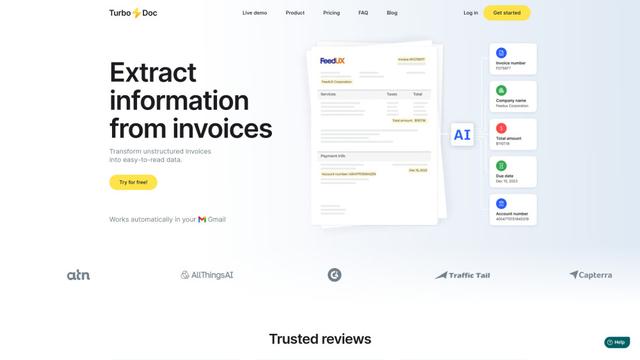
TurboDoc is an AI-powered invoice processing software that automatically extracts and transforms unstructured invoice data into organized, easy-to-read structured data through Gmail integration and intelligent document processing.
Smart Invoices
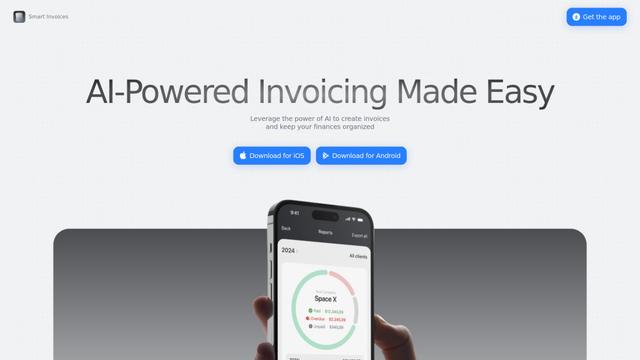
Smart Invoices is an AI-powered invoicing application that enables businesses to create, manage, and track professional invoices quickly while offering features like automated calculations, client integration, and cloud synchronization.

Spendtally
Spendtally is a smart expense tracking app that helps users manage their finances by scanning receipts, providing spending insights, and offering personalized recommendations for better deals and healthier shopping choices.

Simplify Money App
FreemiumAI Accounting Tools
Simplify Money is an AI-powered personal finance app that helps users track spending, set budgets, manage debt, and achieve financial goals through personalized insights and guidance.
Popular AI Tools Like Rex
Trillion
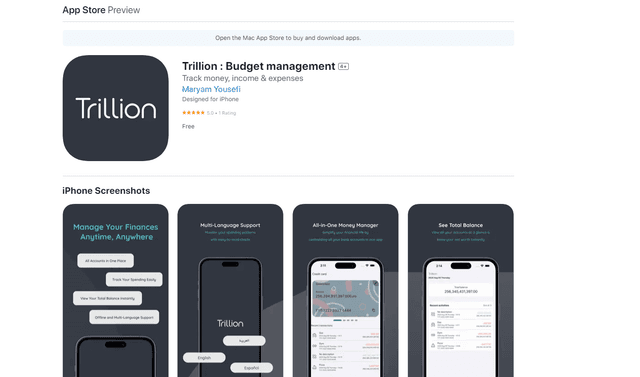
Trillion is an all-in-one personal finance app that helps users track expenses, set budgets, and manage finances across multiple currencies and accounts with an ad-free, multilingual interface.

Receipt Snapper And Scanner
Receipt Snapper And Scanner is a mobile app that allows users to instantly capture, categorize, and organize receipts through photo scanning with automatic data extraction and smart organization features.

Intuit
FreemiumAI Accounting Tools
Intuit is a global financial technology platform that provides financial management and compliance software and services for consumers, small businesses, and accounting professionals.

Datarails
Datarails is an AI-powered financial planning and analysis (FP&A) platform that automates financial reporting and planning while allowing finance teams to continue using familiar Excel spreadsheets.