
Lettertrace
Lettertrace is a free, open-source, bring-your-own-key tool that monitors how AI models like ChatGPT, Claude, and Gemini mention your brand, tracking visibility, share of voice, prominence, and sentiment over time.
https://lettertrace.com/?ref=producthunt
Product Information
Updated:Aug 15, 2026
What is Lettertrace
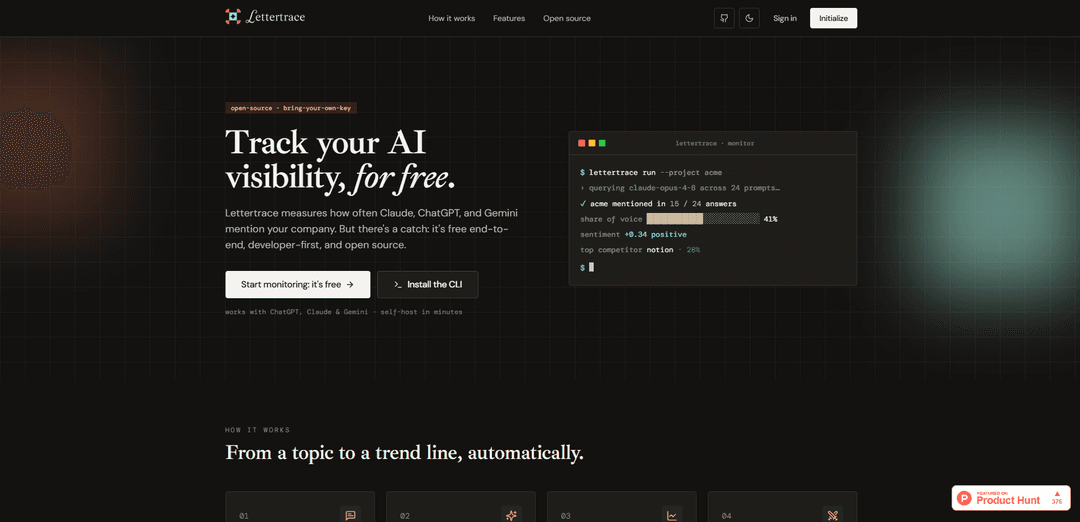
Lettertrace is a developer-first monitoring product for AI search/brand visibility that helps you understand what major AI assistants say about your company. Built to be free end-to-end and open source (MIT licensed), it’s designed for teams doing AEO/GEO who want measurable, repeatable reporting on AI mentions without expensive SaaS fees. It supports multiple models (including ChatGPT, Claude, and Gemini), can be self-hosted quickly, and keeps you in control by using your own API keys and storing data in your own infrastructure (e.g., Supabase).
Key Features of Lettertrace
Lettertrace is an open-source, developer-first AI visibility monitoring tool that tracks how often major AI assistants (ChatGPT, Claude, Gemini, and Google AI Overviews) mention your company across buyer-relevant topics. It generates natural prompt variations, runs multi-model queries using your own API keys, and turns the resulting answers into actionable AEO/GEO metrics such as visibility, share of voice, prominence, sentiment, and competitor benchmarking over time. It supports scheduled monitoring to build trend lines and is designed to be self-hosted so your data stays in your own infrastructure (e.g., Supabase).
AI mention tracking across models: Measures how frequently your brand appears in answers from ChatGPT, Claude, Gemini, and Google AI Overviews, enabling side-by-side comparison of AI “answer engines.”
Topic-based monitoring: Lets you define the subjects buyers ask about (e.g., “best CRM for startups”) and tracks brand visibility for those topics rather than generic keyword rankings.
Automatic prompt variation generation: Expands a single topic into many realistic question variations so you can monitor how AI responds to the kinds of prompts users actually type.
Competitive benchmarking & share of voice: Ingests competitor brands and calculates share of voice—showing how often you “win” recommendations versus rivals per topic and model.
Sentiment & recommendation diagnostics: Analyzes whether mentions are positive/negative and whether the model recommends your brand, not just whether it appears.
Self-hosted, BYO keys, and scheduled runs: Uses your own OpenAI/Anthropic/Google keys (encrypted at rest) and can be run daily/weekly to create trend lines over time; designed for quick self-hosting with your own Supabase-backed storage.
Use Cases of Lettertrace
B2B SaaS AEO/GEO performance tracking: Monitor whether AI assistants recommend your product for high-intent categories (e.g., project management, CRM) and quantify share of voice against direct competitors.
Marketing & brand teams measuring AI brand visibility: Track how brand mentions and sentiment change after campaigns, PR, content launches, or positioning updates, using repeatable runs as time-series datapoints.
SEO/content teams validating topic coverage: Identify which buyer questions lead to weak or missing brand mentions in AI answers, then prioritize content/FAQ updates to improve AI retrieval and recommendations.
Competitive intelligence for product category leadership: Benchmark which competitors AI models cite most often for a topic cluster and detect shifts in “AI mindshare” week over week.
Agencies reporting AI visibility for clients: Standardize reporting across multiple clients and topics by running scheduled monitors and presenting visibility, sentiment, and share-of-voice deltas over time.
Pros
Open-source (MIT) and self-hostable, offering transparency and extensibility.
Bring-your-own-key model with encrypted-at-rest keys; avoids vendor markup and keeps data in your infrastructure.
Multi-model coverage plus prompt variation generation provides more realistic and robust monitoring than single-prompt checks.
Actionable metrics (visibility, share of voice, sentiment) make it suitable for ongoing AEO/GEO tracking and competitor benchmarking.
Cons
Requires access to and management of third-party API keys, which can introduce ongoing usage costs.
Self-hosting and Supabase setup may be a barrier for non-technical teams without developer support.
Results can vary by model updates and prompt variability, so trends require careful interpretation over time.
How to Use Lettertrace
1) Decide how you want to run Lettertrace (hosted or self-hosted): Lettertrace is open-source and bring-your-own-key (BYOK). You can either use the hosted app (log in and connect your keys) or self-host it in your own infrastructure.
2) (Self-host) Clone the repository and install dependencies: Run: `git clone lettertrace && cd lettertrace` then `npm install`.
3) (Self-host) Create your local environment file: Copy the example env file: `cp .env.example .env.local`.
4) (Self-host) Add Supabase configuration: Edit `.env.local` and add your Supabase URL + keys (the site indicates your data lives in your own Supabase).
5) (Self-host) Start the development server: Run `npm run dev` and open `http://localhost:3000`.
6) Create a project for your brand: Set up your brand/project in the app (or via CLI) so Lettertrace knows what company/entity to look for in AI answers.
7) Bring your own API keys (BYOK): Add your Anthropic, OpenAI, and/or Google API keys. Lettertrace uses these to query Claude, ChatGPT, and Gemini. The site states keys are encrypted at rest and don’t leave your infrastructure.
8) Add the topics you want to monitor: Enter subjects your buyers ask about (examples given: “best CRM for startups”, “email tools for agencies”). These topics define what Lettertrace will ask the models.
9) Generate prompt variations automatically: Use Lettertrace’s variation generation so one topic becomes many natural questions (matching how people actually ask AI assistants), without manual prompt-writing.
10) Run a monitor (CLI example): Use the CLI to execute a run, e.g. `lettertrace run --project acme`. A run queries models across multiple prompts and records results as a datapoint.
11) Review the visibility report metrics: Inspect the report outputs Lettertrace highlights: brand visibility, share of voice, prominence, and sentiment—broken down per topic, per model, over time.
12) Benchmark competitors: Add competitor brands to compare recommendations and mentions, then review who wins share of voice (the site shows competitor breakdowns like Acme vs Notion vs Linear).
13) Track trends over time: Repeat runs on a cadence; each run becomes a datapoint so you can watch week-over-week movement in visibility, prominence, and sentiment.
14) Schedule monitoring: Enable scheduled monitoring (daily/weekly) to build an ongoing trend line you can act on.
15) (Hosted) Start quickly via the web app: Go to `https://lettertrace.com/login`, set up your brand, add a key, and run your first monitor in minutes (as described on the official site).
Lettertrace FAQs
Lettertrace is an open-source, developer-first tool that tracks how often AI assistants (like ChatGPT, Claude, and Gemini) mention your company and related topics, producing visibility metrics over time.
Lettertrace Video
Popular Articles

Vosko AI: Localize and Dub Videos for Global Audiences
Oct 15, 2026
Atoms: A Multi-Agent AI Platform That Transforms Ideas into Launch-Ready Products
Oct 13, 2026

Nano Banana SBTI: What It Is, How It Works, and How to Use It in 2026
Apr 15, 2026

Atoms Review — The AI Product Builder Redefining Digital Creation in 2026
Apr 10, 2026
Latest AI Tools Similar to Lettertrace
invoices.dev
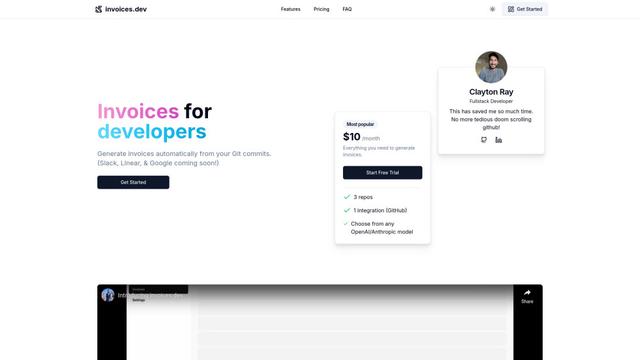
invoices.dev is an automated invoicing platform that generates invoices directly from developers' Git commits, with integration capabilities for GitHub, Slack, Linear, and Google services.
Monyble
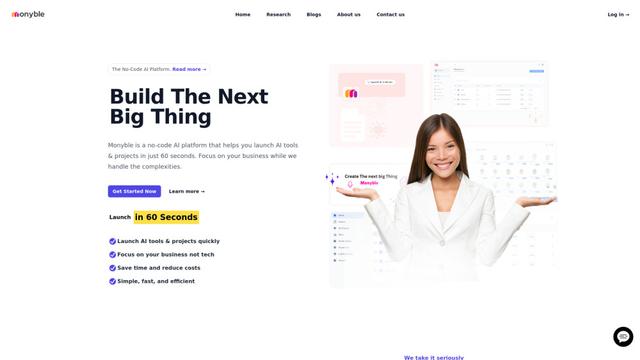
Monyble is a no-code AI platform that enables users to launch AI tools and projects within 60 seconds without requiring technical expertise.
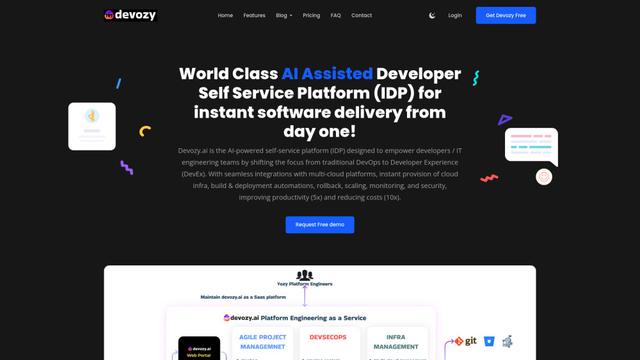
Devozy.ai
Devozy.ai is an AI-powered developer self-service platform that combines Agile project management, DevSecOps, multi-cloud infrastructure management, and IT service management into a unified solution for accelerating software delivery.
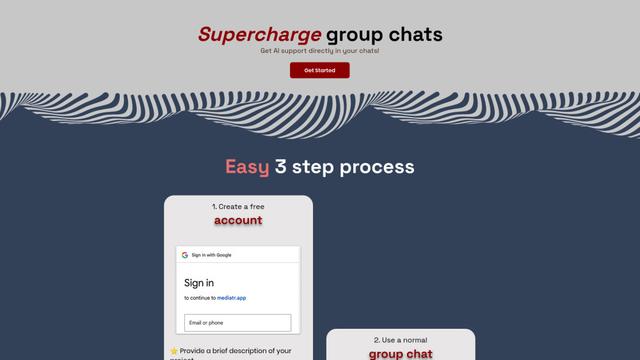
Mediatr
MediatR is a popular open-source .NET library that implements the Mediator pattern to provide simple and flexible request/response handling, command processing, and event notifications while promoting loose coupling between application components.
Popular AI Tools Like Lettertrace
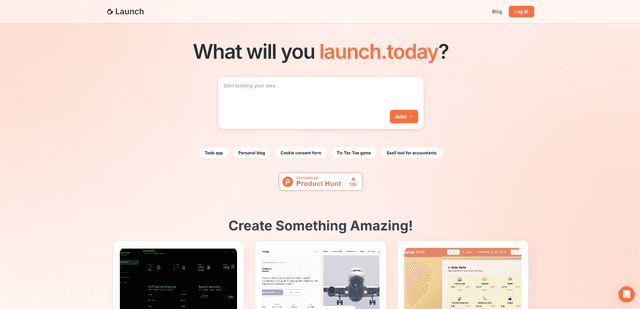
Launch
Launch is an AI-powered platform that enables users to build full-stack applications instantly while providing comprehensive tools for product launches, entrepreneurship programs, and customer acquisition.

GitHub Copilot Chat
GitHub Copilot Chat is an AI-powered coding assistant that provides natural language interactions, real-time code suggestions, and contextual support directly within supported IDEs and GitHub.com.
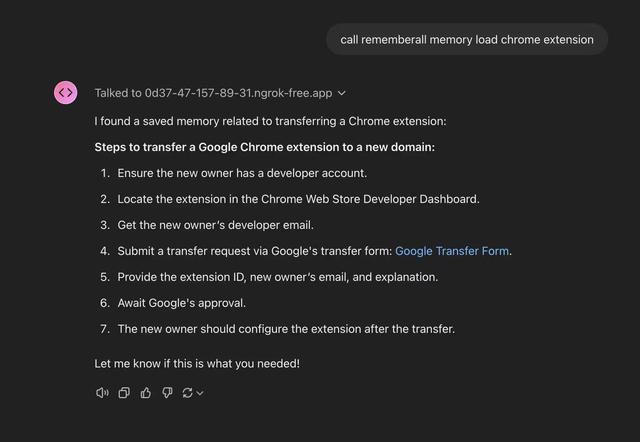
Rememberall
Rememberall is a secure, open-source long-term memory solution that enables AI applications and GPT models to maintain persistent memory across conversations through semantic search and vector storage capabilities.
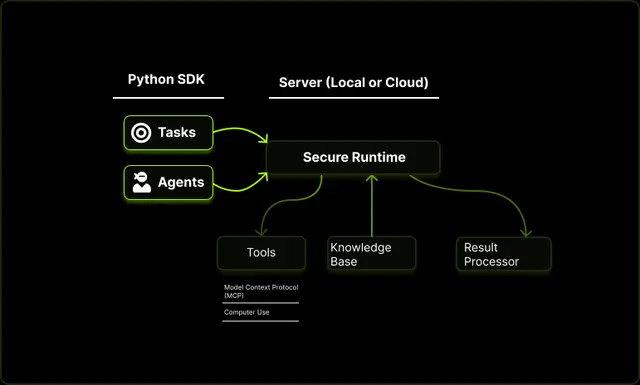
Upsonic
Upsonic is a reliability-focused AI agent framework with dockerized server-client architecture that enables trusted agent workflows through advanced features like verification layers, triangular architecture, and Model Context Protocol (MCP) integration.