
LazySEO
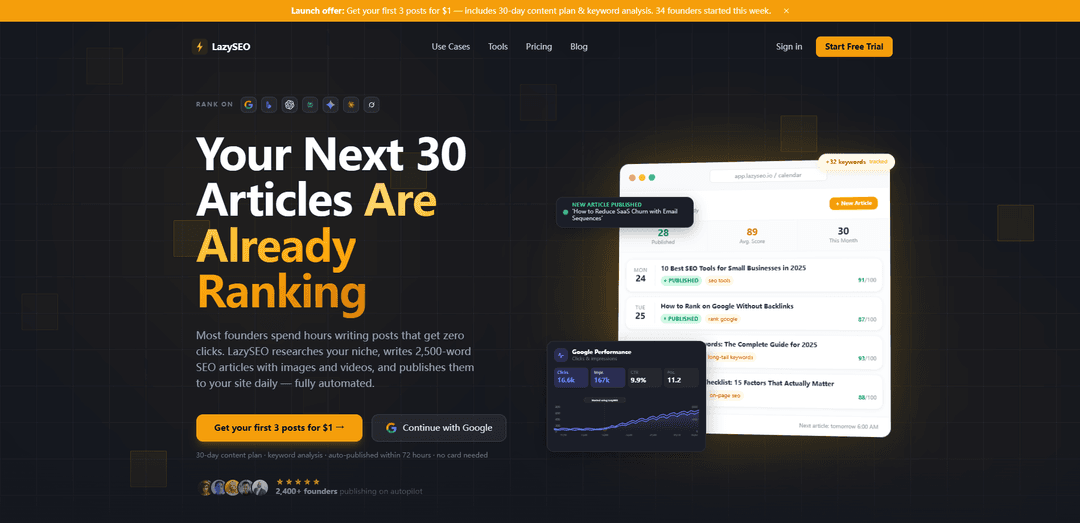
LazySEO is an AI-powered SEO autopilot that automates keyword research, long-form content creation, internal linking, and direct publishing to your CMS to help you rank on Google and AI search engines like ChatGPT and Perplexity.
https://lazyseo.io/?ref=producthunt
Product Information
Updated:May 19, 2026
What is LazySEO
LazySEO is an automated SEO content platform built for founders, SaaS teams, and eCommerce brands who want consistent organic growth without running a full content operation. It analyzes your site and niche, generates a 30-day content plan, writes SEO-optimized long-form articles (with supporting media), and publishes them directly to platforms like WordPress, Webflow, Ghost, Shopify, and more. The product positions itself around “set it once” execution—turning a blank or underused blog into a continuously updated channel designed to rank in both traditional search and AI-driven answer engines.
Key Features of LazySEO
LazySEO is an AI-powered SEO automation platform that scans your site and competitors, builds a 30-day keyword-driven content plan, generates long-form SEO articles (with images/video and internal links), scores them against SEO checks, and auto-publishes directly to popular CMSs on a daily schedule. It also supports programmatic SEO from CSV datasets and includes an automated backlink exchange to help grow authority, with content structured for both Google rankings and AI search citations (e.g., ChatGPT/Perplexity/Gemini/AI Overviews).
Automated keyword research + 30-day content plan: Crawls your site, scans competitors, finds low-competition “winnable” keywords, clusters them, and produces a ready-to-run 30-article monthly calendar.
Long-form article generation with SEO scoring: Creates research-backed ~2,500–4,000 word articles using SERP data and runs a multi-point scoring/QA loop (e.g., title/meta/readability/keyword usage/structured data), targeting a minimum quality threshold (e.g., 85/100).
Hands-free publishing to major CMSs: One-click connectors and scheduling publish posts directly to WordPress, Webflow, Ghost, Shopify, Framer (plus options like Wix/Notion/webhooks), eliminating manual copy-paste and formatting.
Topical authority + internal linking automation: Reads existing content to match brand voice and automatically weaves contextual internal links to strengthen site structure and compound PageRank over time.
Programmatic SEO from CSV datasets: Uploads a spreadsheet (up to ~500 rows), applies a title/template with placeholders, and generates one researched, optimized, scheduled article per row for scalable location/product/use-case pages.
Backlink exchange network: Credit-based cooperative link-building: earn credits by linking out contextually, then spend credits to receive niche-relevant dofollow backlinks with DR filtering and health monitoring.
Use Cases of LazySEO
SaaS demand generation at scale: Automatically publish long-tail “how to,” comparison, and integration articles to capture high-intent keywords and build topical authority without hiring an internal content team.
eCommerce SEO for product discovery: Generate buying guides, product roundups, and category-supporting content that ranks organically and drives conversion-focused traffic while reducing reliance on paid ads.
Local/service-area programmatic pages: Create city/region-specific pages (e.g., “Best {service} in {location}”) using CSV-driven programmatic SEO to expand coverage across multiple markets.
Indie hackers and solo founders’ autoblogging: Set-and-forget content production that matches existing voice and publishes daily, letting small teams focus on product while still building organic traffic.
AEO/GEO optimization for AI search visibility: Structure content with clear headings and quotable answers to increase the chance of being cited in AI answers (ChatGPT/Perplexity/Gemini) and Google AI Overviews.
Agency-style output without agency overhead: Replace or supplement traditional SEO retainers by automating research, drafting, optimization checks, and publishing—useful for lean marketing teams needing consistent output.
Pros
End-to-end automation (research → writing → optimization → publishing) with minimal setup time
Scales content production via daily publishing and CSV-based programmatic SEO
Built-in mechanisms for authority growth (internal linking + backlink exchange) and AI-search citation optimization
Cons
Hands-free auto-publishing may require oversight to ensure brand, legal, and factual accuracy for sensitive industries
Backlink exchange participation may not fit every brand’s risk tolerance or SEO strategy
Long-form daily output can create content bloat if keyword targeting and topical focus aren’t monitored
How to Use LazySEO
1) Create an account and start the $1 trial: Go to https://www.lazyseo.io/register (or /signup) and create your account to get your first 3 posts for $1 (no card needed is also mentioned on the site).
2) Connect your website/CMS: In the onboarding flow, plug in your blog using a one-click connector (WordPress, Webflow, Ghost, Shopify, Framer, Wix, Notion, or Webhook/API). LazySEO will read your existing posts to match your tone, format, and vocabulary.
3) Let LazySEO crawl your site and analyze competitors: After connecting, LazySEO crawls your site, analyzes your niche and competitors, and prepares the automation pipeline (keyword research → writing → scoring → internal linking → publishing).
4) Review the auto-generated 30-day content plan: LazySEO generates a 30-day content calendar with ~30 targeted, low-competition (“winnable”) keywords and clusters them into a ready-to-run plan. Confirm the direction/keywords if you want control.
5) Configure publishing preferences (autopilot vs review mode): Choose whether posts publish automatically on schedule (hands-free) or use a review mode when you want to approve content before it goes live.
6) Generate and publish your first articles (within ~72 hours): LazySEO writes long-form SEO articles (typically 2,500–4,000 words) with images/videos, then publishes directly to your connected CMS—no copy/paste or manual formatting.
7) Rely on built-in SEO checks before each post ships: Each article is run through automated checks (e.g., title tag, meta description, readability, keyword density, structured data) and is intended to meet a minimum quality score threshold (e.g., “Nothing ships below 85/100”).
8) Let internal linking compound topical authority: Before publishing, LazySEO scans your existing articles and weaves in contextual internal links so PageRank and topical authority compound as more posts go live.
9) (Optional) Use Programmatic SEO to scale with a CSV: Upload a CSV dataset (up to 500 rows) containing columns like product/location/use_case. Define a title template using placeholders (e.g., “Best {{product}} for {{location}}”). LazySEO generates one researched article per row and schedules them daily.
10) (Optional) Enable the Backlink Exchange to earn and spend link credits: Join LazySEO’s cooperative link-building network. When your articles contextually link to other niche sites, you earn credits; spend credits to receive niche-matched dofollow backlinks, with options like minimum Domain Rating (DR) filtering and health monitoring alerts.
11) Keep autopublishing daily to build rankings over time: With the schedule set, LazySEO continues publishing daily (e.g., 30 articles/month). Over the following weeks/months, expect indexing, impressions, and rankings to build as content accumulates.
12) Track outcomes in search and AI engines: Monitor indexing and performance in Google Search Console and watch for visibility in AI search experiences (e.g., ChatGPT/Perplexity/Gemini citations) as articles are structured for AEO/GEO with clear headings and quotable answers.
LazySEO FAQs
LazySEO is an AI-powered SEO autoblogging platform that automates keyword research, long-form content creation (typically 2,500–4,000 words with images/videos), SEO scoring, internal linking, and publishing to your site on a daily schedule.
Popular Articles

Atoms: A Multi-Agent AI Platform That Transforms Ideas into Launch-Ready Products
May 22, 2026

Nano Banana SBTI: What It Is, How It Works, and How to Use It in 2026
Apr 15, 2026

Atoms Review — The AI Product Builder Redefining Digital Creation in 2026
Apr 10, 2026

Kilo Claw: How to Deploy and Use a True "Do‑It‑For‑You" AI Agent(2026 Update)
Apr 3, 2026
Latest AI Tools Similar to LazySEO

Frizerly
Frizerly is an AI-powered platform that automatically creates and publishes SEO-optimized blog content by learning about your business and industry to help improve your website's search rankings.
WP AutoBlog
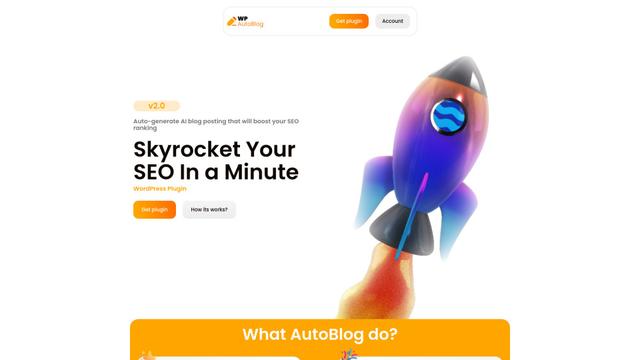
WP AutoBlog is a WordPress plugin that leverages AI to automatically generate and publish SEO-optimized blog content while handling keyword research, image selection, and scheduled posting.
BlogBud AI
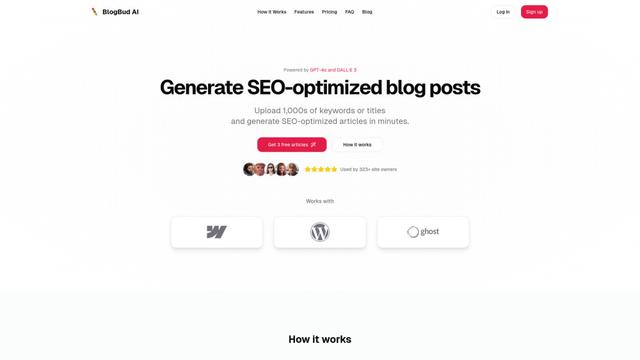
BlogBud AI is a powerful AI-powered content generation platform that helps users create thousands of SEO-optimized blog articles at scale using GPT-4o and DALL-E 3 technologies.

Scriptio AI
ScriptioAI is a unique content creation application that combines three major AI technologies (Google Bard, ChatGPT, and Microsoft AI) to transform voice commands, text, URLs, websites, or keywords into various digital content formats like eBooks, flipbooks, audiobooks, and podcasts.
Popular AI Tools Like LazySEO
Writesonic
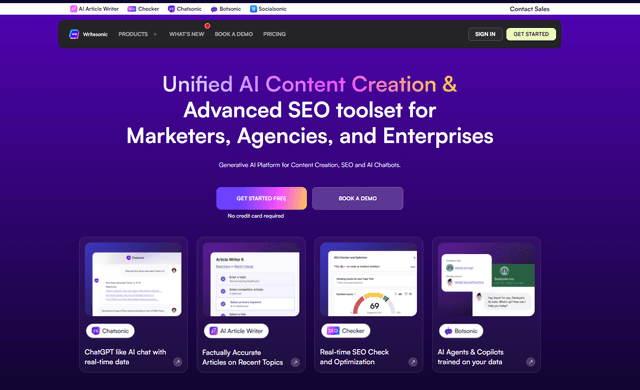
Writesonic is an AI-powered content creation platform that offers writing assistance, SEO optimization, and custom AI chatbots to help marketers, agencies, and enterprises produce high-quality content efficiently.
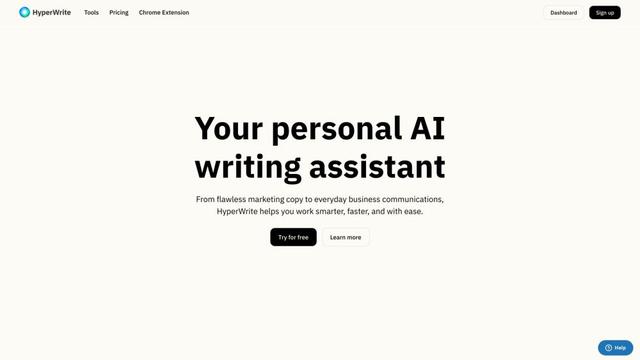
HyperWrite
HyperWrite is an AI-powered writing assistant that uses advanced artificial intelligence to help users generate high-quality content, improve their writing, and boost productivity across various writing tasks.
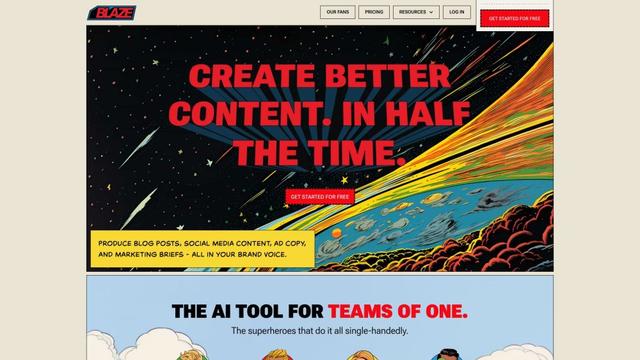
Blaze
Blaze is an AI tool designed for solo marketers to produce high-quality content, including blog posts, social media content, and ad copy, in their brand voice.

Junia AI
Junia AI is an AI-powered content creation tool that generates SEO-optimized, long-form articles to help boost search rankings and organic traffic.