
How AI-pilled are you?
"How AI-pilled are you?" is a free, no-signup, ~12-minute diagnostic that scores your organization’s AI fluency (0–100) and provides an explainable tiered report with benchmarks and next-step recommendations.
https://www.ai-pilled.com/?ref=producthunt
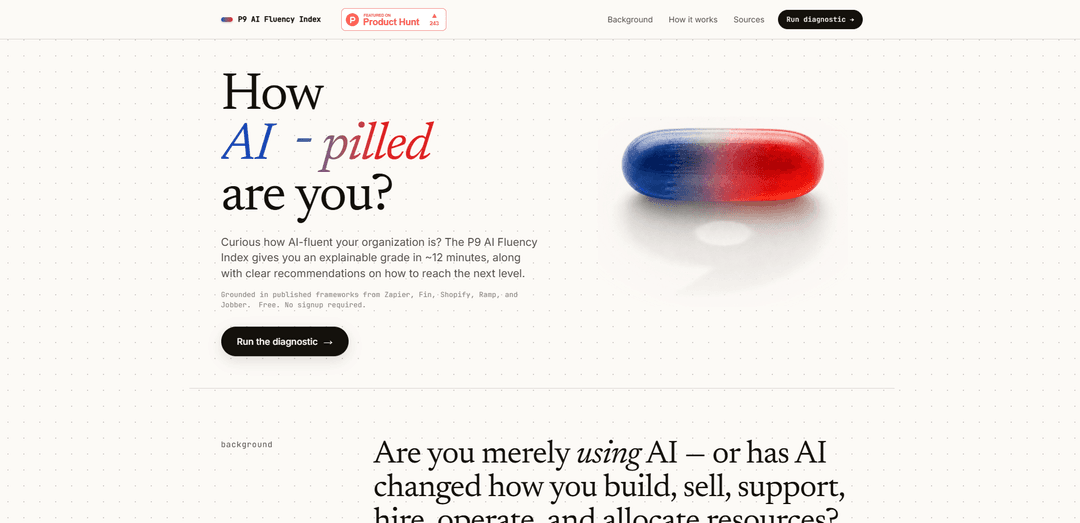
Product Information
Updated:May 15, 2026
What is How AI-pilled are you?
"How AI-pilled are you?" is an online assessment (the P9 AI Fluency Index) designed to help organizations understand whether they’re merely using AI or whether AI has meaningfully changed how they build, sell, support, hire, operate, and allocate resources. It frames AI fluency as measurable productivity and capability gains—faster throughput, lower unit costs, shorter cycle times, eliminated work categories, and new economically-viable capabilities—then summarizes your current maturity in a clear, shareable report. The index is grounded in published rubrics and real-world benchmarks from companies and frameworks such as Zapier, Fin, Shopify, Ramp, Jobber, and related industry research.
Key Features of How AI-pilled are you?
“How AI‑pilled are you?” is a free, no-signup, ~12‑minute diagnostic (the P9 AI Fluency Index) that scores an organization’s AI fluency on an explainable 0–100 scale and assigns a tier from L0 (Unactivated) to L5 (AI‑Native). It asks nine plain-language questions across six dimensions (Culture & Talent, Team Fluency by Function, Throughput, Tooling & Context, Product, Governance), then returns a shareable report card with a dimension breakdown, benchmark anchors drawn from published frameworks (e.g., Zapier, Fin, Shopify, Ramp, Jobber, Anthropic), and a short set of recommended moves to reach the next level—emphasizing measurable productivity and workflow change over “AI vibes.”
12-minute, no-signup diagnostic: Runs quickly with nine plain-language questions (mostly single-select) and requires no email or account, lowering friction for broad internal use.
Explainable 0–100 score + L0–L5 tiering: Converts responses into weighted levels (0–5) to produce a transparent overall score and maturity tier from Unactivated to AI‑Native.
Six-dimension maturity model: Breaks AI fluency into Culture & Talent, Team Fluency by Function, Throughput, Tooling & Context, Product, and Governance to pinpoint where progress is blocked.
Benchmark-anchored framework: Grounded in publicly shared rubrics and case studies (Zapier hiring rubric, Fin throughput metrics, Shopify culture memo, Ramp tooling harness/Dojo, Jobber engineering ladder, Anthropic process signals) to reduce subjectivity.
One-page report card with recommendations: Outputs a shareable scorecard showing dimension-by-dimension strengths/weaknesses plus a small set of concrete next steps to climb the next rung.
Throughput-first orientation: Frames “AI fluency” as measurable productivity gains and workflow changes (cycle time, unit cost, eliminated work categories, new capabilities) rather than mere tool adoption.
Use Cases of How AI-pilled are you?
Executive baseline + roadmap (any industry): Leadership teams use the score and dimension breakdown to establish a starting point, align on what “AI fluency” means, and prioritize the next operational changes.
GTM enablement (SaaS / sales-led orgs): Revenue teams identify gaps in function-level fluency and tooling/context, then standardize playbooks (research, outreach, support workflows) to improve throughput.
Customer support transformation (e-commerce / fintech / marketplaces): Support orgs assess whether AI is changing resolution workflows and cost-to-serve, using the governance and tooling dimensions to reduce risk while scaling automation.
Hiring and talent development (HR / recruiting): People teams use the rubric-inspired structure to shape training plans and interview screens, focusing on iteration, pushback, and workflow change rather than prompt “flashiness.”
Engineering maturity assessment (product & platform teams): Engineering leaders benchmark adoption and agentic practices (inspired by Jobber-style ladders) and identify whether AI is improving cycle time without creating silent complexity.
Governance and risk check (regulated sectors): Healthcare, finance, and legal teams use the governance dimension to surface policy/process gaps and ensure experimentation is paired with appropriate controls.
Pros
Free, fast, and no signup required—easy to share and repeat periodically.
Explainable scoring with dimension breakdowns turns “AI adoption” into a structured maturity conversation.
Grounded in recognizable public benchmarks, helping reduce internal debate and anchoring recommendations in real-world practices.
Cons
Self-reported answers can bias results without independent validation or metrics instrumentation.
A nine-question diagnostic may oversimplify complex org realities (especially across large, multi-business enterprises).
Recommendations are necessarily general; teams may still need deeper consulting, change management, or tooling work to execute.
How to Use How AI-pilled are you?
1) Open the diagnostic site: Go to https://www.ai-pilled.com/?ref=producthunt in a web browser.
2) Read what the diagnostic measures (optional but recommended): Review the page’s overview: the P9 AI Fluency Index scores your organization’s AI fluency across six dimensions (Culture & Talent, Team Fluency by Function, Throughput, Tooling & Context, Product, Governance) and maps you to one of six tiers (L0 Unactivated → L5 AI-Native).
3) Start the diagnostic: Begin the questionnaire (“Run the diagnostic”). The site states it takes ~12 minutes and requires no signup.
4) Answer the nine questions in plain language: Complete all questions about how your company uses AI today. Per the site: eight questions are single-select, and one question expands into five sub-questions (one per functional area).
5) Submit to calculate your score: After answering, proceed to results. The site calculates each answer as a level (0–5) multiplied by a question weight, then rolls everything up into an overall 0–100 score and a tier (L0–L5).
6) Review your report card: View the one-page report card showing: (a) your tier and 0–100 score, (b) a six-dimension breakdown highlighting over/under-performance, (c) comparison anchors against named public benchmarks, and (d) three recommended moves to reach the next level.
7) Use the recommendations to plan next actions: Translate the three recommended moves into an internal action plan (e.g., initiatives by dimension such as improving tooling/context, driving measurable throughput gains, or strengthening governance).
8) Share the results (optional): Use the shareable report card to align leadership and teams. The site indicates sharing does not require providing an email.
9) Re-run periodically to track progress: Repeat the diagnostic after implementing changes to see whether your score/tier improves and which dimensions moved.
How AI-pilled are you? FAQs
It’s a free, no-signup-needed diagnostic called the P9 AI Fluency Index that grades how AI‑fluent your organization is and provides recommendations to improve.
How AI-pilled are you? Video
Popular Articles
Atoms: A Multi-Agent AI Platform That Transforms Ideas into Launch-Ready Products
May 22, 2026

Nano Banana SBTI: What It Is, How It Works, and How to Use It in 2026
Apr 15, 2026
Atoms Review — The AI Product Builder Redefining Digital Creation in 2026
Apr 10, 2026
Kilo Claw: How to Deploy and Use a True "Do‑It‑For‑You" AI Agent(2026 Update)
Apr 3, 2026
Latest AI Tools Similar to How AI-pilled are you?
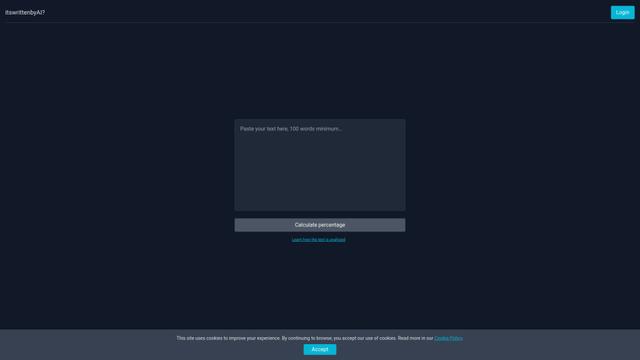
Itswrittenbyai
Itswrittenbyai is an AI detection tool that helps identify content generated by popular AI models like ChatGPT, Claude, and Gemini.
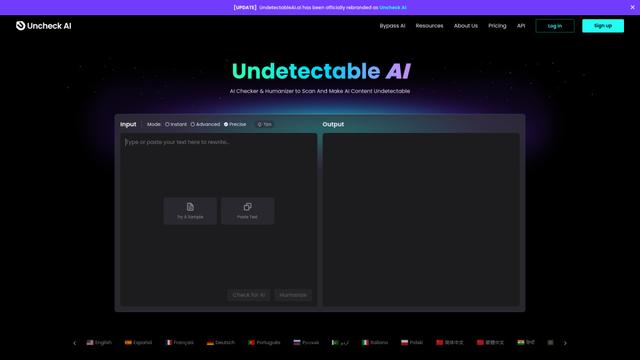
Uncheck AI
Uncheck AI is an advanced AI detection and humanization tool that can accurately identify AI-generated content and rewrite it to be undetectable by popular AI detectors.
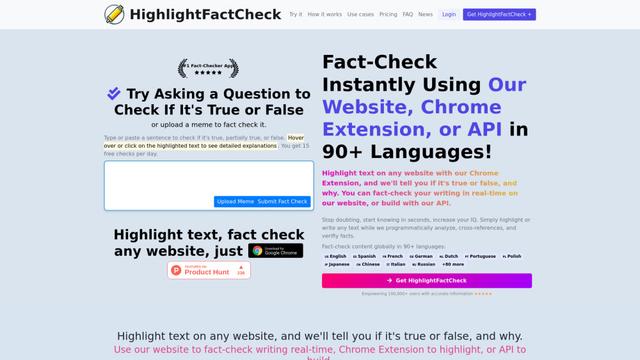
HighlightFactCheck.com
HighlightFactCheck.com is a smart companion for verifying online information, offering instant AI-powered fact-checks through a website, Chrome extension, and API in over 90 languages.
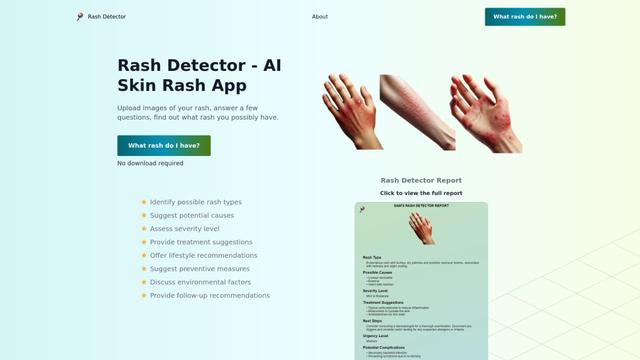
Rash Detector
Rash Detector is an AI-powered web app that analyzes images of skin rashes to provide insights on possible rash types, causes, severity, and treatment suggestions.
Popular AI Tools Like How AI-pilled are you?
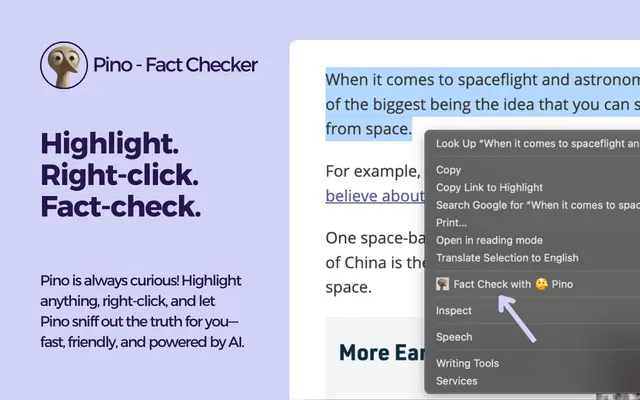
Pino - Fact Checker
Pino is an AI-powered Chrome extension that enables instant fact-checking of any text with truth scores, detailed analysis, and reliable sources through a simple highlight-and-click interface.
GPTZero
GPTZero is a leading AI detection tool that accurately identifies AI-generated text from various language models across sentence, paragraph, and document levels.
ZeroGPT
ZeroGPT is a comprehensive AI content suite featuring a highly accurate AI detector tool that analyzes text to determine whether it was written by AI (like ChatGPT, GPT-4, Gemini) or humans, along with additional features like summarization, paraphrasing, translation and grammar checking capabilities.
Undetectable AI
UndetectableAI.ai is an AI content detection and humanization tool that scans AI-generated text and rewrites it to be undetectable by AI detectors while maintaining quality and meaning.