HiAPI
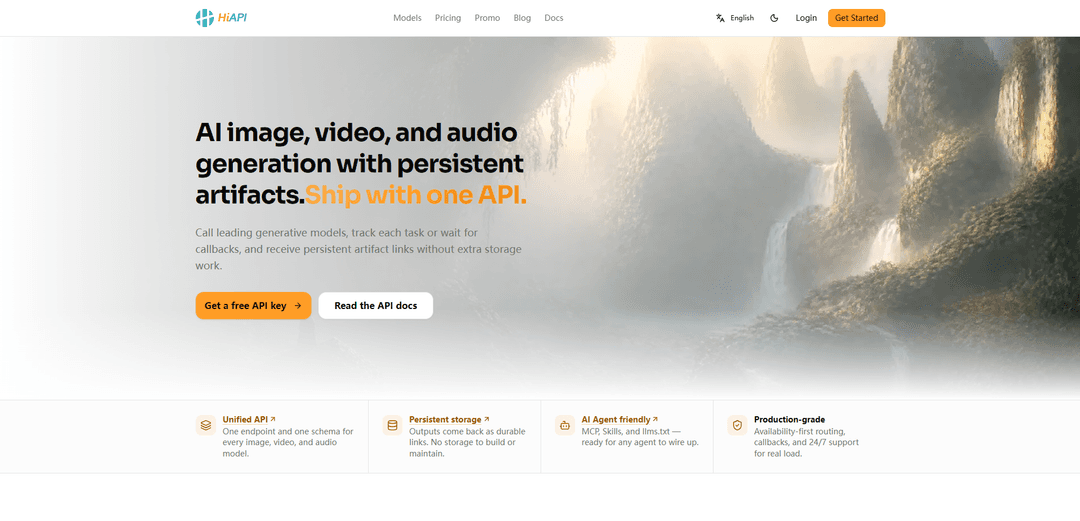
HiAPI gives developers unified access to leading AI models for image generation, image editing, video generation, and text workflows through a single API key. It provides OpenAI-compatible requests, RESTful APIs, transparent pricing, unified billing, public documentation, and a playground for testing models before integration.
https://www.hiapi.ai/en?utm_source=aipure
Product Information
Updated:Jul 10, 2026
What is HiAPI
HiAPI is a developer-focused platform that lets you generate images, videos, and audio through a single, consistent API, without having to integrate and maintain separate SDKs and storage pipelines for each model provider. It offers a curated set of leading generative models (e.g., GPT Image 2, FLUX, Nano Banana for images; Seedance and HappyHorse for video), transparent per-task pricing, and durable output links so your generated media remains accessible without building your own storage layer. HiAPI is designed for both direct application integration and agent-based workflows, supporting OpenAI-compatible patterns as well as agent-oriented tools like Skills, Remote MCP, and llms.txt guidance.
Key Features of HiAPI
HiAPI is a developer-first, unified AI API gateway that lets you generate images, videos, and audio through a single async task endpoint and consistent schema, while returning durable (persistent) artifact links so you don’t need to build your own storage layer. It supports production workflows with task tracking, polling or webhooks (callbacks), availability-first routing, transparent per-model pricing, and agent-friendly integrations via Skills, Remote MCP tools, and an OpenAI-compatible option for easier migration and agent/tooling interoperability.
Unified async Task API: Create generation jobs with POST /v1/tasks (one endpoint, one payload shape) and retrieve results via task status (e.g., GET /v1/tasks/:id), across image/video/audio models.
Persistent artifact storage: Set storage to "persistent" to receive durable output links for generated media, avoiding separate storage infrastructure and simplifying downstream reuse.
Callbacks (webhooks) and polling: Long-running media jobs are handled cleanly: poll task status or provide callback.url to receive completion notifications when the task reaches a final state.
Multi-model access with one API key: Route requests to featured and curated models (e.g., GPT Image 2, FLUX, Seedance, HappyHorse, etc.) by changing the model field without changing your integration pattern.
Agent-friendly integration (Skills + Remote MCP + llms.txt): Designed for AI agents (Claude/Cursor/Codex, etc.) with discoverable instructions and tool-like access paths, enabling composable workflows beyond simple request/response.
Transparent, output-based pricing: Each model lists clear per-task costs so teams can estimate and control spend before shipping, with predictable pay-as-you-go billing.
Use Cases of HiAPI
Creative automation for marketing teams: Generate campaign images, variants, and short promo videos, then pass persistent artifact links into review tools, ad builders, or CMS pipelines.
AI video SaaS and prototyping: Rapidly test and swap video models via a single endpoint, using callbacks for long jobs and keeping outputs accessible without managing storage.
E-commerce product imagery and mockups: Produce studio-style product renders, lifestyle scenes, and iterative edits; persistent links simplify catalog workflows and asset reuse.
Agent-driven content pipelines: Let an agent orchestrate generation steps (e.g., storyboard → image drafts → video) using Skills/Remote MCP, with task tracking and webhook completion events.
Developer integration for multimodal apps: Ship apps that need image/video/audio generation with minimal surface area: one key, one task lifecycle, consistent retrieval, and predictable costs.
Pros
Single unified async endpoint and schema across media types simplifies integration and model switching.
Persistent artifact links reduce engineering overhead for storage and asset handoff between systems.
Callbacks and task tracking are well-suited to long-running image/video/audio jobs without HTTP timeouts.
Agent-friendly options (Skills/Remote MCP/llms.txt) make it easier to wire generation into tool-using agents.
Cons
Model-specific input parameters can vary, so some models may require a model→payload adapter layer.
Async workflow (create task, then poll/callback) adds implementation steps compared to purely synchronous APIs.
Performance and capabilities vary by underlying model (e.g., some workflows may be slower at higher resolutions).
How to Use HiAPI
1) Create a HiAPI account and get an API key: Sign up on hiapi.ai and copy your API key from the dashboard. You will use it as a Bearer token in the Authorization header.
2) Pick a featured model (image/video/audio) to start: Browse the Models page and choose a model suited to your workflow (e.g., GPT Image 2 for text-to-image, Seedance/HappyHorse for video). Note the recommended model id (e.g., "gpt-image-2/text-to-image"; older aliases like "gpt-image-2" may still work but new code should use the full id).
3) Use the unified async Task API to submit a generation job: Send POST https://api.hiapi.ai/v1/tasks with JSON containing: (a) "model" (the model id), (b) "input" (model-specific parameters like prompt), and optionally (c) "storage": "persistent" to get durable artifact links, and (d) "callback" to receive a webhook when finished.
4) Example: submit an image generation task (text-to-image): POST /v1/tasks with headers Authorization: Bearer <HIAPI_API_KEY> and Content-Type: application/json, body like: {"model":"gpt-image-2/text-to-image","input":{"prompt":"a cat wearing sunglasses"},"storage":"persistent"}.
5) Track completion: poll the task status (or use callbacks): After creating a task, HiAPI returns a task id. Retrieve results by calling GET https://api.hiapi.ai/v1/tasks/{id} until the task reaches a final state. Alternatively, set "callback": {"url":"https://yourapp.com/webhook","when":"final"} on creation to avoid polling.
6) Download or use the returned artifact links: When the task is final, the response includes output artifact URLs. If you set storage to "persistent", these links are durable so you don’t need to build your own storage pipeline.
7) Iterate on prompts and parameters: Refine your prompt and any model-specific inputs (e.g., aspect ratio for many image models; video models may have different inputs). Keep the same request shape and swap only the "model" and "input" fields as needed.
8) (Optional) Integrate with agents using Skills or Remote MCP: If you’re wiring generation into an agent workflow, use HiAPI’s agent integrations (Skills / Remote MCP tools) so the agent can call models as tools. For straightforward app control, keep using direct REST calls to /v1/tasks.
9) (Optional) Use OpenAI-compatible integration where applicable: If your stack already uses OpenAI-compatible clients, HiAPI also supports OpenAI-compatible endpoints (e.g., /v1/chat/completions) so migration can be as small as pointing the base URL to https://api.hiapi.ai and using your HiAPI key, while still using the task API for async media generation workflows.
HiAPI FAQs
HiAPI is a unified, developer-first AI API gateway that provides one API key and a consistent interface to multiple image, video, and audio generation models. It is designed for production workloads with task tracking, callbacks, and durable artifact links.
Popular Articles

Vosko AI: Localize and Dub Videos for Global Audiences
Oct 15, 2026

Atoms: A Multi-Agent AI Platform That Transforms Ideas into Launch-Ready Products
Oct 13, 2026

Nano Banana SBTI: What It Is, How It Works, and How to Use It in 2026
Apr 15, 2026

Atoms Review — The AI Product Builder Redefining Digital Creation in 2026
Apr 10, 2026
Latest AI Tools Similar to HiAPI

Loud Fame
Loud Fame is an AI-powered video transformation tool that allows users to convert regular videos into anime-style animations and create AI-generated celebrity talking videos.

BizBoom.ai
BizBoom.ai is an AI-powered platform that automatically generates professional product videos from product links and images with 95% less cost.
EzVideos
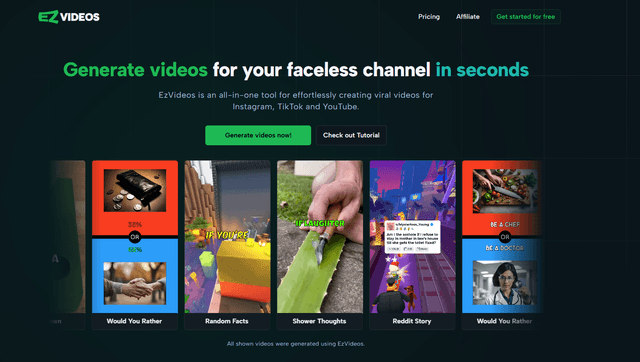
EzVideos is an all-in-one video creation tool that helps users generate viral videos for social media platforms like Instagram, TikTok, and YouTube with automated editing features and built-in resources.
Illuminix
Illuminix is an AI-powered platform that empowers businesses with autonomous hyper-experts and specialized tools for automated business processes, data management, and video content creation.
Popular AI Tools Like HiAPI
HunyuanVideo-I2V
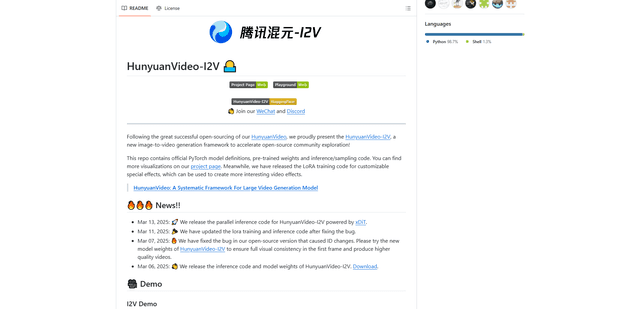
HunyuanVideo-I2V is an open-source AI framework developed by Tencent that transforms static images into high-quality, dynamic videos with customizable motion effects and exceptional visual consistency.
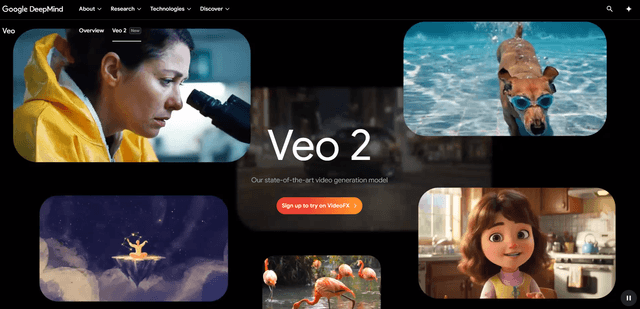
Google Veo 2
Veo 2 is Google DeepMind's state-of-the-art AI video generation model that can create high-quality videos up to 4K resolution with realistic motion, extensive camera controls, and improved physics simulation from text prompts.
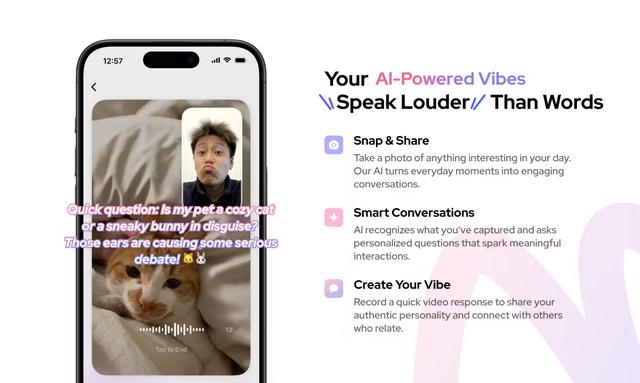
Vibing
Vibing is an AI-powered dating app that helps users share authentic moments through video stories and make genuine connections based on personality matching and interactive features.
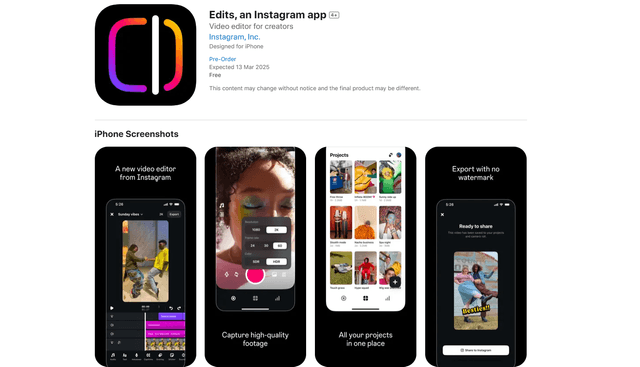
Edits, an Instagram app
Edits is Instagram's free video creation app that provides creators with professional editing tools, AI features, and analytics capabilities to create high-quality videos directly from their phones.