
Google Gemma 4
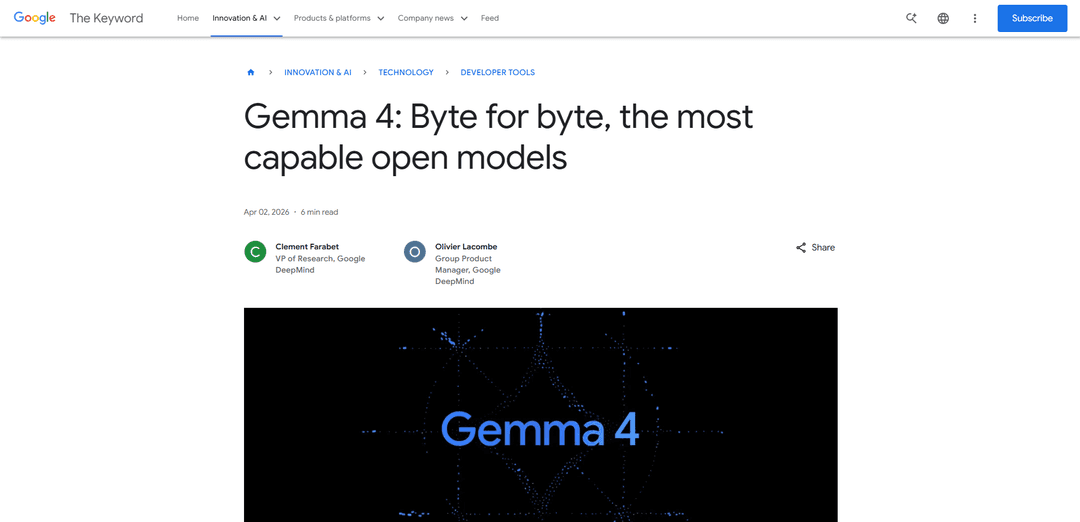
Google Gemma 4 is a family of state-of-the-art open-weight AI models released under Apache 2.0 license, featuring advanced reasoning, multimodal capabilities, and agentic workflows that can run efficiently on devices from smartphones to workstations.
https://blog.google/innovation-and-ai/technology/developers-tools/gemma-4?ref=producthunt
Product Information
Updated:Apr 10, 2026
Google Gemma 4 Monthly Traffic Trends
Google Gemma 4 received 8.5m visits last month, demonstrating a Slight Decline of -12.1%. Based on our analysis, this trend aligns with typical market dynamics in the AI tools sector.
View history trafficWhat is Google Gemma 4
Google Gemma 4, launched on April 2, 2026, represents Google DeepMind's latest generation of open AI models built on the same research and technology foundation as Gemini 3. Released under the commercially permissive Apache 2.0 license, Gemma 4 is designed to make frontier-level AI capabilities widely accessible to developers, researchers, and enterprises. The model family comes in four distinct sizes: E2B (Effective 2 billion parameters), E4B (Effective 4 billion parameters), 26B Mixture of Experts (MoE), and 31B Dense, each optimized for different hardware configurations ranging from mobile devices and IoT hardware to professional workstations and cloud infrastructure. Building on the success of previous Gemma generations—which have been downloaded over 400 million times and spawned a 'Gemmaverse' of more than 100,000 community-created variants—Gemma 4 delivers unprecedented intelligence-per-parameter, with the 31B model ranking #3 and the 26B model ranking #6 among open models on the Arena AI text leaderboard, outcompeting models up to 20 times their size.
Key Features of Google Gemma 4
Google Gemma 4 is a family of state-of-the-art open AI models released under the Apache 2.0 license, built on the same research foundation as Gemini 3. It comes in four sizes (E2B, E4B, 26B MoE, and 31B Dense) optimized for different hardware from mobile devices to workstations. The models feature advanced reasoning, native function calling for agentic workflows, multimodal capabilities (text, image, video, and audio on smaller models), support for 140+ languages, extended context windows up to 256K tokens, and exceptional code generation. Designed for on-device deployment, Gemma 4 delivers frontier-level AI capabilities with minimal hardware requirements while maintaining complete data sovereignty and privacy.
Advanced Reasoning and Agentic Workflows: Native support for multi-step planning, function calling, structured JSON output, and system instructions enables developers to build autonomous AI agents that can interact with tools, APIs, and execute complex workflows reliably.
Multimodal Understanding: All models natively process text, images, and video with variable resolutions, excelling at visual tasks like OCR and chart understanding. E2B and E4B models additionally support native audio input for speech recognition and translation across multiple languages.
On-Device Deployment with Near-Zero Latency: Optimized for edge devices including smartphones, Raspberry Pi, and IoT hardware, running completely offline with minimal memory footprint (E2B uses <1.5GB on some devices) through collaboration with Qualcomm, MediaTek, and Google Pixel teams.
Massive Multilingual Support: Pre-trained on 140+ languages with out-of-the-box support for 35+ languages, enabling developers to build inclusive, high-performance applications with proper cultural context understanding for global audiences.
Extended Context Windows: Edge models feature 128K token context windows while larger models offer up to 256K tokens, allowing developers to process entire code repositories, long documents, or extensive conversations in a single prompt.
Apache 2.0 Open Source License: Commercially permissive licensing with no monthly active user limits or acceptable-use policy restrictions, providing complete developer flexibility, digital sovereignty, and full control over data, infrastructure, and model deployment.
Use Cases of Google Gemma 4
Local AI Coding Assistants: Developers can use Gemma 4 in Android Studio and IDEs to power local code generation, completion, and correction without sending code to the cloud, maintaining privacy and reducing latency for development workflows.
Offline Mobile Applications: Build intelligent Android apps with features like voice assistants, real-time translation, document summarization, and image analysis that run entirely on-device without internet connectivity, ensuring user privacy and instant responses.
Enterprise Sovereign AI Solutions: Organizations and government agencies can deploy localized AI services that meet strict data residency, compliance, and sovereignty requirements while respecting regional nuances and maintaining complete control over sensitive data.
Healthcare and Scientific Research: Fine-tune Gemma 4 for specialized medical or scientific applications, such as cancer therapy discovery (as demonstrated with Yale University's Cell2Sentence-Scale), while maintaining HIPAA compliance and data security through on-premises deployment.
Autonomous AI Agents: Build always-on AI assistants that can interact with personal files, applications, databases, and external APIs to automate multi-step tasks, from customer service workflows to complex business process automation.
Multilingual Content Processing: Create applications that understand and generate content across 140+ languages with proper cultural context, enabling global businesses to provide localized customer experiences, translation services, and international support systems.
Pros
Apache 2.0 license provides complete commercial freedom without user limits or restrictive policies, unlike competitors like Llama 4
Exceptional efficiency with models that outperform competitors 20x their size, ranking #3 and #6 globally on Arena AI leaderboard
True on-device deployment capability with minimal memory footprint (<1.5GB for E2B) enabling offline operation on smartphones and edge devices
Comprehensive day-one support for major frameworks and tools (Hugging Face, vLLM, llama.cpp, Ollama, NVIDIA NIM, etc.) ensuring easy integration
Cons
Open-weight models raise potential concerns about misuse without strict centralized controls or monitoring
Requires technical expertise to deploy, fine-tune, and optimize for specific use cases compared to managed cloud services
Smaller models (E2B, E4B) trade some capability for efficiency, potentially limiting performance on highly complex tasks
Forward compatibility with Gemini Nano 4 is promised for later in 2026, meaning some production features are still in preview or development
How to Use Google Gemma 4
1. Choose your deployment environment: Decide where you want to run Gemma 4: on-device (Android, Raspberry Pi, desktop), in the cloud (Google Cloud, Vertex AI), or locally on your development machine. Select the appropriate model size: E2B (2B parameters) for mobile/IoT, E4B (4B parameters) for edge devices, 26B MoE for fast inference, or 31B Dense for maximum quality.
2. Access Gemma 4 through your preferred platform: For quick experimentation, use Google AI Studio (for 31B and 26B models) or Google AI Edge Gallery (for E4B and E2B models). To download model weights, visit Hugging Face, Kaggle, or Ollama. For Android development, access through the AICore Developer Preview or Android Studio.
3. Install required dependencies and tools: Install your preferred framework with day-one support: Hugging Face Transformers, vLLM, llama.cpp, MLX, Ollama, LM Studio, or Unsloth. For local deployment, ensure you have at least 4GB RAM for the smallest model (E2B) or up to 19GB for the largest (31B). For Python-based workflows, install the necessary libraries using pip.
4. Load and initialize the model: Download the model weights from your chosen platform. For Hugging Face, use the Transformers library to load the model. For local CLI usage, use the litert-lm CLI tool (available on Linux, macOS, and Raspberry Pi). For Ollama, run 'ollama pull gemma4' followed by the specific model variant. For Unsloth Studio, install using 'curl -fsSL https://unsloth.ai/install.sh | sh' and launch with 'unsloth studio -H 0.0.0.0 -p 8888'.
5. Configure model parameters and system prompts: Set up your inference parameters including context window (128K for edge models, up to 256K for larger models). Utilize native system prompt support by specifying the 'system' role for structured conversations. Configure temperature, top-p, and other generation parameters based on your use case.
6. Implement basic text generation: Start with simple text prompts to test the model. For chat applications, format your input with appropriate role tags (system, user, assistant). The model supports text, image, and audio inputs (audio only for E2B and E4B models). Process responses and handle streaming output if needed.
7. Set up function calling for agentic workflows: Define your tools and functions with clear descriptions and argument specifications (e.g., a weather lookup function). Format tool definitions according to Gemma 4's function calling schema. Send user prompts along with available tools, and the model will generate structured function call objects in JSON format when appropriate.
8. Implement tool execution and response handling: Parse the model's function call output to extract the function name and arguments. Execute the requested function with the provided parameters. Return the function results back to the model in the conversation context. The model will then generate a natural language response incorporating the tool results.
9. Enable multimodal capabilities (optional): For vision tasks, pass images along with text prompts to analyze charts, diagrams, OCR, or visual content. All Gemma 4 models support image and video input at variable resolutions. For E2B and E4B models, include audio input for automatic speech recognition (ASR) and speech-to-translated-text translation across multiple languages.
10. Optimize for production deployment: For Android apps, use the ML Kit GenAI Prompt API to run Gemma 4 on-device with AICore. For cloud deployment, use Vertex AI, Cloud Run, or GKE on Google Cloud. Apply quantization (Q4_K_M or similar) to reduce memory footprint for local deployment. Monitor performance metrics like tokens-per-second and latency. For Android, code written for Gemma 4 will be forward-compatible with Gemini Nano 4 devices.
11. Fine-tune for specific use cases (optional): Use platforms like Google Colab, Vertex AI, or Unsloth to customize Gemma 4 for your specific tasks. Prepare your training dataset in the appropriate format. Configure training parameters and leverage tools like Hugging Face TRL for efficient fine-tuning. The Apache 2.0 license allows complete customization and commercial use.
12. Implement safety and security measures: Review the Responsible Generative AI Toolkit and model card for safety guidelines. Implement content filtering based on your application requirements. For edge/robotics deployments with physical actuators, consider security middleware like HDP (Helix Delegation Protocol) to verify signed delegation tokens and classify actions by irreversibility before tool execution.
Google Gemma 4 FAQs
Yes. Gemma 4 is released under the Apache 2.0 license, which allows commercial use, redistribution, and modification without royalties, monthly active user limits, or acceptable-use policy enforcement restrictions.
Google Gemma 4 Video
Popular Articles
Atoms: A Multi-Agent AI Platform That Transforms Ideas into Launch-Ready Products
May 22, 2026

Nano Banana SBTI: What It Is, How It Works, and How to Use It in 2026
Apr 15, 2026

Atoms Review — The AI Product Builder Redefining Digital Creation in 2026
Apr 10, 2026

Kilo Claw: How to Deploy and Use a True "Do‑It‑For‑You" AI Agent(2026 Update)
Apr 3, 2026
Analytics of Google Gemma 4 Website
Google Gemma 4 Traffic & Rankings
8.5M
Monthly Visits
#8357
Global Rank
#353
Category Rank
Traffic Trends: Nov 2024-Jun 2025
Google Gemma 4 User Insights
00:00:53
Avg. Visit Duration
1.93
Pages Per Visit
55.03%
User Bounce Rate
Top Regions of Google Gemma 4
US: 26.94%
IN: 8.76%
GB: 5.14%
JP: 4.24%
DE: 3.01%
Others: 51.91%
Latest AI Tools Similar to Google Gemma 4
Athena AI
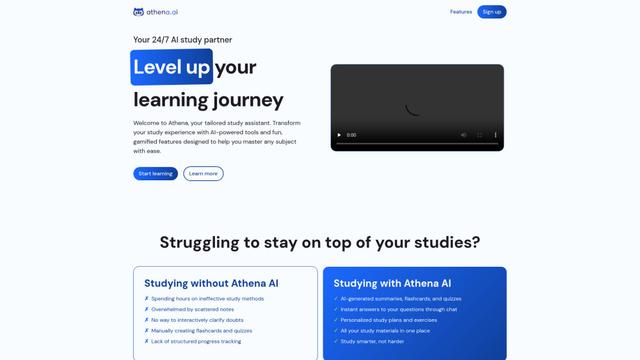
Athena AI is a versatile AI-powered platform offering personalized study assistance, business solutions, and life coaching through features like document analysis, quiz generation, flashcards, and interactive chat capabilities.
Aguru AI
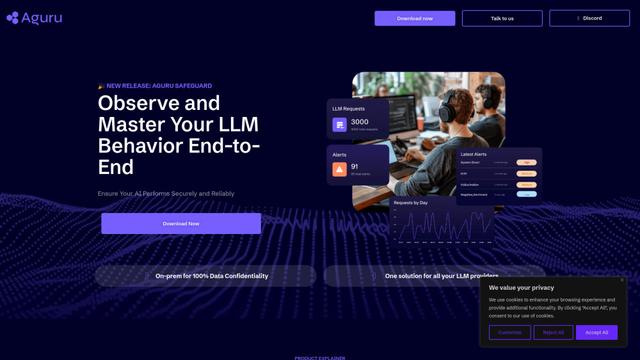
Aguru AI is an on-premises software solution that provides comprehensive monitoring, security, and optimization tools for LLM-based applications with features like behavior tracking, anomaly detection, and performance optimization.
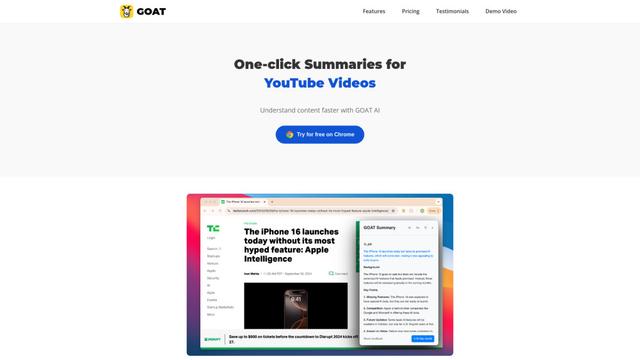
GOAT AI
GOAT AI is an AI-powered platform that provides one-click summarization capabilities for various content types including news articles, research papers, and videos, while also offering advanced AI agent orchestration for domain-specific tasks.
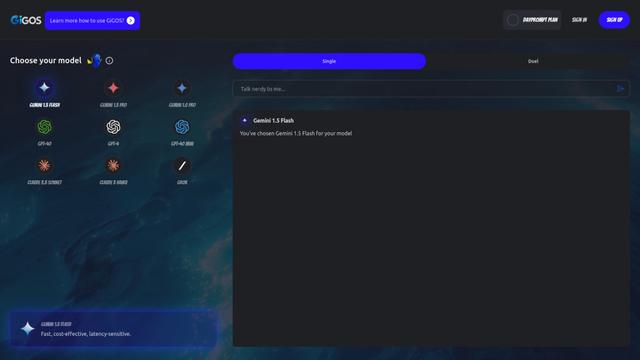
GiGOS
GiGOS is an AI platform that provides access to multiple advanced language models like Gemini, GPT-4, Claude, and Grok with an intuitive interface for users to interact with and compare different AI models.
Popular AI Tools Like Google Gemma 4
GPT‑5.5 | ChatGPT Official
GPT‑5.5 in ChatGPT is OpenAI’s latest work-focused model designed to understand complex goals, use tools effectively, check its work, and carry multi-step tasks (coding, research, documents, spreadsheets) through to completion with stronger safeguards.
SearchGPT
SearchGPT is an AI-powered search prototype by OpenAI that provides fast, conversational answers with clear sources using GPT models.
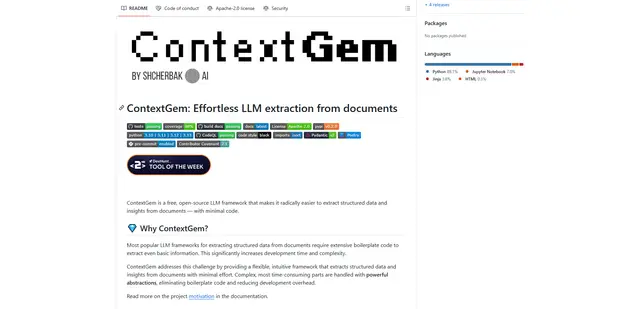
ContextGem
ContextGem is a free, open-source LLM framework that simplifies structured data and insights extraction from documents with minimal code through powerful built-in abstractions and automated features.
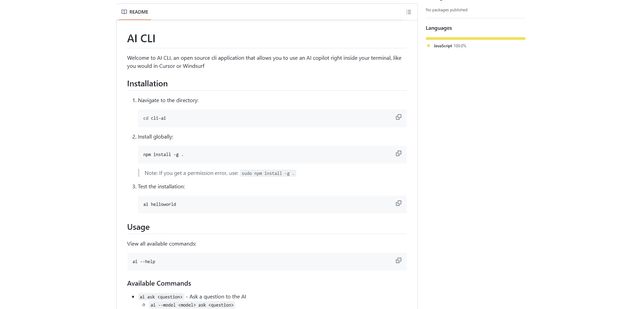
AI CLI
AI CLI is an open-source command-line interface tool that brings AI capabilities directly to your terminal, allowing you to interact with various AI models like OpenAI's GPT and Anthropic's Claude through simple commands.