
Claude Opus 4.7
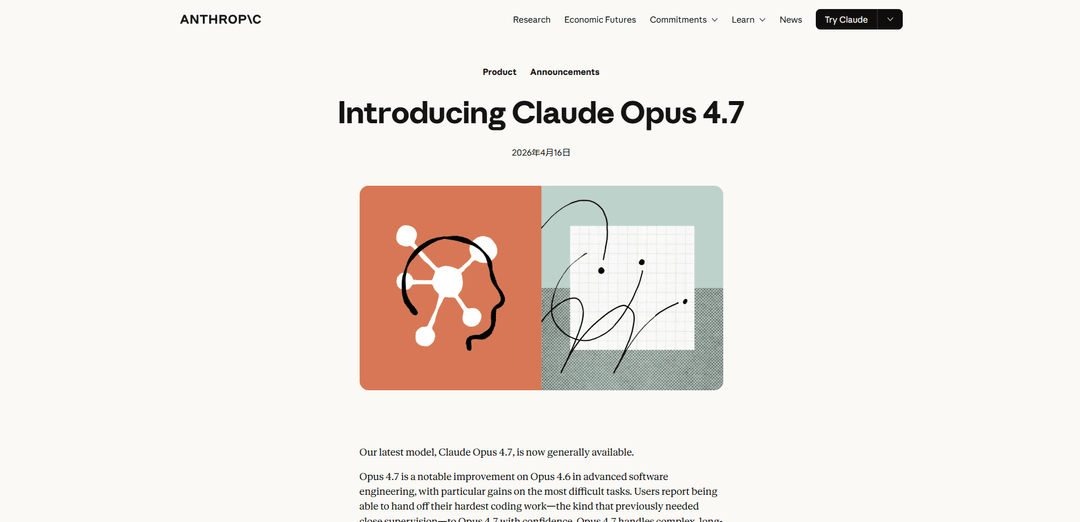
Claude Opus 4.7 is Anthropic's latest flagship AI model featuring advanced software engineering capabilities, enhanced visual intelligence with support for high-resolution images up to 2,576 pixels, and improved instruction-following for complex, long-running autonomous tasks.
https://www.anthropic.com/news/claude-opus-4-7?ref=producthunt
Product Information
Updated:May 8, 2026
Claude Opus 4.7 Monthly Traffic Trends
Claude Opus 4.7 received 14.6m visits last month, demonstrating a Moderate Growth of 28.3%. Based on our analysis, this trend aligns with typical market dynamics in the AI tools sector.
View history trafficWhat is Claude Opus 4.7
Claude Opus 4.7 is Anthropic's most powerful generally available AI model, released on April 16, 2026, representing a significant upgrade over its predecessor Claude Opus 4.6. This advanced large language model excels at complex software engineering, multi-step reasoning, document analysis, and professional work creation. While positioned below the more capable but restricted Claude Mythos Preview, Opus 4.7 delivers state-of-the-art performance across numerous benchmarks including coding, finance agent evaluations, and real-world knowledge work. The model is available across all Claude products, the Claude API, Amazon Bedrock, Google Cloud's Vertex AI, and Microsoft Foundry, maintaining the same pricing as Opus 4.6 at $5 per million input tokens and $25 per million output tokens. Notably, Opus 4.7 includes built-in cybersecurity safeguards that automatically detect and block high-risk requests, with its cyber capabilities intentionally reduced compared to Mythos Preview as part of Anthropic's responsible AI deployment strategy.
Key Features of Claude Opus 4.7
Claude Opus 4.7 is Anthropic's latest generally available AI model, released on April 16, 2026, representing a notable improvement over Opus 4.6. It excels in advanced software engineering, autonomous coding, and long-running agentic tasks with a 64.3% score on SWE-bench Pro, outperforming GPT-5.4 and Gemini 3.1 Pro. The model features triple the image resolution (up to 2,576 pixels), enhanced instruction following, file system-based memory for multi-session work, and improved honesty with lower hallucination rates. While less capable than the restricted Claude Mythos Preview, Opus 4.7 includes built-in cybersecurity safeguards that automatically detect and block high-risk security uses. It maintains the same pricing as Opus 4.6 ($5 per million input tokens, $25 per million output tokens) and is available across all Claude products, API, and major cloud platforms.
Advanced Software Engineering Capabilities: Achieves 64.3% on SWE-bench Pro coding benchmark with 13% improvement over Opus 4.6, enabling autonomous handling of complex, long-running coding tasks with minimal supervision. Features self-verification abilities and catches logical faults during planning phase.
High-Resolution Vision Processing: Supports images up to 2,576 pixels on the long edge (~3.75 megapixels), representing more than 3x the capacity of prior Claude models. Enables reading tiny text in legal documents, interpreting complex circuit schematics, and navigating desktop interfaces with pixel-perfect accuracy.
Enhanced File System-Based Memory: Remembers important notes across long, multi-session work and uses them to move on to new tasks with less up-front context. Improves continuity and reduces the need for repeated instructions in extended workflows.
Cybersecurity Safeguards: Includes automatic detection and blocking of requests indicating prohibited or high-risk cybersecurity uses. Cyber capabilities deliberately reduced compared to Mythos Preview, with legitimate security professionals able to access full capabilities through the Cyber Verification Program.
Improved Honesty and Reliability: Shows large reductions in important omissions and moderate improvements in factuality with lower hallucination rates. Better at reporting when data is missing instead of providing plausible-but-incorrect fallbacks.
Flexible Effort Control: Introduces new 'xhigh' effort level between high and max, plus task budgets feature that allows developers to guide Claude's token spend and prioritize work across longer runs with finer control over reasoning versus latency tradeoffs.
Use Cases of Claude Opus 4.7
Autonomous Software Development: Developers can hand off complex coding tasks requiring multi-step reasoning, CI/CD automation, and long-running workflows with confidence. The model resolves 3x more production tasks than Opus 4.6 and handles async workflows, debugging, and code review with minimal human intervention.
Enterprise Document Analysis and Knowledge Work: Excels at processing high-resolution documents, legal contracts, financial models, and technical diagrams. Achieves state-of-the-art results on GDPval-AA benchmark for economically valuable work across finance and legal domains, with 21% fewer errors in document reasoning.
Multi-Agent Coordination and Agentic Workflows: Enables hours-long autonomous task execution with sustained focus and coherence. Shows 14% improvement on complex multi-step workflows with one-third fewer tool errors, making it suitable for agent teams handling parallel operations and long-duration investigations.
Professional Creative Work: Produces higher-quality user interfaces, slide decks, presentations, and professional documents with improved aesthetic taste and creativity. Particularly strong at building dashboards and data-rich interfaces with design choices ready for production.
Computer Vision and Visual Intelligence Tasks: Processes complex visual information including dense screenshots, technical schematics, medical images, and architectural diagrams. Achieves 98.5% on visual-acuity benchmarks for computer-use applications, enabling autonomous penetration testing and UI navigation.
Cybersecurity Research and Testing: Security professionals enrolled in the Cyber Verification Program can use the model for legitimate vulnerability research, penetration testing, and red-teaming while safeguards protect against malicious use by automatically blocking high-risk requests.
Pros
State-of-the-art performance on coding benchmarks (64.3% on SWE-bench Pro), outperforming GPT-5.4 and Gemini 3.1 Pro with significant improvements in autonomous software engineering
Triple the image resolution capacity (3.75 megapixels) enables processing of detailed visual content previously impossible with Claude models
Improved reliability and honesty with large reductions in hallucinations, better instruction following, and ability to report missing data instead of fabricating answers
Same pricing as Opus 4.6 with no cost increase despite substantial capability improvements, available across all major cloud platforms
Cons
Less broadly capable than Claude Mythos Preview, which remains restricted and unavailable to general users
Updated tokenizer increases token count by 1.0-1.35x for certain inputs, potentially increasing costs for some use cases
Strict instruction following may produce unexpected results for prompts designed for earlier models, requiring prompt re-tuning and harness adjustments
Slightly reduced cybersecurity vulnerability reproduction capability (73.1% vs 73.8% in Opus 4.6) due to deliberately throttled cyber capabilities and built-in safeguards
How to Use Claude Opus 4.7
1: Access Claude Opus 4.7 through one of the available platforms: Claude.ai website (for Pro, Max, Team, and Enterprise users), Claude API, Amazon Bedrock, Google Cloud's Vertex AI, Microsoft Foundry, or GitHub Copilot (for Business and Enterprise users with admin-enabled policy).
2: If using the Claude web interface, navigate to the Test menu and choose Playground. Select 'Claude Opus 4.7' from the model picker dropdown.
3: If using the API, specify the model identifier 'claude-opus-4-7' in your API request through the Anthropic Messages API, AWS CLI, AWS SDK, or bedrock-runtime endpoints.
4: Remove any temperature, top_p, or top_k parameters from your requests, as setting these to non-default values will return a 400 error in Opus 4.7. Use prompting to guide the model's behavior instead.
5: Choose an appropriate effort level for your task: use 'high' or 'xhigh' effort for coding and agentic use cases. The new 'xhigh' level provides finer control between 'high' and 'max' effort, balancing reasoning capability with response speed.
6: For agentic workflows, optionally set a task budget to give Claude an estimate of how many tokens to target for a full loop, including thinking, tool calls, tool results, and final output.
7: If you need to see the model's reasoning process, explicitly opt in to display thinking content by adding '"display": "summarized"' to your request, as thinking blocks are omitted from responses by default in Opus 4.7.
8: For high-resolution image analysis, send images up to 2,576 pixels on the long edge (~3.75 megapixels). The model will automatically process them at higher fidelity, though this will consume more tokens.
9: If using Claude Code (Mac app), access Opus 4.7 with the default 'xhigh' effort level, and use the new '/ultrareview' slash command for dedicated code review sessions or enable auto mode for longer uninterrupted tasks.
10: For cybersecurity professionals needing to use Opus 4.7 for legitimate security work (vulnerability research, penetration testing, red-teaming), join Anthropic's Cyber Verification Program to bypass automatic safeguards.
11: Monitor your token usage, as Opus 4.7 uses a new tokenizer that may consume 1.0-1.35x more tokens for the same input compared to previous models, and adjust prompts or task budgets accordingly.
12: Review and adjust your prompts from previous Claude models, as Opus 4.7 follows instructions more literally and precisely than earlier versions, which may produce unexpected results with loosely-written prompts.
Claude Opus 4.7 FAQs
Claude Opus 4.7 is Anthropic's latest AI model that represents a notable improvement over Opus 4.6, particularly in advanced software engineering, coding tasks, visual intelligence, and document analysis. It's designed to handle complex, long-running tasks with improved rigor and consistency.
Popular Articles

Vosko AI: Localize and Dub Videos for Global Audiences
Oct 15, 2026

Atoms: A Multi-Agent AI Platform That Transforms Ideas into Launch-Ready Products
Oct 13, 2026

Nano Banana SBTI: What It Is, How It Works, and How to Use It in 2026
Apr 15, 2026

Atoms Review — The AI Product Builder Redefining Digital Creation in 2026
Apr 10, 2026
Analytics of Claude Opus 4.7 Website
Claude Opus 4.7 Traffic & Rankings
14.6M
Monthly Visits
#4098
Global Rank
#69
Category Rank
Traffic Trends: Jul 2024-Jun 2025
Claude Opus 4.7 User Insights
00:02:54
Avg. Visit Duration
2.92
Pages Per Visit
55.51%
User Bounce Rate
Top Regions of Claude Opus 4.7
US: 27.17%
CN: 9.53%
IN: 5.58%
KR: 4.27%
GB: 3.72%
Others: 49.72%
Latest AI Tools Similar to Claude Opus 4.7
Athena AI
Athena AI is a versatile AI-powered platform offering personalized study assistance, business solutions, and life coaching through features like document analysis, quiz generation, flashcards, and interactive chat capabilities.

Aguru AI
Aguru AI is an on-premises software solution that provides comprehensive monitoring, security, and optimization tools for LLM-based applications with features like behavior tracking, anomaly detection, and performance optimization.
GOAT AI
GOAT AI is an AI-powered platform that provides one-click summarization capabilities for various content types including news articles, research papers, and videos, while also offering advanced AI agent orchestration for domain-specific tasks.
GiGOS
GiGOS is an AI platform that provides access to multiple advanced language models like Gemini, GPT-4, Claude, and Grok with an intuitive interface for users to interact with and compare different AI models.
Popular AI Tools Like Claude Opus 4.7

GPT‑5.5 | ChatGPT Official
GPT‑5.5 in ChatGPT is OpenAI’s latest work-focused model designed to understand complex goals, use tools effectively, check its work, and carry multi-step tasks (coding, research, documents, spreadsheets) through to completion with stronger safeguards.
SearchGPT
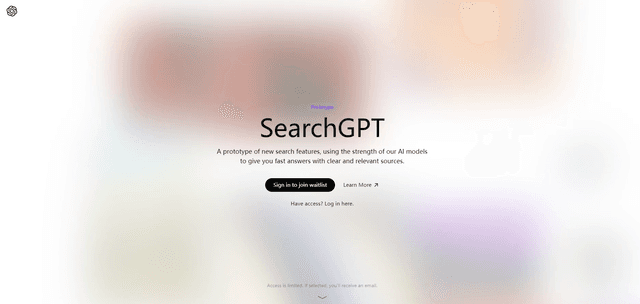
SearchGPT is an AI-powered search prototype by OpenAI that provides fast, conversational answers with clear sources using GPT models.
ContextGem
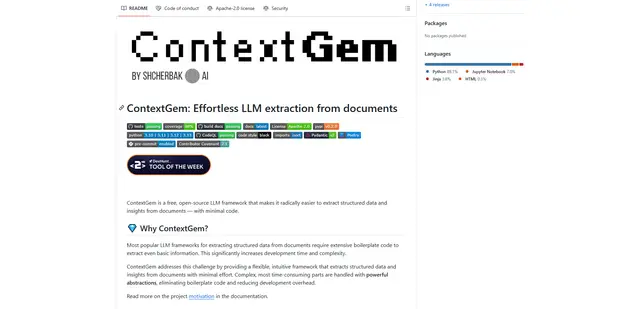
ContextGem is a free, open-source LLM framework that simplifies structured data and insights extraction from documents with minimal code through powerful built-in abstractions and automated features.
AI CLI
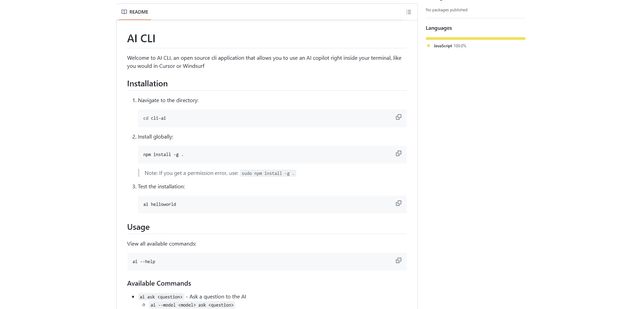
AI CLI is an open-source command-line interface tool that brings AI capabilities directly to your terminal, allowing you to interact with various AI models like OpenAI's GPT and Anthropic's Claude through simple commands.