
Screen Pipe
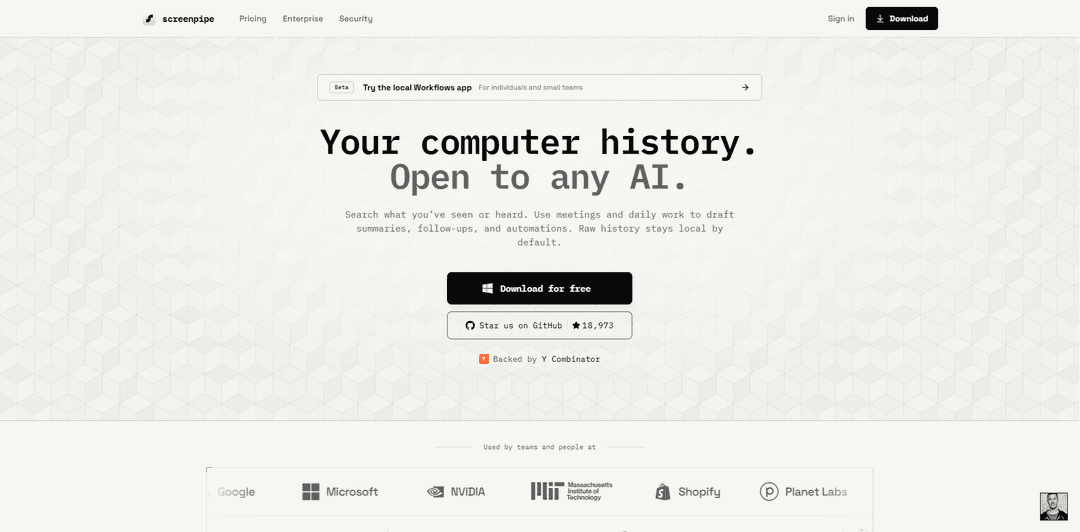
Screenpipe is a local-first app that continuously records your screen and audio, extracts searchable context (accessibility text, OCR, transcripts), and exposes it via a local API and MCP server so AI agents can use your work history across models and OSes.
https://screenpi.pe/
Product Information
Updated:Oct 10, 2026
Screen Pipe Monthly Traffic Trends
Screen Pipe experienced a 12.2% increase in visits, reaching 48,786 visits. The emphasis on privacy and high-quality screen recording features likely contributed to this growth, as it is highlighted as a leading alternative to Rewind AI, particularly for users who value visual documentation and local data processing.
What is Screen Pipe
Screenpipe is an AI “work memory” platform for macOS, Windows, and Linux that captures what happens on your computer—screen activity, app context, and audio—so you can later search, recall, and automate based on real evidence of your work. It’s designed to keep raw history local by default, while still making that history usable for assistants and workflows through a local database and developer-friendly interfaces like a REST API and an MCP server.
Key Features of Screen Pipe
Screenpipe is a local-first “AI memory” desktop app and framework that continuously captures your screen and audio, extracts on-screen text (via accessibility APIs with OCR fallback), transcribes speech, and makes this history searchable and usable by AI assistants through a local REST API and MCP server. It enables natural-language search over what you’ve seen/heard, supports scheduled autonomous workflows (“pipes”) that can summarize days, draft meeting notes, sync to tools like Obsidian, and more, and includes deterministic, per-pipe permission controls (e.g., app/window/url/content-type scoping) to keep sensitive data out and prevent unsafe actions—while keeping raw history on-device by default.
24/7 screen + audio capture (local): Continuously records screen activity and audio, extracting text via accessibility APIs with OCR fallback and producing local audio transcripts; data is stored on your machine (e.g., under ~/.screenpipe/) by default.
AI-powered search over your work history: Search what you’ve seen or heard using natural language, jump to exact moments with screenshots and extracted text, and replay audio for specific time ranges.
Local REST API + MCP server for AI assistants: Exposes your captured history via a local API (commonly http://localhost:3030) and an MCP server so tools like ChatGPT, Claude, Cursor, or other MCP-compatible agents can query your on-device context.
Pipes: scheduled AI agents and automations: Install or author “pipes” (markdown-defined agents with prompts and schedules) that can generate daily summaries, meeting notes, time breakdowns, sync to knowledge bases, and execute workflows by querying your screen data and calling approved APIs.
Deterministic permission system for safe data access: Per-pipe, YAML-based allow/deny controls (e.g., allow-apps, deny-apps, deny-windows, allow-content-types, time-range, days, allow-raw-sql, allow-frames) restrict what the AI can access; enforcement is described as multi-layered and not prompt-based.
Team/enterprise deployment controls: Supports enterprise rollouts with central configuration and managed workflows; admins can manage capture policies and pipe permissions while captured data can remain on employee devices depending on storage/sharing configuration.
Use Cases of Screen Pipe
Meeting notes and follow-ups (knowledge workers): Use captured screen context plus audio transcription to automatically draft meeting summaries, action items, and follow-up emails—grounded in what was actually shown and said.
Workflow discovery and SOP creation (consulting/operations): Analyze repeated screen-level processes (e.g., invoice reconciliation) to map steps, identify manual handoffs, and generate private playbooks/SOPs and automation candidates.
Time tracking and daily/weekly reporting (individuals & teams): Run scheduled pipes that summarize your day, produce standup updates, or generate time breakdowns across apps and projects based on real usage evidence.
Audit trail and context recall (project-heavy roles): Quickly retrieve “where did I see that?” information by searching across screen text, app names, and browser URLs, then jumping back to the original evidence.
Sensitive environments (healthcare/regulated work): Keep PHI or other sensitive data local while still enabling search and summarization; scope capture/AI access by app/window and apply on-device redaction to reduce exposure.
Automating repetitive back-office tasks (finance/admin): Build or install pipes that use your screen history to assist with tasks like invoice processing—e.g., extracting details from emails, drafting tracker entries, and flagging mismatches while leaving approvals to humans.
Pros
Local-first by default: raw screen/audio history can stay on-device, reducing reliance on third-party clouds for core memory storage.
Strong automation surface: local API + MCP integration + scheduled “pipes” enable both search and agentic workflows across many tools.
Deterministic access controls: per-pipe allow/deny rules and multi-layer enforcement help keep sensitive apps/windows/content out of AI context.
Cons
High sensitivity footprint: recording screen and audio 24/7 can raise privacy, compliance, and internal policy concerns even if stored locally.
Alpha-stage stability/UX risk: sources indicate frequent updates and ongoing bug fixes, implying potential reliability and setup friction.
Commercial licensing constraints: source-available with personal non-commercial use permitted; commercial use requires a license.
How to Use Screen Pipe
1) Install Screenpipe: Download and install Screenpipe for your OS (macOS/Windows/Linux) from the official site. Screenpipe is local-first and stores captured data on your machine by default.
2) Launch Screenpipe and enable capture permissions: Open the desktop app and grant the required OS permissions for screen capture and microphone/audio capture so Screenpipe can record screen activity and transcribe audio.
3) Start recording your work history: Let Screenpipe run in the background to continuously capture your screen (using accessibility APIs with OCR fallback) and audio (with transcription). Your history is saved locally (commonly under ~/.screenpipe/).
4) Search and rewind your history in the app: Use the app’s search/timeline to find what you saw or heard earlier. Click a moment to view the screenshot and extracted text, and play back audio for the selected time period.
5) Use the local REST API for programmatic access: Query your captured screen recordings, extracted screen text, and audio transcriptions via HTTP endpoints on the local API (typically http://localhost:3030). Use this to build your own tools and integrations.
6) Connect AI agents via the MCP server: Run the MCP server so AI assistants/agents can query your Screenpipe history as context. Docs are available at docs.screenpi.pe/mcp-server, and you can start it with: npx -y screenpipe-mcp.
7) Use the CLI to manage Screenpipe tasks: Run Screenpipe commands from the terminal using the CLI: npx -y screenpipe@latest <command>. Use this for setup and workflow automation tasks supported by the CLI.
8) Create a “Pipe” (scheduled AI task) to automate workflows: Create a pipe (a scheduled AI agent) defined by a markdown file (pipe.md) that includes a prompt and schedule. Pipes can query your screen/audio history, call APIs, write files, and take actions.
9) Scope what the AI can access (privacy & permissions): Configure per-pipe access controls using YAML frontmatter fields such as allow-apps, deny-apps, deny-windows, allow-content-types, time-range, days, allow-raw-sql, and allow-frames to deterministically restrict what data the agent can read.
10) Reuse templates and existing open-source pipes: When you create a pipe, Screenpipe provides a useful template with sample functions/components and reusable prompts. You can also browse existing open-source pipes and fork/build on them.
11) Build an app/agent that queries recent activity (example pattern): In your app, query a time window (e.g., last 5 minutes) from Screenpipe, then feed results into your LLM. Example pattern shown in docs uses @screenpipe/js to queryScreenpipe({ startTime, limit, contentType }) and then streams an LLM response.
12) (Optional) Roll out to a team (enterprise): For team deployments, use enterprise features for central configuration and managed workflows. Admin access to captured data depends on configured storage/sharing paths; seat management alone does not automatically share context across teammates.
Screen Pipe FAQs
Screenpipe records screen activity and audio so your AI can use your work history as context. It runs on macOS, Windows, and Linux, and provides a local REST API and an MCP server so agents can query your history.
Official Posts
Loading...Popular Articles

Vosko AI: Localize and Dub Videos for Global Audiences
Oct 15, 2026

Atoms: A Multi-Agent AI Platform That Transforms Ideas into Launch-Ready Products
Oct 13, 2026

Nano Banana SBTI: What It Is, How It Works, and How to Use It in 2026
Apr 15, 2026

Atoms Review — The AI Product Builder Redefining Digital Creation in 2026
Apr 10, 2026
Analytics of Screen Pipe Website
Screen Pipe Traffic & Rankings
16.1K
Monthly Visits
#1384536
Global Rank
#8473
Category Rank
Traffic Trends: Sep 2024-Jun 2025
Screen Pipe User Insights
00:01:14
Avg. Visit Duration
2.01
Pages Per Visit
44.09%
User Bounce Rate
Top Regions of Screen Pipe
US: 42.79%
IN: 30.26%
CN: 16.17%
DE: 2.76%
ES: 2.57%
Others: 5.46%
Latest AI Tools Similar to Screen Pipe
Noiz
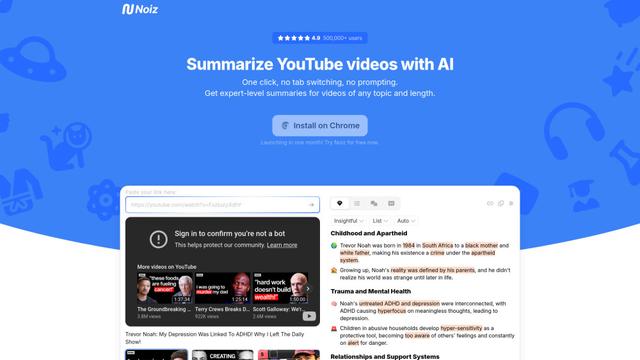
Noiz is an AI-powered video summarizer tool that transforms YouTube videos into concise summaries, transcripts, and key insights in 41 languages with just one click.
RollSummary
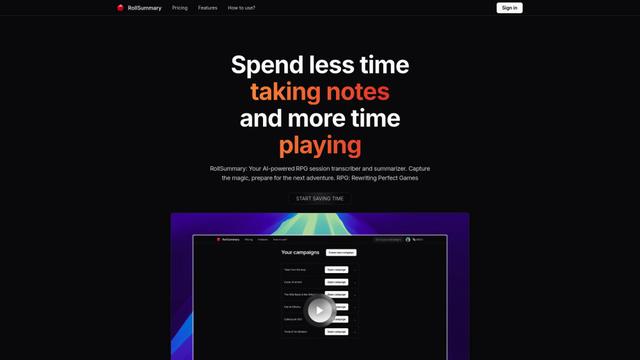
RollSummary is an AI-powered RPG session transcriber and summarizer that helps players and GMs capture, track and prepare their tabletop gaming sessions through automated transcription and smart summaries.
Long Summary
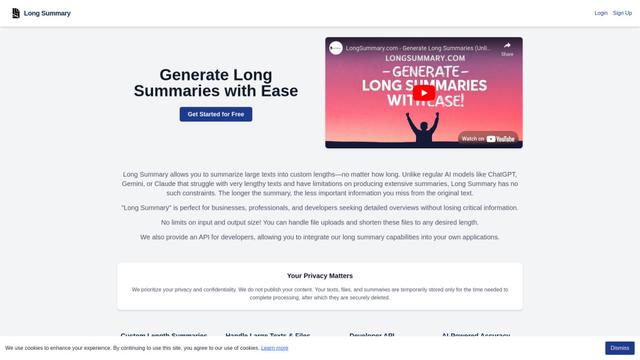
Long Summary is an AI-powered text summarization tool that enables users to generate summaries of any length without input or output limitations, offering custom-length summaries for various content types while maintaining information accuracy.
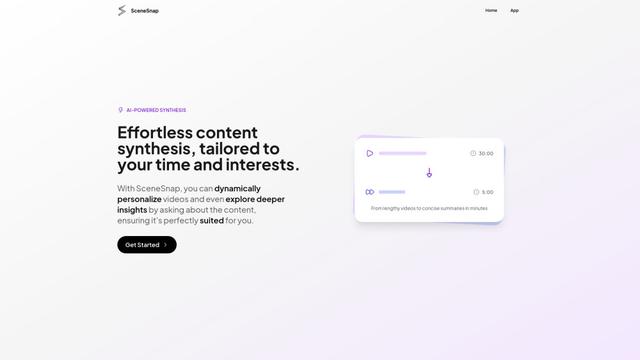
SceneSnap
SceneSnap is an AI-powered content synthesis platform that transforms lengthy videos into personalized, interactive summaries tailored to users' specific interests and time constraints.
Popular AI Tools Like Screen Pipe
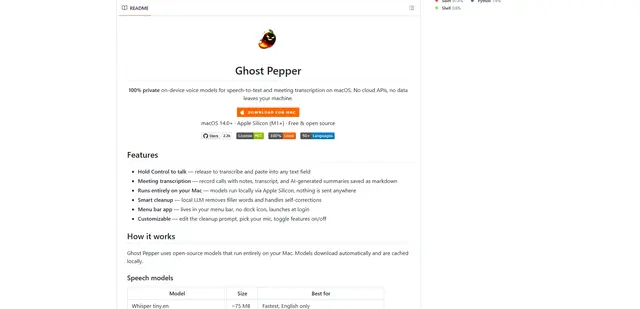
Ghost Pepper 🌶️
Ghost Pepper is a 100% local, privacy-focused speech-to-text and meeting transcription app for macOS that runs entirely on your Mac using open-source AI models, featuring hold-to-talk recording, intelligent text cleanup, and multi-language support without sending any data to the cloud.
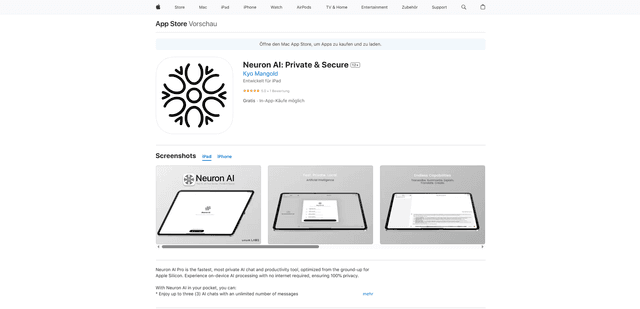
Neuron AI
Neuron AI is a private and secure AI chat and productivity tool optimized for Apple Silicon that runs completely on-device without requiring internet connection, ensuring 100% data privacy.
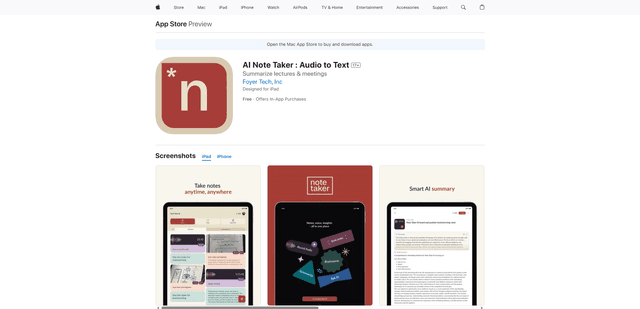
AI Note Taker : Audio to Text
AI Note Taker is an intelligent note-taking assistant that automatically converts audio/voice recordings into text transcriptions while providing AI-powered summaries and organization features for lectures, meetings, and conversations.
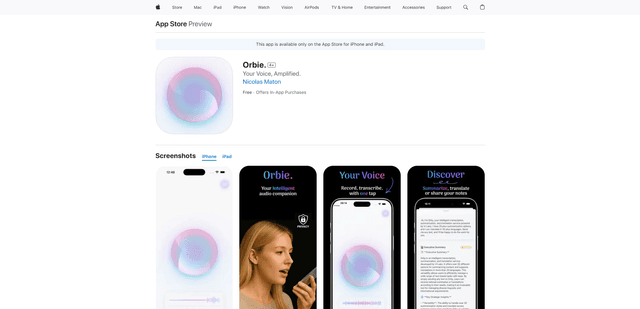
Orbie.
Orbie. is an intelligent audio companion app that transforms voice recordings into clear, shareable text with AI-powered transcription, summarization, and translation capabilities.